Medical Treatments · Fillers & Injectables · Dr Sin Yong
Skin Boosters in Singapore: injectable HA and PN
Tiny, shallow injections that work on skin quality: hydration, texture, fine lines and crepiness. Three families of boosters do this in different ways.
By Dr Sin Yong · 8 October 2026
Medically reviewed by Dr Sin Yong, medical adviser · Last reviewed 10 November 2026
A skin booster is a course of tiny, shallow injections of hyaluronic acid (HA), polynucleotides (PN) or PDLLA that works on skin quality: hydration, texture and fine crepey lines, without adding volume. It suits dull, dehydrated or thin skin. At SkinRev Lab in CityLink Mall, Dr Sin Yong performs skin booster injections after a consultation.
In short
A skin booster in Singapore is a series of tiny, shallow injections that improve skin quality rather than face shape: hyaluronic acid (HA) boosters hydrate, and polynucleotide (PN) boosters such as Rejuran support repair. At SkinRev Lab, City Hall, Dr Sin Yong performs injectable boosters, and the Needleless SkinBooster, with no injections, is S$288 per region.
Our guide to skin booster side effects explains which bumps and bruises are normal and when to call a doctor.
Our skin booster aftercare guide sets out what to do and avoid in the first days after treatment.
Key facts
- Performed by: Dr Sin Yong, at SkinRev Lab, #B1-28 CityLink Mall (City Hall MRT).
- Technique: Microdroplets of about 0.01 to 0.05 mL, about 1 to 2 mm deep and about 1 cm apart.
- Session: 30 to 45 minutes including numbing.
- Downtime: Small bumps and redness for hours to a day or two; bruising is possible.
- Price: Injectable boosters priced at consultation; Needleless SkinBooster S$288 per region and Rejuran PDRN Facial S$288 to S$388, before GST.
Updated
At a glance
| Performed by | Dr Sin Yong, Global Key Opinion Leader for CLASSYS, DEKA, Fotona, Alma, HIRONIC, ilooda and Lutronic · MBBS (Singapore), MRCS (Edinburgh), MSc Practical Dermatology (Cardiff), Professional Diploma in Obstetrics and Gynaecology (RCPI) |
|---|---|
| Where | SkinRev Lab, #B1-28 CityLink Mall (City Hall MRT) |
| Before treatment | A consultation and examination by Dr Sin Yong |
| Price | Priced at consultation |
| Book | WhatsApp +65 8266 9585 · daily, 11am to 8pm |
Your doctor
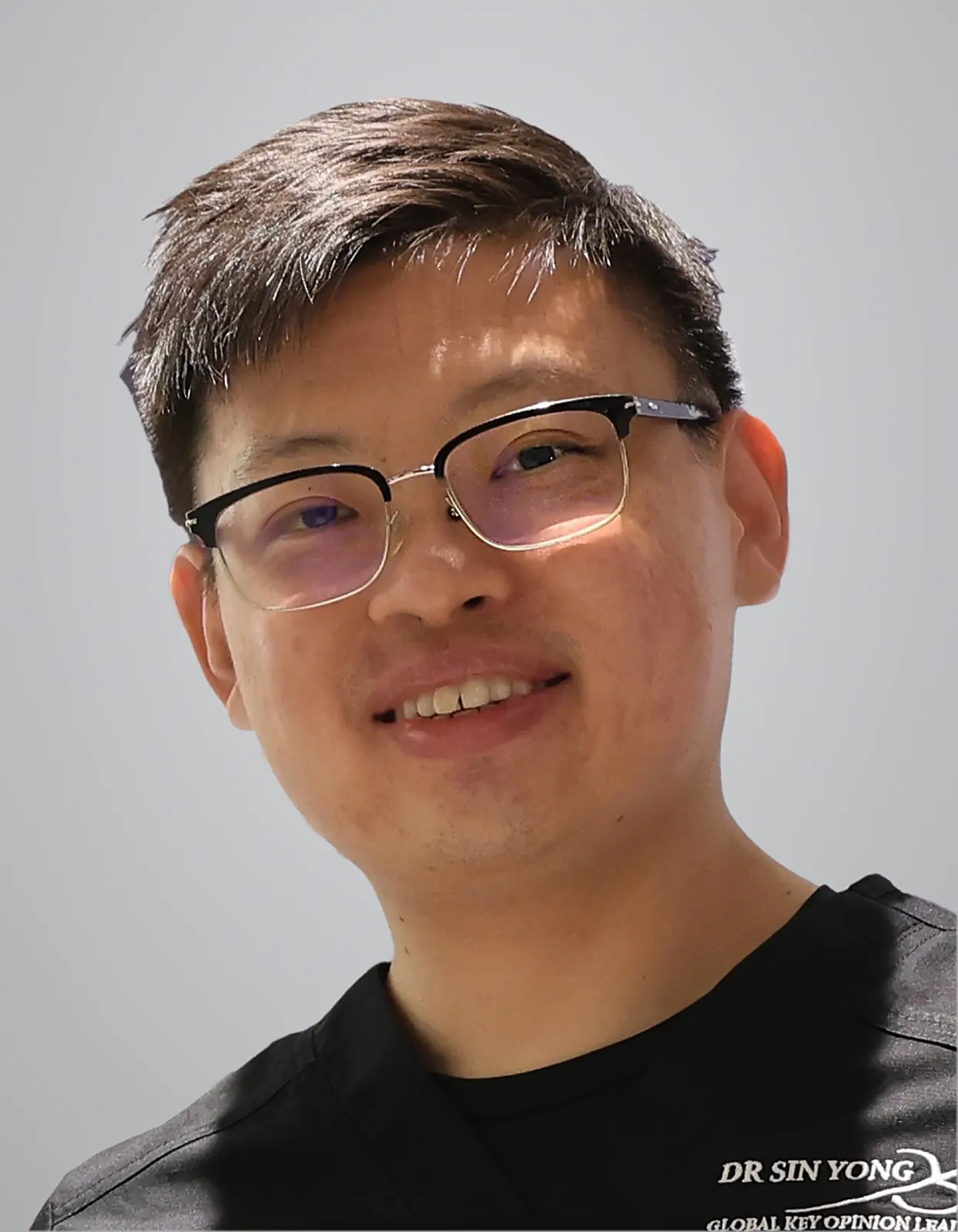
Dr Sin Yong
This treatment is performed by Dr Sin Yong himself, after a consultation. He is a Global Key Opinion Leader for seven device makers and has been invited to teach doctors in São Paulo, Bangkok, Seoul, Taipei, Dubai and Singapore.
Invited to present or train: DEKA Academy 2026, Florence 2026 · CLASSYS Academy, São Paulo 2026 · 7th CLASSYS APAC Symposium, Bangkok 2026
MBBS (NUS) · MRCS (Edinburgh) · MSc Aesthetic Medicine, Distinction (London) · MSc Practical Dermatology (Cardiff) · Professional Diploma in Obstetrics and Gynaecology (RCPI) · Profile · Brands & devices
Quick answer
- Tiny, shallow injections that work on skin quality: hydration, texture, fine lines and crepiness. Three families of boosters do this in different ways.
- Used for: Under-Eye Lines & Crepey Skin, Fine Lines & Wrinkles, Dehydrated Skin, Neck & Hand Ageing.
- Performed by: Dr Sin Yong at SkinRev Lab, #B1-28 CityLink Mall (City Hall MRT) (beside Orchard MRT).
- Book: WhatsApp SkinRev Lab on +65 8266 9585.
- Suitability, number of sessions and pricing are decided at consultation; individual results vary.
Watch · Dr Sin Yong explains
An injectable skin booster is a series of very small, shallow injections into the skin to improve how it looks and behaves, rather than to change face shape. People looking for a skin booster in Singapore usually ask about it for dull or dehydrated skin, fine lines, crepey under-eyes or neck, and texture that makeup does not hide. Boosters are performed by Dr Sin Yong at SkinRev Lab; SkinRev Lab has needle-less alternatives. The Chanel injection (NCTF 135HA), a skin booster Dr Sin Yong performs at SkinRev Lab, is explained on its own page. Nucleofill, a polynucleotide booster Dr Sin Yong performs at SkinRev Lab, is explained on its own page.
There are three main families. HA boosters use soft, lightly cross-linked or non-cross-linked hyaluronic acid to attract and hold water in the dermis. Polynucleotide (PN) boosters use purified DNA fragments that form a hydrophilic scaffold thought to support tissue repair. PDLLA boosters use tiny poly-D,L-lactic acid particles that trigger a gradual collagen response. Which one, or which combination, depends on what your skin needs. How Juvelook is done at SkinRev Lab, and its risks, are explained in Juvelook in Singapore. How hand filler restores volume on the back of the hand is explained separately. The injectable version is covered in our guide to Rejuran injection.


Full guide: Skin boosters vs facials
How it works
The mechanism,
in plain English
Boosters are placed in the dermis or just below it, typically 1–2 mm deep, as microdroplets of around 0.01–0.05 mL per point, spaced about 1 cm apart. They can be given by hand with a fine needle (often 30–32 gauge), with an injector device, or by cannula threading. The small volume per point is why boosters do not visibly add volume, and why the skin shows a grid of small bumps immediately afterwards.
Each family acts differently. HA boosters bind water and improve hydration and elasticity, with effects seen as the skin settles. A PN booster is thought to form a scaffold-like matrix that supports remodelling and hydration, and is often chosen for thin, sensitive or barrier-compromised skin. A PDLLA booster is a biostimulator: the particles provoke a controlled inflammatory and fibroblast response, so changes appear gradually over weeks. Even shallow injections can rarely enter a vessel, so anatomy knowledge and careful technique still matter, especially around the eyes and nose. For the difference, read skin booster vs filler. The Rejuran skin booster options, injected and needleless, are compared on our Rejuran page.
“A skin booster changes the quality of the skin, not the shape of the face, and it is honest to say so before anyone books.”
— Dr Sin Yong, SkinRev Lab
- Product
- HA booster, polynucleotide (PN) booster or PDLLA booster, chosen to suit the skin
- Target layer
- Dermis and the junction just below it, about 1–2 mm deep
- Dose per point
- Microdroplets of about 0.01–0.05 mL, spaced about 1 cm apart
- Typical session
- 30–45 minutes including numbing
- Downtime
- Small bumps and redness for hours to a day or two; bruising possible
- Performed by
- Dr Sin Yong, SkinRev Lab
Benefits of skin boosters, and their limits
Skin boosters work on the quality of the skin, not the shape of the face. People choose them for:
- Hydration: HA boosters bind water in the skin, which helps skin that looks dull or feels tight.
- Texture and fine lines: crepey lines on the cheeks, under-eyes, neck and hands.
- Skin that is thin or easily irritated: PN boosters are often considered here.
- Gradual collagen support: PDLLA boosters act slowly over months.
Change builds gradually and does not last indefinitely, so Dr Sin Yong will explain how long results may last for you and when maintenance makes sense.
Skin boosters do not lift sagging skin, fill hollows or remove pigmentation. If one of those is your main concern, Dr Sin Yong will say so and suggest a different treatment.
Is it right for you
Who it suits,
and who it does not
Skin boosters usually suit people with dull, dehydrated or rough skin, fine crepey lines on the face, under-eyes, neck or hands, and early loss of elasticity. A PN booster is often considered for thin or sensitive skin; an HA booster for dehydration and fine lines; a PDLLA booster for people who want gradual collagen support and can accept slower change.
Boosters also suit people preparing skin before or after laser or energy-based treatments. How a polynucleotide treatment differs from PDRN is explained in our PN guide.
Boosters are not advised during pregnancy or breastfeeding, over active infection, eczema flares, cold sores or inflamed acne, or in people with known allergy to the ingredients (PN boosters are derived from fish DNA). Anyone with autoimmune disease, keloid tendency or a bleeding tendency should discuss it first. Boosters will not lift sagging skin, fill hollows or remove pigmentation; those need lifting, filler or laser. If you dislike the idea of visible bumps for a day, plan around social events.
Non-invasive alternative at SkinRev Lab
Rejuran® PDRN Facial (needle-free) — The Rejuran® PDRN Facial at SkinRev applies c-PDRN topically without injections, as a skin-quality treatment for people who prefer not to have needles. It works on the skin surface and will not reach the dermis the way an injected PN booster does, so the effect is gentler; it can be a good starting point or a maintenance step. Read more
What to expect
Consultation, session
and aftercare
At consultation, Dr Sin Yong assesses your skin type, sensitivity, previous treatments and goals, then recommends a booster type or combination and explains what it can and cannot do. Numbing cream is usually applied for 20–30 minutes. The injections are quick, and you will feel a series of small pricks. The skin shows small raised bumps in a grid, with some redness.
Bumps usually flatten within hours to a day, though thin under-eye skin can take a little longer. Bruising is possible, especially around the eyes. Avoid makeup for the rest of the day, and avoid saunas, strenuous exercise and facial treatments for a day or two. Use gentle skincare and sunscreen. Change builds gradually over weeks, and a course is usually planned at consultation.
Where this happens
Medical and non-invasive treatments — SkinRev Lab, CityLink Mall #B1-28, 1 Raffles Link, Singapore 039393. Underground from City Hall MRT and Esplanade MRT; a short walk from Raffles Place, Marina Bay, Suntec and Bugis. Open daily 11am–8pm. Medical treatments by Dr Sin Yong; facials and body treatments by trained therapists.
Dr Sin Yong performs medical treatments at SkinRev Lab, CityLink Mall (City Hall).
What the research says
The evidence,
with sources
A systematic review of 13 clinical studies found that injectable HA formulations improved facial skin quality, including hydration, firmness, texture, radiance and elasticity, with high satisfaction and a good safety record. The authors noted that larger randomised studies are still needed. A randomised split-hand study in 100 Chinese adults also found that HA gel injected in a series of treatments improved skin quality, roughness and hydration measures compared with the untreated hand.
For polynucleotides, an international expert panel summarised the evidence for skin hydration and rejuvenation, structural support, barrier repair and scar remodelling. They noted a favourable safety profile, with no reported cases of granuloma or vascular occlusion at the time, but also that the evidence base remains limited and more randomised and histological studies are needed. PDLLA boosters are widely used, but high-quality comparative data are still emerging, so we do not overstate them.
References
- Ghatge AS, Ghatge SB. The effectiveness of injectable hyaluronic acid in the improvement of the facial skin quality: a systematic review. Clin Cosmet Investig Dermatol. 2023;16:891-899.
- Wu Y, Tian Y, Xu J, et al. A randomized study showing improved skin quality and aesthetic appearance of dorsal hands after hyaluronic acid gel treatment in a Chinese population. J Cosmet Dermatol. 2020;19(7):1627-1635.
- Rho NK, Chilukuri S, Chan G, et al. Expert perspectives: evidence-based applications of polynucleotides (PNs) in aesthetic medicine and dermatology. Clin Cosmet Investig Dermatol. 2026;19:557226.
At a glance
Skin boosters in Singapore: the types at a glance
Most skin boosters in Singapore fall into a few families. Brand names change, but the type decides what a booster can do.
| Type | Example names | Mainly for | At SkinRev Lab |
|---|---|---|---|
| Hyaluronic acid (HA) | Skinvive and other HA microdroplet boosters | Hydration, fine lines, dull skin | Injected by Dr Sin Yong; priced at consultation |
| Polynucleotide (PN) | Rejuran | Thin or sensitive skin, repair, under-eyes | Injected by Dr Sin Yong; priced at consultation |
| PDLLA with HA | Juvelook | Gradual collagen stimulation | Injected by Dr Sin Yong; priced at consultation (the DEKA RedTouch laser is an alternative) |
| Needleless | Needleless SkinBooster; Rejuran PDRN Facial | Subtle hydration and glow, no injections | Needleless SkinBooster S$288 per region; Rejuran PDRN Facial S$288 to S$388, before GST |
For how boosters compare with filler, see skin booster vs filler; for planning around an event, see skin booster timing.
Skin boosters for acne scars and the under-eye area
Acne scars. Skin boosters can improve the look of acne-marked skin by supporting hydration and skin quality, and PN boosters are the type usually considered. They do not release scars that are tethered to deeper tissue or resurface pitted scars. Those need a doctor's assessment and usually an energy-based treatment; see acne scars for how each scar type is approached. Boosters are not injected into skin with inflamed acne.
Under the eyes. The skin here is thin, and Dr Sin Yong will explain the risks of treating it for you. Before treating, Dr Sin Yong checks what is causing the concern:
- Fine, crepey lines are a skin-quality problem, which is what a skin booster is for.
- A hollow is a volume problem and may need a tear trough filler assessment.
- Puffiness from bulging fat is not improved by a skin booster.
Other ways people ask
Also searched as
Is a skin booster injection different from a needle-free skin booster?
Yes. A skin booster injection places HA, PN or PDLLA as tiny droplets into the skin itself; it is performed by Dr Sin Yong after a consultation and priced at consultation. A needle-free option such as SkinRev Lab's Needleless SkinBooster delivers hydrating and brightening boosters without any injection, and its results are subtle. Your skin and your goals decide which suits you.
What happens during a skin booster injection?
Numbing cream is applied for 20 to 30 minutes, then the booster is placed as many small, shallow injections, which most people feel as a series of small pricks. Boosters are usually given as a course spaced several weeks apart, with occasional maintenance, and the plan is set at consultation. Areas with thin skin, such as under the eyes, are more prone to bruising and swelling.
Step by step
Skin booster injection in Singapore: what happens, step by step
- Consultation: Dr Sin Yong looks at hydration, texture and fine lines, and suggests HA, PN or PDLLA, or a needleless option if injections do not suit you.
- Preparation: Skin is cleansed and numbing cream applied for 20 to 30 minutes.
- Injection: Many tiny, shallow injections across the face, neck or hands, by needle or a device that spaces them evenly.
- Afterwards: Small bumps for a day or two, sometimes bruising. Sunscreen and a gentle routine.
- Course: Usually a few sessions weeks apart, then maintenance planned at review. Priced at consultation.
Prefer no needles? See needleless skin booster.
Names
Skinboosters vs skin boosters: the names explained
People search for skinboosters in Singapore, skin boosters and individual brand names as if they were the same thing. "Skinboosters" is in fact Galderma's brand name for its Restylane hyaluronic acid range, while "skin booster" is the generic term for any injection aimed at hydration, texture and fine lines rather than volume. The table sorts out the names.
| Name | What it means |
|---|---|
| Skin booster (generic) | Any injection aimed at skin quality rather than volume: HA, PN, PDRN and others |
| Skinboosters | Brand name of Galderma's Restylane Skinboosters, a hyaluronic acid range |
| Profhilo | Hybrid high and low molecular weight HA, injected at five BAP points per side |
| Rejuran Healer | Polynucleotide (PN) booster, given as a course |
| Juvelook | PDLLA with HA; performed by Dr Sin Yong at SkinRev Lab, priced at consultation; lumps can occur, and the DEKA RedTouch laser is an alternative |
| Exosome booster | Not offered; no exosome product approved for aesthetic injection found in Singapore |
Sources: Sparavigna A, Tenconi B. Efficacy and tolerance of an injectable medical device containing stable hybrid cooperative complexes of high- and low-molecular-weight hyaluronic acid. Clin Cosmet Investig Dermatol. 2016;9:297-305; Squadrito F, et al. Pharmacological activity and clinical use of PDRN. Front Pharmacol. 2017;8:224.
Names you will see
Skin booster brands in Singapore: what each one is
| Product | Type | Mainly for | Typical course |
|---|---|---|---|
| Restylane Skinboosters (Vital, Vital Light) | Stabilised HA, microdroplets | Hydration, fine lines, neck and hands | 3 sessions, 4 weeks apart |
| Teosyal Redensity I | HA plus amino acids, vitamins, minerals | Dull, dehydrated skin | 3 sessions |
| Juvéderm Volite | Cross-linked HA | Hydration and smoothness for up to 9 months | 1 session |
| Profhilo | High and low molecular weight HA, no cross-linking | Laxity and crepey skin; 5-point technique | 2 sessions, 4 weeks apart |
| Rejuran | Polynucleotide (PN) | Repair, acne-marked or thin skin | 3 to 4 sessions |
| NCTF 135HA (Chanel injection) | HA with a vitamin and amino-acid cocktail | Glow, texture, fine lines | 3 to 4 sessions |
| Juvelook | PDLLA in HA | Collagen building, pores, shallow scars | 2 to 3 sessions |
Products are listed so you can read a clinic quote; which of them SkinRev Lab uses is covered in the sections above and confirmed with Dr Sin Yong at consultation. Ask which product is used and keep a record of its name.
Sources: Zhou R, Yu M. J Cosmet Dermatol 2024 (local HA injection and skin ageing, meta-analysis); Tintor G et al. Pharmaceuticals 2026 (hybrid HA complexes).
Skin booster cost in Singapore: what sets the price
At SkinRev Lab, injectable skin boosters are priced at consultation, because the plan is built around your skin. Four things set the cost of a skin booster in Singapore:
- Type of booster: HA, PN and PDLLA products are priced differently.
- Areas: full face only, or with the under-eyes, neck or hands.
- Number of sessions: boosters are usually given as a course, so compare the cost of the course and not of one visit.
- Maintenance: how often a top-up session is suggested afterwards.
Ask for the product name, the number of sessions and the total before you start. The needle-free option, the Needleless SkinBooster, is performed by Aesthetic Therapists and is priced separately. Our skin booster price guide explains each factor in more detail.
Common questions
Your questions,
answered
Where do Skinvive, Rejuran and Juvelook fit among skin boosters?
They are brand names for different booster types. Skinvive is a hyaluronic acid (HA) microdroplet booster, Rejuran is a polynucleotide (PN) booster, and Juvelook combines PDLLA with HA. HA mainly hydrates, PN supports repair, and PDLLA stimulates collagen over months. Juvelook is performed by Dr Sin Yong at SkinRev Lab after assessment and priced at consultation; lumps can occur with PDLLA, so he explains that risk first, and the DEKA RedTouch laser is an alternative for skin quality. He chooses the booster type after assessing your skin.
What is the difference between a skin booster and filler?
A filler is a firmer gel placed deeper to add volume or projection in a defined spot. A skin booster is injected as tiny droplets into the skin itself to improve hydration, texture and fine lines. Boosters do not change face shape. If a hollow or a short chin is the issue, filler or another structural option is needed; if the skin itself looks tired, a booster is more suitable.
How much does a skin booster injection cost in Singapore?
The cost depends on the booster type, the areas treated and the number of sessions planned, so pricing is given at your consultation with Dr Sin Yong at SkinRev Lab. At SkinRev Lab, Dr Sin Yong performs injectables after a consultation. If you would like a needle-less option, the Rejuran® PDRN Facial at SkinRev is S$288–S$388, and the Needleless SkinBooster is S$288 per region.
Which skin booster in Singapore is right for me: HA, PN or PDLLA?
It depends on your skin. HA boosters suit dehydration and fine lines. PN boosters are often chosen for thin, sensitive or barrier-weak skin and the under-eye area. PDLLA boosters suit people who want gradual collagen support and can accept slower change. Many plans combine types over a course. Dr Sin Yong will explain which fits your skin and why at consultation.
Does it hurt?
Numbing cream is used for 20–30 minutes beforehand, so most people feel a series of small pricks rather than real pain. Areas with thin skin, such as under the eyes and the neck, can feel more sensitive. PDLLA boosters can sting slightly more as they are injected. The discomfort is brief and the session moves quickly once started.
How many sessions do I need?
There is no fixed number for everyone. Boosters are usually given as a course spaced several weeks apart, followed by occasional maintenance, but the exact plan depends on your skin, the booster type and your goals. A course is usually planned at consultation with Dr Sin Yong, and your skin is reviewed along the way so the plan can be adjusted.
Are skin boosters safe around the eyes?
Boosters are commonly used for crepey under-eye skin, but this area is delicate. Bruising and swelling are more likely, and the area has vessels connecting to the eye, so technique, shallow placement and small volumes are important. Dr Sin Yong will check whether the under-eye concern is skin quality, a hollow, or fat bulging forward, because a booster only helps the first.
How much is a skin booster in Singapore?
At SkinRev Lab, injectable skin boosters are priced at consultation, because the product, the number of syringes and sessions depend on your skin. SkinRev Lab's needle-free Needleless SkinBooster is S$288 per region before GST.
Is a skin booster worth it?
It can be, if your concern is skin quality: dehydration, dullness, fine lines or crepey skin. A booster will not lift sagging or change face shape, and results build over a course and fade over months, so it suits people who accept maintenance. An honest assessment first decides whether it is the right tool.
How long do skin boosters last?
Results build over a course and then fade gradually over months, so most plans include maintenance sessions. How long they last depends on the booster type, your skin and your habits, such as sun protection and smoking.
Do skin boosters actually work?
For skin quality, yes, within limits: studies show improvements in hydration, elasticity and fine texture over a course, with HA and polynucleotide boosters the most studied. They do not lift sagging skin, fill hollows or remove pigmentation, and results fade without maintenance.
Is skin booster good for skin?
For suitable people, boosters can improve hydration, fine lines and texture with a short recovery. They are not advised during pregnancy or breastfeeding, over active acne, eczema or infection, or with allergy to the ingredients. Dr Sin Yong checks suitability at consultation.
What are skin boosters?
Skin boosters are injectable treatments that place small amounts of hyaluronic acid or polynucleotides just under the skin surface to improve hydration, texture and fine crepiness, rather than to add shape as filler does. Most plans use two or three sessions a few weeks apart. Needleless versions infuse serums without injections and give a lighter, shorter effect.
How long does a skin booster injection take?
Allow time for numbing cream, which stays on for 20 to 30 minutes, then the injections themselves, which move quickly once started. The total depends on the area treated.
What should I avoid after a skin booster injection?
For a day or two avoid makeup on the day, saunas, hard exercise, facials and massage on the area. Small bumps settle within a day or two; bruising can take up to about a week.
What is the best skin booster in Singapore?
No single booster suits everyone. HA boosters suit dehydrated, dull skin; Profhilo suits crepey, lax skin; polynucleotide boosters such as Rejuran Healer suit thin, sensitive or scarred skin. The right choice depends on your skin, and Dr Sin Yong advises at consultation.
How far apart are skin booster sessions?
Most courses use two to three sessions about two to four weeks apart, then maintenance every few months. Profhilo is usually two sessions about a month apart.
Can I combine a skin booster with laser?
Yes, often. They are usually spaced apart, for example a booster one to two weeks after a gentle laser, or before a more intensive one, so that swelling from one does not affect the other. The order is planned at consultation.
What happens at a skin booster injection in Singapore, step by step?
A skin booster injection in Singapore takes about 45 minutes: numbing cream for 20 to 30 minutes, cleansing, then many shallow injections or a 5-point technique depending on the product, followed by a soothing mask. Small blebs settle in 24 to 48 hours; Dr Sin Yong performs it at SkinRev Lab.
Skin booster guides
Every skin booster guide: brands, prices and comparisons
Skin booster Singapore: your questions, answered
Does a skin booster injection hurt?
Numbing cream is applied first, and most people then feel a series of small pricks. Thin areas such as the under-eyes are more sensitive, and PDLLA boosters can sting a little more. The feeling passes quickly once the session ends.
How many skin booster sessions do I need, and how far apart?
There is no fixed number. Boosters are usually given as a course, followed by maintenance sessions at longer intervals. Some products follow a different schedule. The plan depends on the booster type and how your skin responds, and it is set at consultation.
When will I see results, and how long do skin boosters last?
Change builds gradually over the weeks after each session, as the skin settles and takes up water. Results do not last indefinitely, and Dr Sin Yong will explain how long they may last for you. How long they hold depends on the booster type, your skin, sun protection and smoking, which is why maintenance sessions are part of most plans. Individual results vary.
What is the downtime after a skin booster injection?
Small raised bumps at the injection points and some bruising can follow, especially around the eyes. Dr Sin Yong will tell you how long they may take to settle and give you aftercare advice, including what to avoid.