
In short
Acne scar treatment in Singapore is matched to the scar type. Ice pick scars usually need TCA CROSS, boxcar scars fractional CO2 laser or RF microneedling, and rolling scars subcision; mixed scars are combined. At SkinRev Lab, City Hall, Dr Sin Yong treats them after assessment, priced at consultation. Expect softer, shallower scars over several sessions, not erased ones.
Key facts
- Who performs it: Dr Sin Yong (MBBS Singapore, MRCS Edinburgh, MSc Practical Dermatology Cardiff, Prof Dip Obstetrics and Gynaecology RCPI), at SkinRev Lab, CityLink Mall (City Hall), or IN Eternity Clinic, Pacific Plaza (Orchard).
- Methods: Subcision, TCA CROSS, fractional CO2 (Tetra Pro S3 Resurfacing), RF microneedling, and 4D Scar Reconstruction for mixed scars.
- Scar types: Ice pick, boxcar and rolling, as classified by Jacob, Dover and Kaminer (J Am Acad Dermatol, 2001).
- Sessions: Usually a course over months; collagen keeps remodelling for three to six months after each session.
- Downtime: From 1 to 3 days of redness after RF microneedling to about 1 to 2 weeks after 4D Scar Reconstruction.
- Price: Doctor-led treatments are priced at consultation. For surface texture only, SKINTIGHT microplasma is S$588 per zone before GST.
Not all acne marks are scars. Flat brown or red marks are pigmentation and usually fade on their own over months. True scars involve permanent structural change to the skin — and the three main types (ice pick, boxcar and rolling) each respond to different treatments, which is why a single approach rarely clears everything.
For options and prices, see Acne Scars: Types and the Options for Each, including when a doctor is the right route.
Acne scar guides
Every acne scar guide, by scar type and method
Marks That Aren't Scars
Post-inflammatory hyperpigmentation is a flat brown or dark mark left after a spot heals, and post-inflammatory erythema is the flat red equivalent. Neither involves structural damage — the skin surface is level, just discoloured. Both usually fade over 3–12 months, faster with sun protection. Treating these as scars leads to unnecessary and sometimes counterproductive intervention.
Ice Pick Scars
Narrow, deep and steep-sided, ice pick scars look like small punctures. Because they extend deep into the dermis with a very small surface opening, resurfacing treatments struggle to reach the base — they smooth the surrounding skin without lifting the scar floor. These are the most challenging type and often need targeted rather than general treatment.
Boxcar Scars
Boxcar scars are wider with defined vertical edges and a flat base, like a shallow crater. Because the base is broader and often shallower, they respond better to collagen-stimulating and resurfacing approaches that build volume beneath and soften the edges.
Rolling Scars
Rolling scars create a wavy, undulating surface caused by fibrous tethers pulling the skin down from below. The skin itself is relatively intact — the problem is the tethering. Treatments that address the fibrous bands and stimulate collagen beneath tend to give the most satisfying improvement in this type. For tethered scars in detail, see our rolling scars treatment guide.
Setting Realistic Expectations
Meaningful improvement is very achievable; complete erasure usually is not. A realistic goal is substantial softening — scars becoming much less noticeable in normal lighting rather than disappearing entirely. Anyone promising complete clearance in one session is overselling. Most people need a course, and often a combination of approaches for different scar types on the same face.
Acne marks or acne scars? A quick check at home
Before paying for scar treatment, check whether you have scars at all. Flat marks are colour, not structure, and the American Academy of Dermatology notes that a flat spot of colour left after acne usually is not a scar. Marks fade; true scars rarely disappear on their own.
For brown marks, the plan is sun protection, a hands-off rule and gentle brightening. At SkinRev Lab that means the Needleless SkinBooster with a tone booster or HydraFacial Syndeo; marks that persist can be treated with laser toning or pico laser by Dr Sin Yong at SkinRev Lab or IN Eternity Clinic.
- Side-light test: hold your phone torch at the side of your face. Scars cast shadows; flat marks do not.
- Touch test: run a fingertip across the area. If it feels level, it is a mark.
- Stretch test: gently stretch the skin. Rolling scars soften or flatten; ice pick and boxcar scars mostly stay.
| What you see | What it is | What usually helps |
|---|---|---|
| Flat brown or grey-brown mark | Post-inflammatory hyperpigmentation (PIH), more common in Asian skin | Sun protection, brightening care, low-energy laser if it persists |
| Flat pink, red or purple mark | Post-inflammatory erythema (PIE), from small blood vessels | Time and gentle care; a doctor can assess persistent redness |
| A dip that casts a shadow | Atrophic scar: ice pick, boxcar or rolling | Does not fade on its own; needs procedures |
| A raised, firm bump | Hypertrophic or keloid scar | A doctor's assessment; planned differently |
Acne marks (PIH): causes and treatment · Laser toning for post-acne marks
Types of acne scars and what treats each one
Scar type decides treatment. The classification used by dermatologists, published by Jacob, Dover and Kaminer, sorts depressed scars by shape and width, and DermNet notes that ice pick scars are the most common atrophic type. Most people have a mix, which is why one device rarely suits a whole face.
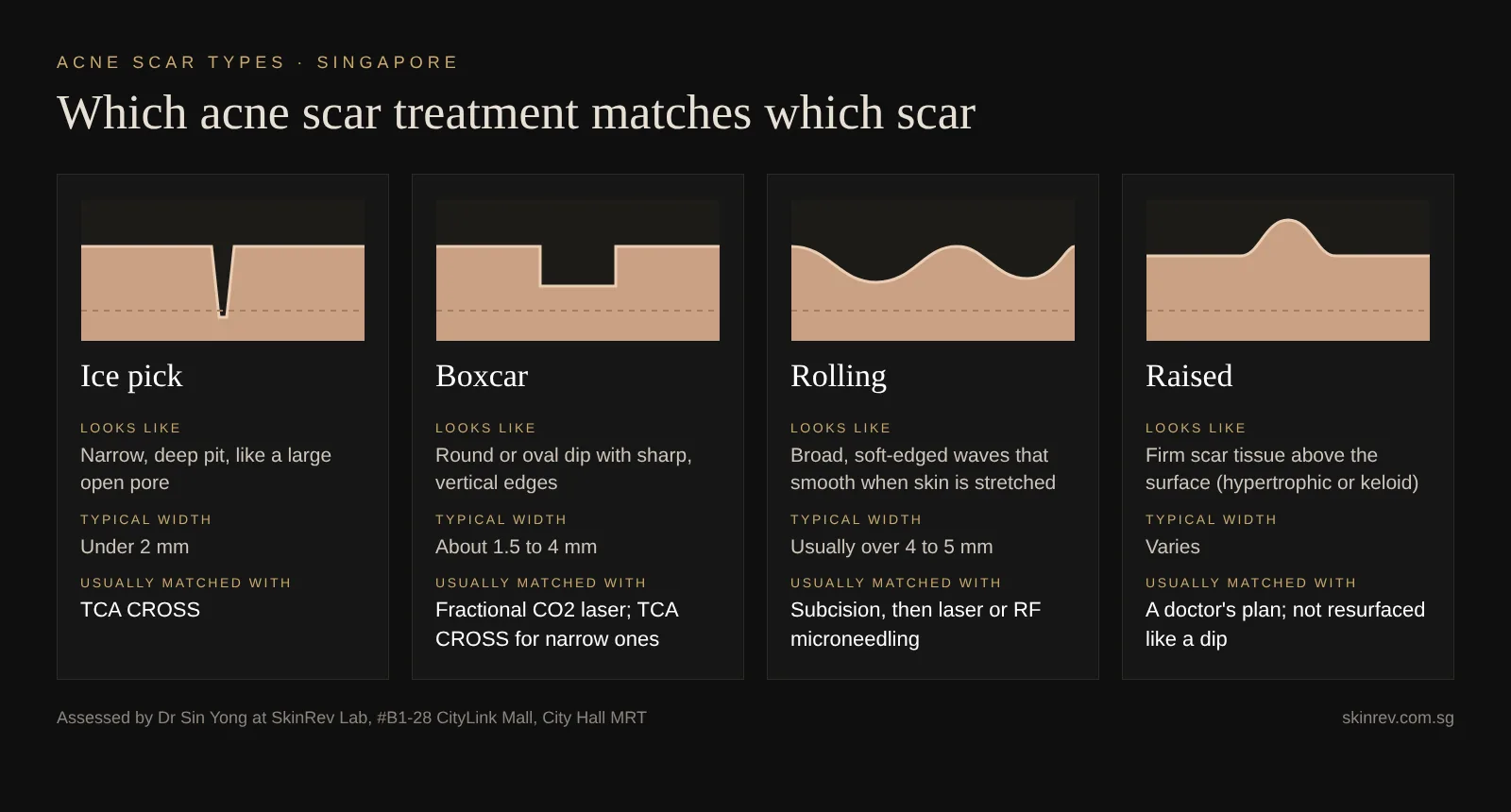
| Scar type | What it looks like | Typical width | Treatments usually matched |
|---|---|---|---|
| Ice pick | Narrow, deep pit, like a large open pore | Under 2 mm | TCA CROSS |
| Boxcar | Round or oval dip with sharp, vertical edges | About 1.5 to 4 mm | Fractional laser; TCA CROSS for narrow ones |
| Rolling | Broad, soft-edged waves that smooth when skin is stretched | Usually over 4 to 5 mm | Subcision, then laser or RF microneedling |
| Hypertrophic or keloid | Raised, firm scar tissue | Varies | Medical assessment; not treated like depressed scars |
Acne scars: what goes where · Keloid scars
Acne scar treatment in Singapore: how a doctor treats each scar
Depressed scars need procedures that work beneath the surface, and these are performed by a doctor. A review in the Journal of Clinical and Aesthetic Dermatology concluded that combining methods in a multi-step approach may give better results than any single treatment, and that subcision can make scars more responsive to the treatments that follow.
At SkinRev Lab or IN Eternity Clinic, Dr Sin Yong maps each scar by type before planning. The 4D Scar Reconstruction protocol brings the methods below together for mixed scarring; not everyone needs all of them.
- Subcision: a fine needle or cannula is passed under the scar, with local anaesthetic, to cut the fibrous bands that tether rolling scars so the skin can lift.
- TCA CROSS: a high-strength trichloroacetic acid solution is placed precisely into each narrow scar to prompt collagen inside it. It suits ice pick and narrow boxcar scars that lasers struggle to reach.
- Fractional CO2 laser (Tetra Pro S3): ablative microbeams with point-shots into individual scars, then a fractional pass so edges blend. Expect about five to seven days of swelling and fine crusts.
- RF microneedling: fine needles carry radiofrequency heat into the dermis while largely sparing the surface, with one to three days of redness. It is often considered for skin that darkens easily.
- Volume support: where a released scar has lost volume, a filler or collagen-stimulating injectable may be placed beneath it as part of the 4D plan.
4D Scar Reconstruction · Fractional CO2 laser (Tetra Pro S3) · RF microneedling
Acne scar treatments compared: downtime and who they suit
Recovery differs a lot between treatments, so plan around your calendar as well as your scars. Suitability is assessed first and individual results vary.
| Treatment | Suits | Typical downtime | Where |
|---|---|---|---|
| Subcision | Rolling scars | Bruising that can take up to two weeks to fade | Dr Sin Yong, SkinRev Lab and IN Eternity Clinic |
| TCA CROSS | Ice pick and narrow boxcar scars | Crusting for about a week | Dr Sin Yong, SkinRev Lab and IN Eternity Clinic |
| Fractional CO2 (Tetra Pro S3) | Boxcar scars and overall texture | About 5 to 7 days of swelling and crusts | Dr Sin Yong, SkinRev Lab and IN Eternity Clinic |
| RF microneedling | Shallow scars and texture, skin prone to darkening | 1 to 3 days of redness | Dr Sin Yong, SkinRev Lab and IN Eternity Clinic |
| 4D Scar Reconstruction | Mixed scar types | About 1 to 2 weeks of social downtime | Dr Sin Yong, SkinRev Lab and IN Eternity Clinic |
| SKINTIGHT microplasma | Surface texture and shallow marks | Pinpoint scabbing for a few days on scar settings | SkinRev Lab, S$588 per zone |
| Rejuran PDRN Facial | Texture and calmer post-acne skin | Usually no recovery period | SkinRev Lab, S$288 to S$388 |
What SkinRev Lab can and cannot do for acne scars
SkinRev Lab is an aesthetic clinic. It can refine the surface, calm skin that is still breaking out and support recovery between medical sessions, but it cannot lift a tethered scar or reach the base of an ice pick pit. Prices below are per session, before GST.
Many people use SkinRev Lab alongside a doctor's plan: calming breakout-prone skin before scar work starts, and keeping skin hydrated and protected between medical sessions once the doctor says the skin has healed.
- SKINTIGHT: micro-plasma on the Alma PrimeX that resurfaces the surface and prompts collagen renewal. About 30 minutes, S$588 per zone. Scar settings use higher ablation and leave pinpoint scabbing for a few days.
- SKINLDM: LDM ultrasound that calms inflamed, breakout-prone skin, which helps limit new marks. About 30 minutes, S$288.
- Rejuran PDRN Facial: needle-free c-PDRN delivered with Meso Touch, for texture and calmer post-acne skin over a course. 60 to 90 minutes, S$288 to S$388.
- HydraFacial Syndeo: vacuum cleansing and extraction to keep congestion down. 45 minutes, S$288 to S$438.
SKINTIGHT microplasma · Rejuran PDRN Facial · Skincare after laser treatment
Before you start: active acne, medicines and skin tone
Good scar results start with quiet skin. The American Academy of Dermatology advises treating acne early and not picking or squeezing, because deeper, inflamed breakouts are the ones most likely to scar.
- Control active acne first. Scars cannot be reconstructed while new ones are forming.
- Tell the doctor about isotretinoin. Older advice was to wait 6 to 12 months after finishing it; a review notes newer data challenge this as an absolute rule, so timing is decided case by case, often with a test area.
- Expect a pigment plan if your skin darkens easily. Lasers and acids can cause temporary darkening in Asian skin, so settings, skin preparation and sun protection matter.
- Book around your diary. Some procedures need a week or two of social downtime, and improvement keeps building for months as collagen remodels.
Acne and breakouts: facial or doctor?
Acne scar treatment cost in Singapore, and how to choose a provider
Cost depends on how many scars you have, their types, which methods each area needs and how many sessions follow. At SkinRev Lab or IN Eternity Clinic, medical treatment is priced at consultation after Dr Sin Yong has mapped your scars. SkinRev Lab prices are published openly, before GST.
Ask for the whole plan rather than a single-session price, and ask every provider, including us, the same questions.
- Which scar types do I have, and which method suits each one?
- Who performs the procedure, and with which device or technique?
- How much downtime should I plan for, and what is the pigment risk for my skin?
- How will progress be judged, for example with photos in the same lighting?
- What does the full course cost, including follow-up?
In what order acne scar treatments are combined
Most people have more than one scar type, so most acne scar treatment in Singapore is a sequence rather than a single procedure. The order matters: tethered scars are released before the surface is resurfaced, and narrow pits are lifted before a laser blends them in.
| Step | What it does | Treatments used | Typical spacing |
|---|---|---|---|
| 1. Calm active acne | Stops new scars forming | Prescription acne treatment by Dr Sin Yong | Before scar work begins |
| 2. Release | Frees rolling scars pulled down by fibrous bands | Subcision | First, so later steps work on freed skin |
| 3. Lift narrow pits | Builds up the floor of ice pick and deep boxcar scars | TCA CROSS | Repeated weeks apart |
| 4. Resurface | Softens edges and blends scars with nearby skin | Fractional CO2 (S3) or RF microneedling | A course, several weeks apart |
| 5. Support | Helps skin quality and tone between steps | Skin boosters, sun protection, gentle facials | Around the medical steps |
Dr Sin Yong's combined protocol is described in 4D scar reconstruction. Results build over months; expect softer, shallower scars rather than erased ones.
Sources: Kravvas G, Al-Niaimi F. A systematic review of treatments for acne scarring. Part 1: non-energy-based techniques. Scars Burn Heal. 2017;3:2059513117695312; Kravvas G, Al-Niaimi F. A systematic review of treatments for acne scarring. Part 2: energy-based techniques. Scars Burn Heal. 2018;4:2059513118793420; Jacob CI, Dover JS, Kaminer MS. Acne scarring: a classification system and review of treatment options. J Am Acad Dermatol. 2001;45(1):109-117.
How to prevent new acne scars while you treat old ones
Treating scars while new ones keep forming is uphill work. The strongest modifiable risk factor for acne scarring is the delay before effective acne treatment, so prevention starts with controlling acne early.
- Treat inflamed acne early: deep, painful or long-lasting spots are the ones that scar; see a doctor rather than waiting months.
- Do not squeeze or pick: it pushes inflammation deeper and increases both scars and dark marks.
- Protect marks from the sun: daily sunscreen helps flat red and brown marks fade and keeps them from darkening.
- Know your risk: severe acne, a long duration, and a family history of scarring all raise the risk.
- Time procedures with medicines: some acne medicines affect when lasers and resurfacing can be done; tell the doctor what you take.
Prescription acne care is explained in acne treatment in Singapore and cystic acne treatment.
Sources: Tan J, et al. Development of an atrophic acne scar risk assessment tool. J Eur Acad Dermatol Venereol. 2017;31(9):1547-1554; Reynolds RV, et al. Guidelines of care for the management of acne vulgaris. J Am Acad Dermatol. 2024;90(5):1006.e1-1006.e30.
Sources
- Jacob CI, Dover JS, Kaminer MS. Acne scarring: a classification system and review of treatment options. J Am Acad Dermatol. 2001;45(1):109-117.
- Hession MT, Graber EM. Atrophic acne scarring: a review of treatment options. J Clin Aesthet Dermatol. 2015;8(1):50-58.
- DermNet. Acne scarring.
- American Academy of Dermatology. Acne scars: how to prevent them.
Scar types
Raised acne scars: hypertrophic scars and keloids
Not every acne scar is a dent. On the chest, shoulders, back and jawline, acne can heal with a raised scar instead. A hypertrophic scar is firm and raised but stays within the edge of the original spot, and often flattens slowly over months. A keloid grows beyond that edge, may itch or hurt, and tends to return if it is simply cut out. Both come from an over-active healing response in the deeper dermis, which is why the lasers used for dents do not treat them in the same way.
| Scar | What it looks like | Usual first steps | At SkinRev Lab |
|---|---|---|---|
| Hypertrophic acne scar | Raised, pink or red, within the original spot | Silicone gel or sheets; steroid injections for thick or itchy scars; laser for redness | Assessed by Dr Sin Yong; see hypertrophic scar treatment |
| Keloid | Raised, spreads beyond the spot, often itchy or tender | Steroid injections and silicone first; cutting it out alone often leads to regrowth | Assessed by Dr Sin Yong; Luminescence Laser may be added; see keloid scars |
| Dents with raised areas | Pitted and raised scars in the same area | Raised scars are calmed first, then dents are treated | Planned in stages after an assessment |
Who should be careful: if you have had keloids before, tell the doctor before any laser, needling or subcision, because injuring the skin can set off a new one.
Before you book
Choosing an acne scar removal clinic in Singapore: seven checks
An acne scar removal clinic in Singapore should be able to tell you which scar types you have before it suggests a plan. These checks apply wherever you go:
- Who treats you: Lasers, subcision, TCA CROSS and RF microneedling for scars are medical procedures. Ask who performs them, and look the doctor up on the Singapore Medical Council register.
- Scar typing first: Ask which of your scars are ice pick, boxcar, rolling or raised, and which are flat marks. A plan that treats them all the same way is a warning sign.
- Active acne: Active acne should be treated or controlled before scars are resurfaced, or the clinic should explain how both will be managed together.
- Skin tone and PIH: Ask how the plan lowers the risk of darkening after treatment, which is common in Asian skin.
- Order of treatment: Most pitted scars need more than one method. Ask what is done first, and why.
- Realistic outcome: Expect softer, shallower scars over several sessions. Be cautious of anyone promising complete removal.
- Pricing: Doctor-led scar treatment is priced at consultation, after the assessment. Ask what each session includes and how many sessions are planned.
At SkinRev Lab, #B1-28 CityLink Mall (City Hall MRT), Dr Sin Yong assesses and treats acne scars himself. WhatsApp 8266 9585, daily 11am to 8pm.
What to expect
Your first acne scar removal visit at SkinRev Lab, step by step
| Step | What happens |
|---|---|
| Before you come | Note any acne medicines (especially isotretinoin), past keloids, cold sores and recent sun exposure. Bring photos if your acne still flares. |
| Assessment | Dr Sin Yong examines the scars under angled light, names each type, and checks for active acne and flat marks. |
| Plan | Which methods, in what order, how many sessions are usual, the expected downtime, and what the plan cannot change. |
| Treatment day | Numbing cream or local anaesthetic as needed, then the chosen method, for example fractional CO2 laser, RF microneedling, subcision or TCA CROSS. |
| Afterwards | Written aftercare, strict sun protection, and a review before the next session, usually weeks apart. |
Scar classification: Jacob CI, Dover JS, Kaminer MS. Acne scarring: a classification system and review of treatment options. J Am Acad Dermatol. 2001;45(1):109-117.
Also searched as
Acne scars treatment in Singapore: other ways people ask
People look for the same help in different words: acne scars treatment Singapore, acne scar removal Singapore, acne scar removal treatment Singapore, acne scar removal in Singapore and Singapore acne scar treatment. They all lead to the same first step on this page: name the scar type, then match the treatment. If you came for the price, see acne scar treatment cost in Singapore; for lasers alone, see acne scar laser treatment.
How long it lasts
Is permanent acne scar removal possible?
People searching for permanent acne scar removal usually want to know whether the result lasts. The honest answer: scars are improved, not erased, but the improvement is largely lasting because it comes from new collagen. Most people can expect scars to become shallower and less noticeable, with the size of the change depending on the scar type, the number of sessions and keeping acne under control. The table shows what lasts and what needs upkeep.
| Scar | What treatment changes | How lasting | What can undo it |
|---|---|---|---|
| Ice pick and narrow boxcar scars | TCA CROSS rebuilds collagen inside each pit | Long-lasting once remodelled; may need top-ups | New deep acne |
| Rolling scars | Subcision cuts the bands that tie the skin down | Released scars can re-tether, so subcision is sometimes repeated | New inflammation, re-tethering |
| Shallow boxcar scars and texture | Fractional CO2 or RF microneedling remodels collagen | Remodelled collagen lasts; ageing continues | Sun damage, ageing |
| Lost volume under scars | An injectable supports the scar floor | Fillers break down; collagen stimulators last longer | Natural breakdown of the product |
| Dark or red marks | Pigment or vascular laser, creams, sun protection | Fades; not a structural change | New breakouts, sun |
Sources: Jacob CI, Dover JS, Kaminer MS. Acne scarring: a classification system and review of treatment options. J Am Acad Dermatol. 2001;45(1):109-117; Fabbrocini G, et al. Acne scars: pathogenesis, classification and treatment. Dermatol Res Pract. 2010;2010:893080.
Which acne scar treatment suits my scar?
A starting point, not a diagnosis: most faces have more than one scar type, so Dr Sin Yong maps each scar at SkinRev Lab or IN Eternity Clinic before planning. If the skin feels level under a fingertip, it is a mark, not a scar.
Collagen keeps remodelling for three to six months after each session, so results are judged well after the last one, and scars soften rather than disappear. Doctor-performed treatments are priced at consultation.
| Scar type | What it looks like | Options | Typical sessions |
|---|---|---|---|
| Ice pick | Narrow, deep pit under 2 mm | TCA CROSS; fractional CO2 for surrounding texture | Often three to six TCA CROSS sessions, weeks apart |
| Narrow or deep boxcar | Sharp-edged dip that stays when stretched | TCA CROSS, with fractional CO2 for the edges | Several sessions over months |
| Shallow or wide boxcar | Round or oval dip with a flat floor | Fractional CO2 (S3 Resurfacing) or RF microneedling | Several, often a month or more apart |
| Rolling | Broad, soft waves that flatten when stretched | Subcision first, then laser or RF microneedling; volume support if needed | One to three subcision sessions, then energy sessions |
| Mixed types | Two or more types on one face | 4D Scar Reconstruction, matched scar by scar | A few combined sessions for some, more for others |
| Surface texture or shallow marks | Mild unevenness, no deep pits | SKINTIGHT microplasma or a Rejuran® PDRN Facial course at SkinRev Lab | A short course planned at your assessment |
| Raised (hypertrophic or keloid) | Firm scar above the surface | A doctor's combined plan; not resurfaced like a dip | Planned by the doctor |
Frequently Asked Questions
It depends entirely on scar type. Ice pick scars need targeted treatment; boxcar and rolling scars respond better to collagen stimulation and resurfacing. Our Rejuran® PDRN Facial supports dermal repair and texture improvement over a course. Assessment first is essential — a single approach rarely suits every scar type.
Flat brown or red marks (post-inflammatory pigmentation and erythema) usually fade over 3–12 months. True structural scars — indentations you can feel — do not resolve on their own and need active treatment to improve.
Most people need a course rather than a single session, typically spaced several weeks apart to allow collagen remodelling between visits. The number depends on scar depth and type, which is determined at consultation.
Boxcar scars are round or oval depressions with sharp, vertical edges, usually about 1.5 to 4 mm across. Shallow ones respond to resurfacing such as fractional CO2 laser, which softens the edges and floor; narrow, deeper ones may also need TCA CROSS. These are doctor-performed treatments. Surface care such as SKINTIGHT can refine the surrounding texture but does not change the depth of a boxcar scar.
Rolling scars are broad, wave-like dips caused by fibrous bands pulling the skin down from below. The usual first step is subcision, where a doctor releases those bands with a fine needle or cannula, followed by laser or RF microneedling to remodel the surface. Where volume has been lost, an injectable may support the released scar. Bruising after subcision can take up to two weeks to fade.
They can usually be improved, though rarely erased. Ice pick scars are under 2 mm wide but deep, so lasers and facials struggle to reach their base. TCA CROSS, in which a doctor places a strong acid precisely into each scar to prompt collagen, is the method most often matched to them. A course spaced weeks apart is usually planned, and results vary.
A facial can improve how scarred skin looks on the surface, with smoother texture, better hydration and calmer redness, but it cannot change the structure of a depressed scar. At SkinRev Lab, the Rejuran PDRN Facial and SKINTIGHT are used for surface texture and shallow marks. Pitted, tethered or deep scars need a doctor's procedures, such as subcision, TCA CROSS or fractional laser.
Flat brown marks are pigment and usually fade over months. Wear sunscreen daily, stop picking, and introduce gentle brightening ingredients such as niacinamide or azelaic acid slowly. At SkinRev Lab, the Needleless SkinBooster with a tone booster supports a more even tone. Marks that persist beyond six months, or look grey-brown, can be assessed for laser toning or pico laser at SkinRev Lab or IN Eternity Clinic.
It can be, with the right choices. The main risk in Asian skin is temporary darkening after lasers, peels and other heat-based treatments. Doctors lower this risk by choosing settings that limit heat spread, preparing the skin beforehand and insisting on strict sun protection afterwards. RF microneedling is often considered for skin that darkens easily, as it largely spares the surface.
Ice pick scars are narrow and deep, so they need targeted treatment such as TCA CROSS. Boxcar scars have sharp edges and respond to fractional laser and RF microneedling. Rolling scars are tethered underneath and improve most with subcision. These are doctor-performed; at SkinRev Lab or IN Eternity Clinic they can be combined in one scar plan, priced at consultation.
Acne marks are flat colour changes, brown (post-inflammatory hyperpigmentation) or red (post-inflammatory erythema), and usually fade with sun protection and brightening treatment. Acne scars change the skin's texture, as pits, boxcars or rolling depressions, and need resurfacing, subcision or collagen-stimulating treatment.
Facials such as HydraFacial or a PDRN facial improve skin quality and the look of marks, but they do not lift pitted scars. Atrophic scars need doctor-led treatment such as fractional CO₂ resurfacing, RF microneedling or subcision.
At SkinRev Lab, doctor-led acne scar treatment is priced at consultation, because the cost depends on your scar types, the methods and the number of sessions. Dr Sin Yong examines the scars first and gives the plan and price before you start. For surface texture only, SKINTIGHT microplasma is S$588 per zone before GST.
No single treatment suits every scar. The method follows the scar type: TCA CROSS for ice pick scars, fractional CO2 laser or RF microneedling for boxcar scars, and subcision for rolling scars, with combinations for mixed scars. This grouping comes from a 2001 classification of acne scars by Jacob, Dover and Kaminer.
Control active acne first, then have the scars assessed by a doctor so that each type is matched to a method. In Singapore that usually means a course of subcision, TCA CROSS, fractional laser or RF microneedling over several months. Creams and facials can improve the surface but do not lift depressed scars.
It depends on the scar. Narrow, deep ice pick scars respond better to TCA CROSS than to lasers; wide boxcar scars to fractional CO2 or RF microneedling; tethered rolling scars to subcision first. Many faces have a mix, so a combined plan usually works better than any one machine. Results vary between people.
Usually not. Most acne scar treatment makes scars shallower, softer and less noticeable, often substantially, but rarely erases them. The realistic goal is skin that looks smoother in normal light, reached over a course of treatments matched to each scar type.
There is no overnight method for true scars. The quickest route to a visible change is a plan matched to your scar types, which often combines subcision, TCA CROSS and fractional CO2 laser or RF microneedling over several months. Flat marks fade faster, with sun protection and time.
It is better to control active acne first, because new spots keep forming scars and inflamed skin heals less predictably. Some gentle steps can start earlier, and some acne medicines affect the timing of lasers. Dr Sin Yong treats the acne and plans the scar work in the right order.
Numbing cream is used for lasers and RF microneedling, and local anaesthetic for subcision, so most people describe heat, pressure or stinging rather than sharp pain. Discomfort and downtime vary by treatment and are explained at consultation.
Korean clinics use the same tools as Singapore clinics: subcision, TCA CROSS, fractional lasers and RF microneedling, often followed by skin boosters such as PN or PDRN to support healing. What makes the difference is grading each scar and combining treatments in the right order, not the country.
Pitted acne scars are lasting changes in the dermis and rarely fill in by themselves, but treatment can make them shallower and softer. Flat red or brown marks are not true scars and usually fade with time and sun protection.
Collagen keeps remodelling for three to six months after each session, so results are judged well after the last one. Swelling in the first days can make scars look better than the final result.
Treated scars do not usually return, because the remodelled collagen stays. New acne can cause new scars, so active acne is controlled first and kept under control during the course.
Mention any acne medicines, especially isotretinoin, past keloids or raised scars, cold sores, pregnancy or breastfeeding, and recent tanning. These change which methods suit you and when to start.
Laser suits boxcar and textured scars, usually alongside other methods, but does little on its own for deep ice pick or tethered rolling scars. Whether it is worth it depends on your scar types, which a doctor confirms first.
No one treatment suits every scar, because each scar type responds to a different method: TCA CROSS for ice pick scars, subcision for rolling scars, fractional CO2 laser or RF microneedling for shallow boxcar scars and texture. A plan matched to your scar map, by a doctor, matters more than any one device.
For most faces, a combination planned scar by scar works better than one treatment repeated. Studies and guidelines support subcision, TCA CROSS, fractional laser and RF microneedling, each for particular scar types; creams and facials cannot lift pitted scars.
Sometimes, for shallow boxcar scars and texture. Ice pick scars are usually too deep and narrow for laser alone, and rolling scars need their bands released first, so many people need laser combined with TCA CROSS or subcision.
From doctors at dermatology and aesthetic clinics, who can perform subcision, TCA CROSS, fractional laser and RF microneedling. At SkinRev Lab, CityLink Mall (City Hall MRT), Dr Sin Yong maps each scar and plans acne scar treatment at consultation; he also sees patients at IN Eternity Clinic, Orchard.
Most plans run over three to nine months: several sessions spaced four to eight weeks apart, with collagen continuing to remodel for months after the last one. Mild texture may need fewer sessions; deep, mixed scars usually need more.
No. Dermatologists and other trained doctors at licensed clinics perform scar procedures. What matters is that a doctor examines and types your scars, explains the risks for your skin tone and performs or closely supervises the treatment.
More skin guides
Melasma treatment in Singapore →Enlarged pores treatment in Singapore →Eye bag and dark circle treatment →Glass skin facials in Singapore →Facials for acne-prone skin in Singapore →Sensitive skin treatment in Singapore →LDM facial: what it is and who it suits →PDRN and Rejuran explained →Oral sunblock in Singapore →Skin boosters vs facials →