Concerns · Growths & Lesions · CityLink Mall
Mole Removal in Singapore
Most moles are harmless, but every mole should be examined by a doctor before anyone removes it. SkinRev has no non-invasive mole treatment, so Dr Sin Yong assesses and removes moles at SkinRev Lab.
By Dr Sin Yong · 8 October 2026
Medically reviewed by Dr Sin Yong, medical adviser · Last reviewed 16 November 2026
Mole removal in Singapore is a minor procedure in which a doctor takes off a mole by shave, excision, radiofrequency or laser, after examining it for signs of skin cancer. At SkinRev Lab, CityLink Mall (City Hall MRT), Dr Sin Yong, medical adviser, examines every mole with a dermatoscope first; removal is priced at consultation, before GST.
In short
Mole removal in Singapore should start with a doctor's check, because a changing mole is a medical question first. At SkinRev Lab, CityLink Mall (City Hall), Dr Sin Yong examines each mole with a dermatoscope, then removes it by shave, punch or excision, and sends it for histology when there is any doubt.
Key facts
- Who removes it: Dr Sin Yong, at SkinRev Lab, #B1-28 CityLink Mall (City Hall MRT), after an examination and dermoscopy.
- Methods: Shave, punch or elliptical excision, a radiofrequency tip, and laser only for small moles that are clearly benign.
- Comfort: Local anaesthetic: most people feel a brief sting, then only pressure.
- Marks: A shaved mole usually heals as a flat, paler or pinker spot; an excised mole leaves a fine line.
- Price: Priced at consultation, once Dr Sin Yong has examined the mole.
Updated
Quick answer
- Most moles are harmless, but every mole should be examined by a doctor before anyone removes it. SkinRev has no non-invasive mole treatment, so Dr Sin Yong assesses and removes moles at SkinRev Lab.
- Medical, performed by Dr Sin Yong at SkinRev Lab, CityLink Mall (City Hall): Assessment and dermoscopy by Dr Sin Yong, Shave or excision removal by Dr Sin Yong, Punch excision, Radiofrequency/electrosurgical removal, Laser removal.
- Assessment first; individual results vary. Medical pricing is given at consultation.
A mole (naevus) is a small cluster of pigment cells called melanocytes. Most adults have several, and many more appear through childhood and early adulthood. Moles can be flat or raised, brown, black or skin-coloured, and they usually stay much the same for years. People look up mole removal in Singapore for different reasons: a raised mole that catches on a razor or collar, one on the face they simply dislike, or one that seems to have changed. That last reason matters most, because it changes what should happen next. Not sure where to start? See skin clinic in Singapore.
Any mole that is changing, bleeding, asymmetric, multi-coloured or growing must be checked by a doctor before anything else is done. Doctors use the ABCDE checklist (Asymmetry, Border irregularity, Colour variation, Diameter above 6 mm and Evolving) as a starting point, then look closer with a dermatoscope. A mole with worrying features is not a cosmetic job. It may need to be removed whole and sent for histology, where a pathologist examines it under the microscope. In Asian skin, melanoma is less common but can appear on the palms, soles or as a new dark streak under a nail, so those sites deserve a look too. What a skin doctor does, and when to see a dermatologist instead, is explained in our skin clinic guide. A red mole is a different lesion: see cherry angioma.
SkinRev Lab is an aesthetic clinic at CityLink Mall, and moles here are removed by Dr Sin Yong; no facial or beauty treatment removes or lightens them. Creams, acids and beauty devices sold for mole removal can irritate a mole, hide changes and leave a scar, with no tissue left to examine. If you message SkinRev about a mole, we book you a consultation with Dr Sin Yong at SkinRev Lab, CityLink Mall, where the doctor examines it first, then discusses whether, and how, it should come off, and removes it there when removal is appropriate.


“A mole is assessed before it is removed, never the other way round.”
— Dr Sin Yong, SkinRev Lab
- What a mole is
- A benign cluster of melanocytes (pigment cells) in the epidermis, dermis or both
- Warning signs
- ABCDE: asymmetry, irregular border, several colours, over 6 mm, evolving
- Other red flags
- Bleeding, itching, crusting, or a new dark line under a nail
- Examination tool
- Dermatoscope: lit magnification, typically around 10×
- Removal methods
- Shave, punch or elliptical excision; the specimen can be sent for histology
- Who removes it
- Dr Sin Yong, SkinRev Lab, after assessment
Mole removal at SkinRev Lab at a glance
Mole removal at SkinRev Lab is a medical service carried out by Dr Sin Yong, medical adviser, after examining the mole. The short version:
- Who does it: Dr Sin Yong. Aesthetic Therapists do not remove moles.
- First step: an examination of the mole, including its shape, colour, border and any recent change.
- Methods: shave removal, punch or elliptical excision, radiofrequency removal or laser, chosen by the type and depth of the mole.
- Laboratory check: tissue from a shave or excision can be sent for examination when Dr Sin Yong recommends it.
- On the day: the area is numbed first; most people go back to work or school the same day.
- Price: confirmed at consultation, once the mole has been examined. Prices are before GST.
- Where: #B1-28 CityLink Mall, by City Hall MRT, daily 11am to 8pm.
What goes where
The honest ladder:
non-invasive first, medical when it is needed
At SkinRev Lab · non-invasive
There is no non-invasive treatment at SkinRev Lab that changes this concern. We will say so at the first visit, and Dr Sin Yong can assess it at SkinRev Lab.
Doctor-led · Dr Sin Yong
Assessment and dermoscopy by Dr Sin Yong — Every mole is examined first, with a dermatoscope and a history of how it has changed. This decides whether it can be left alone, removed for comfort or appearance, or removed whole for histology, and whether referral to a dermatologist or hospital specialist is the right next step. Not sure which you have? Read skin tag vs mole. For how a doctor removes skin tags, see our page on skin tag removal.
Shave or excision removal by Dr Sin Yong — A raised mole that looks clearly benign is often shaved flush with the skin under local anaesthetic, which tends to leave a flat mark. Flat or deeper moles, and any mole with a doubt, are usually cut out fully with a narrow margin and stitched so the whole lesion can be examined. What shapes the cost is explained in mole and skin tag removal cost.
Punch excision — A small circular blade, usually 2–6 mm across, removes a small mole through the full thickness of the skin in one piece. It suits small moles where a complete specimen is wanted with a short, neat closure.
Radiofrequency/electrosurgical removal — A fine radiofrequency or electrosurgical tip can sculpt down a raised, clearly benign mole and seal small vessels at the same time. It is used only after assessment, usually alongside a shave so that tissue is still available for histology.
Laser removal — A laser can flatten or lighten a small mole the doctor is confident is benign, but it vaporises tissue and leaves nothing to examine. For that reason it is not used for any mole that is changing, unusual or uncertain.
Dr Sin Yong performs medical treatments at SkinRev Lab, CityLink Mall (City Hall).
There is no group for whom a non-invasive mole treatment is the right first step, because every mole needs a doctor's check first. Everyone should start with a doctor's assessment. See a doctor promptly if a mole is new in adulthood and changing, is growing or changing shape or colour, bleeds or itches, or looks unlike your other moles, and have regular checks if you have many moles, a family history of melanoma or a history of bad sunburn. If you simply want a long-standing, unchanged mole removed for comfort or appearance, the same rule applies: Dr Sin Yong examines it at SkinRev Lab first, then explains the options.
Where this happens
Medical and non-invasive treatments — SkinRev Lab, CityLink Mall #B1-28, 1 Raffles Link, Singapore 039393. Underground from City Hall MRT and Esplanade MRT; a short walk from Raffles Place, Marina Bay, Suntec and Bugis. Open daily 11am–8pm. Medical treatments by Dr Sin Yong; facials and body treatments by trained therapists.
What the research says
The evidence,
with sources
The ABCD checklist for spotting melanoma was expanded to ABCDE after a review in JAMA concluded that 'evolving', meaning a change in size, shape, colour, symptoms such as itch, or surface bleeding, deserved its own place. The same review found no case for lowering the 6 mm diameter threshold, but stressed that change over time is one of the most useful clues. That is why a changing mole is treated as a medical question, not a cosmetic one. Small, hard white bumps that will not squeeze out are usually milia, which a doctor removes with a sterile needle.
A Cochrane review of more than 100 study cohorts found that adding dermoscopy to a naked-eye examination made melanoma diagnosis more accurate, particularly in experienced hands. On removal technique, a study of biopsied moles followed for at least two years found that clinical regrowth was uncommon, but that it was linked with the shave method rather than with the type of mole. In practice, this supports shaving only moles that look clearly benign, and excising fully when there is any doubt.
References
- Abbasi NR, Shaw HM, Rigel DS, et al. Early diagnosis of cutaneous melanoma: revisiting the ABCD criteria. JAMA. 2004;292(22):2771-2776.
- Dinnes J, Deeks JJ, Chuchu N, et al. Dermoscopy, with and without visual inspection, for diagnosing melanoma in adults. Cochrane Database Syst Rev. 2018;12(12):CD011902.
- Goodson AG, Florell SR, Boucher KM, Grossman D. Low rates of clinical recurrence after biopsy of benign to moderately dysplastic melanocytic nevi. J Am Acad Dermatol. 2010;62(4):591-596.
On the day
Mole removal in Singapore: what happens on the day
Mole removal at SkinRev Lab, CityLink Mall, is a short procedure done by Dr Sin Yong, after examining the mole and you have agreed on removal. This is the usual sequence.
| Step | What happens | What you feel |
|---|---|---|
| 1. History and dermoscopy | Dr Sin Yong asks how the mole has changed and examines it with a dermatoscope | Nothing; a light on the skin |
| 2. Decision | Leave it, remove it for comfort or appearance, or remove it whole for histology; referral if needed | You can take time to decide |
| 3. Local anaesthetic | A small injection numbs the area | A brief sting, then pressure only |
| 4. Removal | Shave, punch or excision; a radiofrequency tip to smooth and seal small vessels | Pressure, no sharp pain |
| 5. Dressing | A small dressing; stitches for an excision | Mild tenderness later that day |
| 6. Histology and review | Tissue is sent to the laboratory when there is any doubt, and results are discussed | Nothing |
For what shapes the price, see mole and skin tag removal cost; if you are not sure what the growth is, read skin tag vs mole.
Methods
Mole removal methods compared
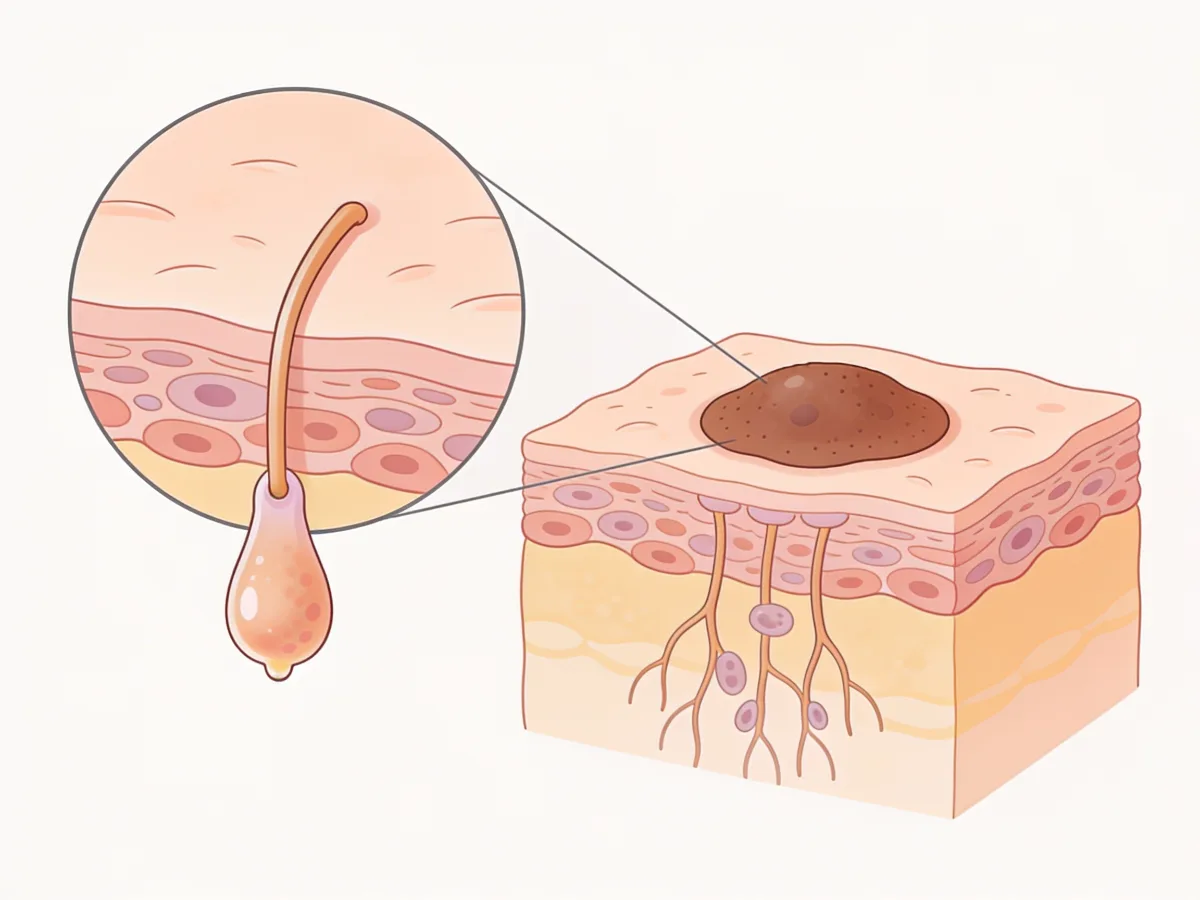
Which method suits a mole depends on what the examination shows, and whether the tissue needs to go to the laboratory. This is how the methods Dr Sin Yong uses at SkinRev Lab differ.
| Method | Usually suits | Tissue for histology? | Usual mark |
|---|---|---|---|
| Shave removal | A raised mole that looks clearly benign | Yes, the shaved part | A flat, slightly paler or pinker spot; some colour can return at the base |
| Punch excision | A small mole, when a complete specimen is wanted | Yes, full thickness in one piece | A short, neat closure from a 2 to 6 mm circular blade |
| Elliptical excision | Flat or deeper moles, and any mole with a doubt | Yes, the whole mole with a narrow margin | A fine stitched line; stitches may need a follow-up visit |
| Radiofrequency tip | Sculpting down a raised, clearly benign mole, usually with a shave | Yes, when combined with a shave | A flat mark; small vessels are sealed at the same time |
| Laser | A small mole the doctor is confident is benign | No: the tissue is vaporised | A flat or lighter mark; never used for a changing or uncertain mole |
Methods as described on this page. Regrowth after removal is uncommon but more likely after a shave than after a full excision.
What decides the cost of mole removal in Singapore
The cost of mole removal depends on the mole, so a firm figure can only be given once a doctor has looked at it. At SkinRev Lab the price is confirmed at consultation, before GST, and before anything is done. Five things move it:
- Size and depth: a small raised mole that can be shaved level takes less time than a deep one that needs excision and stitches.
- Method: shave, radiofrequency and laser removal are shorter procedures than a stitched excision.
- Site: the face, eyelid margin and areas under tension need more care in planning.
- Number: several moles can often be planned in one visit.
- Laboratory examination: sending tissue for a laboratory report is a separate charge.
Ask for the full amount in writing, including any laboratory fee and review visit. Our mole and skin tag removal cost guide explains each item.
Check first
Which moles to check before any removal: ABCDE
Doctors use the ABCDE checklist as a starting point, then look closer with a dermatoscope. A mole with any of these signs is a medical question, and it is removed in a way that keeps the tissue for histology.
| Sign | What to look for | What it means for removal |
|---|---|---|
| A: Asymmetry | One half does not match the other | Have it examined before any removal |
| B: Border | A ragged, notched or blurred edge | Have it examined before any removal |
| C: Colour | Several shades of brown, black, red, white or blue | Have it examined before any removal |
| D: Diameter | Wider than about 6 mm, the size of a pencil eraser | A reason to look closer, not proof of a problem |
| E: Evolving | Any change in size, shape, colour, itch or bleeding | The most useful clue: removed whole so it can be examined |
| Other red flags | Bleeding, crusting, a mole that looks unlike your others, a new dark line under a nail, a new dark spot on a palm or sole | See a doctor promptly; in Asian skin melanoma can start on these sites |
Source: Abbasi and colleagues, JAMA 2004, the review that added E (evolving) to the ABCD rule.
Mole, skin tag or another growth: which removal applies
Not every small growth is a mole, and the removal method follows the diagnosis. A mole is a cluster of pigment cells, flat or raised, usually brown. A skin tag is a soft, skin-coloured flap on a narrow stalk, common on the neck, underarms and eyelids. Other look-alikes include seborrhoeic keratoses, warts and cherry angiomas.
- Skin tag removal: a skin tag is usually snipped or removed with radiofrequency or laser after a doctor confirms what it is. See skin tag removal at SkinRev Lab.
- Not sure which it is: our guide to skin tag vs mole lists the differences you can see at home.
- Rough, stuck-on brown patches: see seborrhoeic keratosis.
- Small red dots: see cherry angioma.
Whatever the growth, Dr Sin Yong examines it first. Anything that has changed, bleeds or looks unlike your other spots is assessed before removal is discussed.
Aftercare
After mole removal: healing and aftercare
- The first days: A small dressing covers the site; keep it clean and avoid picking any scab.
- One to two weeks: Small shaved sites usually scab and the scab falls off; excisions are closed with stitches, which may need a follow-up visit.
- The following months: The mark settles from pink to flat and pale; sun protection on exposed sites lowers the chance of it darkening.
- If colour returns: Some pigment can reappear in the scar, more often after a shave. Tell any doctor who checks it later that the mole was removed, and keep the histology report.
- Come back sooner: If the site becomes hot, swollen, increasingly painful or oozes, contact the clinic.
Will mole removal leave a scar? What decides the mark
Every mole removal leaves some mark, because any cut or burn to the skin heals with new tissue. How visible the mark becomes depends on how deep the removal goes, where the mole sits and how your skin tends to heal. Depth matters most: a review of scar biology notes that superficial injuries that do not reach the deeper layer of the dermis (the reticular dermis) do not cause keloid or hypertrophic (raised) scars (Ogawa, 2017).
| What decides the mark | Usually a smaller mark | Usually a more visible mark |
|---|---|---|
| Depth of removal | Shave or laser removal of a small, raised mole that looks clearly benign | Excision with stitches, used when the whole mole must go to the laboratory |
| Where the mole sits | Skin that is not stretched much by movement | Chest, shoulders and upper back, where skin is stretched by movement |
| Your scar history | No raised scars from past cuts or acne | Past keloids or thick raised scars |
| Skin tone | Lighter skin | Darker skin, which more often turns brown after injury (Davis and Callender, 2010) |
| Aftercare | Site kept clean and covered, then protected from sun | Picking the scab, or sun on a healing site |
If you have formed a keloid before, tell Dr Sin Yong, medical adviser, at your consultation: it can change the method the doctor suggests. Raised scars are covered in our guide to keloid scars.
Mole removal on Asian and darker skin
Mole removal on Asian and darker skin follows the same rule as on any skin: the mole is checked first, and the method is chosen for the mole, not for your skin tone. What changes is the aftercare and what to expect while the site settles. Post-inflammatory hyperpigmentation, the brown mark that can follow any skin injury, affects darker-skinned people more often and more severely (Davis and Callender, 2010). After mole removal it usually shows as a brown ring or patch where the mole was.
- Protect the site from sun: keep it covered while it heals, then use sunscreen on it every day once the skin has closed.
- A brown mark is not the mole coming back: it is pigment from healing. New, darker pigment growing inside the scar is different and should be shown to the doctor.
- Expect the colour to take longer to settle than the wound: the skin can be closed while the mark is still brown.
- Say if you tan easily or mark easily after spots: it helps the doctor plan your aftercare and what to expect from the mark.
At SkinRev Lab, mole removal is performed by Dr Sin Yong, medical adviser, and priced at consultation; Aesthetic Therapists do not remove moles. If a brown mark lingers after healing, our guide to post-inflammatory pigmentation explains the options.
Common questions
Your questions,
answered
Is mole removal in Singapore safe to do just for looks?
It can be, once a doctor has checked the mole. Most moles are harmless, and removing a benign mole for comfort or appearance is a common minor procedure. The key step is the assessment beforehand: a mole that is changing or unusual should be removed in a way that allows histology, not shaved off or lasered for cosmetic reasons. Dr Sin Yong examines every mole at SkinRev Lab before discussing removal.
Which moles should I get checked soon?
Book a check for any mole that is growing, changing shape or colour, bleeding, crusting or itching, or that looks different from your other moles. Also see a doctor about a new dark streak under a nail or a new dark spot on a palm or sole. Most of these turn out to be benign, but they need a proper look, and some will need removal so the tissue can be examined.
How much does it cost to remove a mole in Singapore?
Pricing for mole removal is given at consultation at SkinRev Lab, after Dr Sin Yong has examined the mole. The cost depends on the number of moles, their size and site, the method used, whether stitches are needed, and whether a specimen is sent for histology, which carries a laboratory charge. Mole removal is done by Dr Sin Yong at SkinRev Lab and priced at consultation.
Does mole removal hurt, and will it scar?
The area is numbed with local anaesthetic, so most people feel a brief sting from the injection and then only pressure. Any removal that reaches the dermis leaves some mark. A shaved mole usually heals as a flat, slightly paler or pinker spot, while an excised mole leaves a fine line. How it settles depends on your skin, the site and aftercare, and individual results vary.
Can a mole grow back after removal?
Sometimes. If pigment cells remain at the base, some colour can reappear in the scar, which is more likely after a shave than after a full excision. Regrowth in a removed benign mole is usually harmless, but because it can look unusual under the dermatoscope, tell any doctor who checks it later that it was removed before, and keep the histology report if one was done.
Can I remove a mole with creams or at a beauty salon?
This is not advisable. Creams, acids or devices used without a diagnosis can burn the skin, leave a scar and, more importantly, destroy the tissue a doctor would need if the mole turned out not to be benign. SkinRev Lab's therapists do not remove moles for this reason. Mole removal in Singapore should start with a doctor's examination, which Dr Sin Yong provides at SkinRev Lab.
Can I ask my GP to remove a mole?
Yes. Many GPs in Singapore examine moles and remove simple ones, and refer to a dermatologist or hospital specialist when a mole looks unusual. What matters is that the mole is examined before it is removed, and that anything uncertain is sent for histology. At SkinRev Lab, CityLink Mall, Dr Sin Yong examines and removes moles.
Is it advisable to remove moles?
Most moles are harmless and do not need removing. Removal makes sense when a mole catches on clothing or a razor, when you dislike how it looks and accept a small mark, or when a doctor wants it examined because it is changing. A mole that is growing, bleeding or changing colour should be checked first, not simply removed.
Can mole removal be claimed under insurance?
Removal for appearance is generally treated as cosmetic and is not claimable. When a mole is removed for a medical reason, such as a suspicious change that needs histology, cover depends on your policy, the procedure and the clinic, so ask your insurer before the procedure.
How long does mole removal take to heal?
Small shaved sites usually form a scab that falls off within about one to two weeks. Excisions are closed with stitches and may need a follow-up visit to remove them. The mark keeps fading for months, and sun protection lowers the chance of it darkening.
Is a removed mole sent to the laboratory?
When there is any doubt about a mole, Dr Sin Yong removes it whole and sends it for histology, where a pathologist examines it under the microscope. Shaved moles that look clearly benign can also be sent. Methods that leave no tissue, such as laser alone, are used only for small moles that are clearly benign.
Can I go back to work after mole removal?
Most people return to work or school the same day. Keep the dressing clean and dry as advised, avoid heavy exercise or swimming while a stitched wound heals, and come back for stitch removal or review when asked.
Can several moles be removed in one visit?
Often, yes, once each mole has been examined. Dr Sin Yong decides how many to remove in one session based on their size, site and method, and whether any need to go for histology first.
How many moles can be removed in one session?
Dr Sin Yong decides how many to remove in one session based on their size, site and method.
Mole removal in Singapore: key facts and sources
| Fact | Detail | Source |
|---|---|---|
| What a mole is | A melanocytic naevus: a common benign skin lesion due to a local proliferation of pigment cells (melanocytes). Almost everyone has at least one. | DermNet, 2016 |
| How it is removed | Excision of a flat or suspicious mole, shave removal of a raised mole, electrosurgical destruction, or laser to lessen pigment. A mole that remains suspicious for melanoma after a doctor's assessment is excised for histopathology. | DermNet, 2016 |
| Visits and laboratory check | Most removals require only one office visit. An excised mole is looked at under a microscope by a specially trained doctor, and in most cases a shaved mole is too. | AAD |
| Which moles to check first | Warning signs are summarised as ABCDEF, including a diameter of more than 6mm; a mole with any of these signs should be assessed by a doctor. | SingHealth |
| How a doctor checks it | Pooling 26 in-person evaluations of dermoscopy (23,169 lesions), the review estimated 92% sensitivity for melanoma with dermoscopy plus visual inspection versus 76% for visual inspection alone, at a fixed 80% specificity. | Dinnes et al., Cochrane 2018 |
| Risk of regrowth | A study of 271 biopsy sites in 115 patients found that 7 of 195 dysplastic naevi (3.6%) followed for more than two years recurred on clinical exam; recurrence was significantly associated with shave biopsy. | Goodson et al., 2010 |
| Cost at SkinRev Lab | Priced at consultation, once Dr Sin Yong has examined the mole; before GST. | SkinRev Lab |
| Who performs it at SkinRev Lab | Dr Sin Yong, medical adviser, examines each mole with a dermatoscope and refers to a dermatologist or hospital specialist when a mole looks unusual; otherwise the doctor removes it by shave, punch or elliptical excision, a radiofrequency tip, or laser only for small moles that are clearly benign. Aesthetic Therapists do not remove moles. | SkinRev Lab |
Skin tag removal at SkinRev Lab at a glance
Skin tags are harmless, soft flaps of skin. They are not moles, so Dr Sin Yong checks which one you have before anything is removed.
| Skin tag removal | |
|---|---|
| Who removes it | Dr Sin Yong, after checking it is a skin tag and not a mole |
| How | Snipped, or removed with radiofrequency or laser, after the area is made comfortable |
| Several at once | Usually possible in one visit |
| Healing | A small mark that fades over days to weeks |
| Price | Priced at consultation, before GST |
Skin tag or wart? How to tell them apart
| Skin tag | Wart | |
|---|---|---|
| Looks like | Soft, skin-coloured flap on a thin stalk | Rough, raised, sometimes with tiny dark dots |
| Common places | Neck, underarms, eyelids, groin | Hands, feet, face |
| Spreads? | No | Can spread |
| Usual first step | Check, then remove if wanted | Check, then cryotherapy or removal |
Not sure whether it is a mole? The section on this page about moles, skin tags and other growths explains how each is checked first.
Common types of moles, and the usual next step
Most moles are harmless. Knowing the common types helps you describe yours, but only a doctor's examination can tell which you have.
| Type | What it usually looks like | Usual next step |
|---|---|---|
| Common mole | Small, round, even brown; flat or raised | Can be removed for looks after a check; flat ones may suit laser, raised ones a shave removal |
| Mole present from birth | Often larger, sometimes with hair | Photos over time; any removal is planned with care, often by excision |
| Irregular (atypical) mole | Uneven colour or border, often larger | Examined, and often removed whole so it can be tested |
| Halo mole | A mole with a pale ring around it | Usually monitored after a check |
| Pink or red raised mole | Smooth, dome-shaped, can grow quickly | Examined promptly; removal for testing may be advised |
Any mole that is new in adulthood, changing, itching or bleeding is checked before any removal and is never lasered, because laser leaves no tissue to test. See the ABCDE section above.
Before your mole removal appointment: a short checklist
- Take a clear photo of the mole now, with a ruler beside it if you can, to compare later
- Avoid tanning the area for two weeks
- Bring a list of medicines and supplements; do not stop any prescribed medicine unless your doctor tells you to
- Tell Dr Sin Yong about keloid or raised scars, slow healing or bleeding problems
- Plan around swimming, hot yoga and heavy exercise for the first week
- For a mole on the face, plan a few days without makeup on the spot
A little preparation makes the day simpler and helps healing. Removal is priced at consultation, after Dr Sin Yong has examined the mole and agreed the method with you.
Choosing where to have a mole removed in Singapore: six checks
Mole removal is offered by GPs, aesthetic clinics, dermatologists and hospitals. These checks help you judge any provider, including us. Ask the question in the last column before you agree.
| Check | Why it matters | Question to ask |
|---|---|---|
| A doctor examines the mole, ideally with a dermatoscope, before anything is done | Some moles need testing, not cosmetic removal | "Will you look at it with a dermatoscope first?" |
| You are offered laboratory testing where it is appropriate | Laser leaves no tissue to test, so it suits only moles judged clearly harmless | "Will it be sent to the laboratory?" |
| Suspicious moles are referred to a dermatologist or hospital | Early specialist care matters for changing moles | "What happens if it looks suspicious?" |
| The likely mark, healing time and aftercare are explained | You know what to expect before you agree | "What mark should I expect, and for how long?" |
| The price says what it covers | Examination, removal, laboratory testing and review visits can be charged separately | "Does the price include the laboratory fee and the review?" |
| Removal is done by a doctor, not in a beauty salon or with creams | These can scar, burn or leave part of the mole behind | "Who will remove it?" |
References
- Oakley A (1997, updated 2016). Melanocytic naevus. DermNet. Source
- American Academy of Dermatology. Moles: diagnosis and treatment. AAD (accessed 13 Nov 2026). Source
- Dermatology Service, Sengkang General Hospital. Moles. SingHealth (accessed 13 Nov 2026). Source
- Dinnes J, Deeks JJ, Chuchu N, et al. (2018). Dermoscopy, with and without visual inspection, for diagnosing melanoma in adults. Cochrane Database of Systematic Reviews 2018;(12):CD011902. Source
- Goodson AG, Florell SR, Boucher KM, Grossman D (2010). Low rates of clinical recurrence following biopsy of benign to moderately atypical dysplastic melanocytic nevi. Journal of the American Academy of Dermatology 62(4):591-596. doi:10.1016/j.jaad.2009.06.080. Source
- Ogawa R (2017). Keloid and Hypertrophic Scars Are the Result of Chronic Inflammation in the Reticular Dermis. International Journal of Molecular Sciences 18(3):606. doi:10.3390/ijms18030606. PMID 28287424. Source
- Davis EC, Callender VD (2010). Postinflammatory hyperpigmentation: a review of the epidemiology, clinical features, and treatment options in skin of color. Journal of Clinical and Aesthetic Dermatology 3(7):20-31. PMID 20725554. Source