Guide · Embroidery removal
Embroidery gone wrong: T2 Targeted Tattoo laser removal for brows, lips and hairline
Brows that healed too dark or turned red, lip blush that went patchy or blue, an SMP hairline in the wrong place: cosmetic tattooing can go wrong, and because the pigment sits in the skin, it does not wash off. Here is what can be done, by whom, and what is realistic.
Quick answer
- When eyebrow, lip or scalp embroidery goes wrong, the pigment sits in the dermis, so creams cannot lift it. Laser performed by a doctor is the most studied way to lighten or remove it; non-laser 'saline' removal has little published evidence and works by wounding the skin.
- T2 (Targeted Tattoo) is Dr Sin Yong's staged removal protocol on the DEKA TORO laser: black and grey pigment at 1064 nm, red and orange at 532 nm, blue and green at 785 nm picosecond. Flesh, nude and white cosmetic shades get a test area first, because they can turn darker.
- In a 2023 review of 33 people treated with picosecond laser for facial cosmetic tattoos, about three sessions gave a satisfactory result on average, and 30% showed an unexpected colour change after the first session, often a hidden orange.
- At SkinRev Lab, CityLink Mall (City Hall MRT), Dr Sin Yong assesses the pigment and performs T2 himself. It is a medical treatment, priced at consultation; WhatsApp a clear photo to 8266 9585 to start.

Medically reviewed by Dr Sin Yong · 8 November 2026
Dr Sin Yong, Global Key Opinion Leader
MBBS (Singapore) · MRCS (Edinburgh) · MSc Practical Dermatology (Cardiff) · MSc Aesthetic Medicine (University of London) · 15+ years in clinical practice
This guide is written for SkinRev Lab and reviewed by Dr Sin Yong, who assesses cosmetic tattoos that have gone wrong and performs T2 Targeted Tattoo laser himself at SkinRev Lab, CityLink Mall. DEKA (Italy), the maker of the TORO laser used for T2, has appointed him a Global Key Opinion Leader, as have CLASSYS and HIRONIC (Korea); he speaks and trains doctors at their academies in Europe, Asia and South America.
Global Key Opinion Leader for
- CLASSYS
- DEKA
- HIRONIC
- FOTONA
- ALMA
- LUTRONIC
- ILOODA
 DEKA Academy, Florence 2026
 CLASSYS Academy, São Paulo 2026
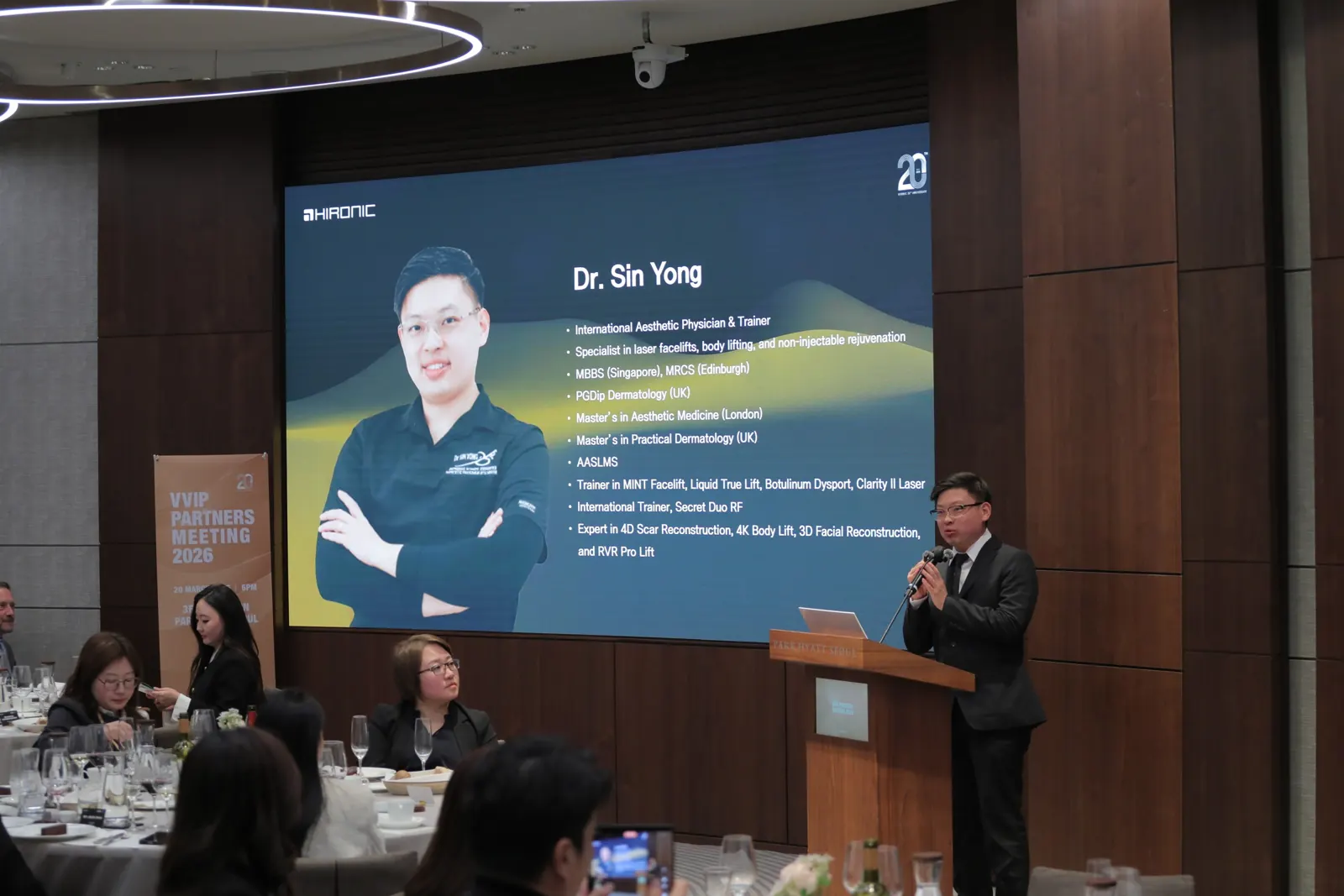 HIRONIC VVIP Partners Meeting, Seoul 2026
 CLASSYS APAC Symposium, Bangkok 2026
His conferences and KOL certificates →More about Dr Sin Yong →
The problems
Embroidery gone wrong: the common problems
| Problem | What usually causes it | Usual first step |
|---|---|---|
| Brows too dark, thick or heavy | Too much pigment, placed too deep, or layered sessions | T2 lightening, usually at 1064 nm |
| Brows turned red, orange or pink | The darker part of a blended pigment fades first, leaving iron oxide tones | Test area, then 532 nm |
| Brows grey, blue or green | Carbon black seen through the skin, or pigment placed too deep | 1064 nm; 785 nm picosecond for a blue-green cast |
| Wrong shape, too high or uneven | Design or placement | Lighten only the parts that are off |
| Lip blush patchy, blotchy or overlined | Uneven healing, or a border drawn outside the natural lip line | Test area, then targeted lightening |
| Lips blue, grey or orange | Cool pigment in naturally darker lips, or uneven dark-lip neutralising | Assessment and a test area first |
| SMP hairline too low, too straight or too dark | Design, or dots too large or too dense | 1064 nm on the dots that need to go |
| SMP dots blurred or blue | Pigment spread or placed too deep | Staged 1064 nm sessions |
| Raised, itchy, lumpy or weeping | Possible allergy, granuloma or infection | See a doctor first; no laser yet |
Most problems are cosmetic: the colour, depth or design is not what you wanted. A few are medical. Swelling that keeps coming back, itch, lumps or weeping within the tattoo can be an allergic or granulomatous reaction to the pigment, which needs a doctor's diagnosis before any laser, because lasering an allergic tattoo can make the reaction worse.
Why it stays
Why cosmetic pigment behaves differently from body tattoo ink
Brow, lip and scalp pigment is placed in the dermis, below the layer of skin that sheds. Cosmetic pigments are usually blends of iron oxides (reds, browns and yellows), carbon black and titanium dioxide (white), mixed to match skin or hair. Over months and years the blend separates: the darker or cooler part fades first and leaves warmer tones behind, or carbon black reads as grey-blue through the skin. That is why old brows turn orange or ashy, and why a session at the wrong wavelength can reveal a colour that was not visible before.
Iron oxide and titanium dioxide also explain the main risk of lasering cosmetic tattoos. In five cases reported in Archives of Dermatology, white, flesh-coloured and pink-red cosmetic tattoos turned dark immediately after Q-switched and pulsed lasers, and red ink containing ferric oxide turned black in the laboratory. The darkened pigment cleared with further laser in three of the five but needed surgical excision in two. A test area, reviewed weeks later, is the usual safeguard.
The protocol
What T2 Targeted Tattoo laser is
T2 stands for Targeted Tattoo. It is Dr Sin Yong's staged tattoo removal protocol on the DEKA TORO, a laser platform that combines a 785 nm picosecond wavelength with 532 nm and 1064 nm nanosecond (Q-switched) outputs. Very short pulses are absorbed by the pigment and break it into smaller fragments, which the skin's clean-up cells carry away over the following weeks.
"Targeted" means two things: each colour is treated at the wavelength it absorbs, and only the pigment that needs to go is treated. On a brow that is mostly fine but too high at the tail, that can mean lightening the tail alone; on an SMP hairline that sits too low, the front few millimetres.
- Evaluation: colours, density, depth, skin type, medical history and, if you have them, photos of how it looked when fresh.
- Written plan and quote before anything is treated.
- Test area where the pigment could darken (flesh, nude, white, pink or light brown) or the reaction is uncertain, reviewed before going further.
- Staged sessions several weeks apart, so the skin heals and clears pigment between visits.
- Review before each step, including whether a new colour has been unmasked.
Complete clearance cannot be promised for any cosmetic tattoo, and no number of sessions is fixed in advance.

What to expect
How many sessions, and what each one feels like
Session numbers depend on the pigment, how deep and dense it is, and how many layers were put in. In a chart review of 76 people treated for eyebrow and eyeliner tattoos, the average was 2.8 laser sessions; in the review of 33 people with facial cosmetic tattoos, about three. In a small series of four people treated for unwanted scalp micropigmentation with 1064 nm picosecond laser, clearance took one to three sessions. Heavy, layered or previously corrected work tends to need more.
Numbing cream is applied beforehand, and the pulses feel like quick, sharp snaps. Expect the treated area to turn white for a few minutes, then redness and swelling for a day or two, and possibly pinpoint bleeding, small blisters or crusts that must be left to fall off. Sun protection matters while the skin heals, especially on Asian skin, which is more prone to temporary darkening or lightening after laser.
Your options
Laser, saline or covering it: which route suits which problem
| Route | Where it fits | Main limits |
|---|---|---|
| T2 laser by a doctor | Dark, grey, blue or misplaced pigment; lightening before any redo | Several sessions; test area for light or warm shades; temporary colour change |
| Saline or other non-laser removal | Sometimes offered for shades that may darken under laser | Very little published data; works by wounding; scarring and texture risk |
| Fading creams or "tattoo erasers" | Not a removal method for pigment in the dermis | Acid products have caused scarring and pale patches |
| Colouring over it | Faded, even work only | Dark or discoloured pigment shows through; more pigment to remove later |
Covering a mistake with more pigment is common, and it is the route most likely to make removal harder later. If you are unsure, have the pigment assessed by a doctor before anyone adds to it.
Where to go
Embroidery removal in Singapore: who should do it

Laser removal of cosmetic tattoos is a medical treatment and should be done by a doctor. Each area has its own precautions: eye shields are essential for brows, people who get cold sores may need antiviral tablets before lip treatment, and the hair around SMP needs to be considered.
At SkinRev Lab, Dr Sin Yong examines the pigment and your skin himself, explains what is realistic, and performs every T2 session. SkinRev Lab is licensed as SkinRev Clinic and is at #B1-28 CityLink Mall, on the underground link between City Hall and Esplanade MRT. It is open daily from 11am to 8pm; WhatsApp +65 8266 9585.
Sources
References & sources
- Hartman et al. Retrospective review of the laser removal of facial cosmetic tattoos. Dermatol Surg. 2023;49(6):559-565.
- Kream E, Jairath N, Bajaj S, Orbuch D, Wang JV, Geronemus RG. Laser removal of eyeliner and eyebrow tattoos: chart review, experiences, and learnings. J Clin Aesthet Dermatol. 2023;16(11):47-49.
- Anderson RR, Geronemus R, Kilmer SL, Farinelli W, Fitzpatrick RE. Cosmetic tattoo ink darkening: a complication of Q-switched and pulsed-laser treatment. Arch Dermatol. 1993;129(8):1010-1014.
- Wu DC. Successful treatment of scalp micropigmentation with 1064 nm picosecond Nd:YAG laser. Lasers Surg Med. 2021;53(7):935-938.
- Geisler AN, Eber A, Kim K, Arndt KA. Lasers for the treatment of eyebrow microblading and cosmetic tattoo pigment: a review of the literature. Lasers Med Sci. 2023;38(1):256.
- Ghafari G, Newcomer J, Rigali S, Liszewski W. Permanent makeup: a review of its technique, regulation, and complications. J Am Acad Dermatol. 2024;91(4):690-698.
Common questions
Your questions,
answered
What can I do if my eyebrow embroidery went wrong?
Wait until it has fully healed, about four to six weeks, as colour often settles. If it is still too dark, the wrong shape or the wrong colour, have a doctor assess it before anyone adds more pigment. T2 laser can lighten the parts that are off, with a test area first for warm or light shades.
Can lip blush that went wrong be removed?
Often it can be lightened. Lip pigments are commonly pink, red or nude shades containing iron oxide or titanium white, which can darken under laser, so a small test area is treated and reviewed first. If you get cold sores, tell the doctor beforehand.
Can scalp micropigmentation be removed?
Usually it can be lightened substantially, because SMP pigment is mostly black and absorbs 1064 nm laser well. In a small published series, clearance took one to three sessions. It can also be removed in part, for example only the front edge of a hairline that sits too low.
What does T2 stand for?
Targeted Tattoo. It is Dr Sin Yong's staged removal protocol on the DEKA TORO laser, which treats each colour at the wavelength it absorbs and treats only the pigment that needs to go.
Is embroidery removal painful?
Numbing cream is applied first. Most people describe quick, sharp snaps. Afterwards the area feels like mild sunburn for a few hours.
How much does embroidery removal cost in Singapore?
Laser removal is a medical treatment, so at SkinRev Lab it is priced at consultation, after Dr Sin Yong has examined the pigment and estimated the course. Wherever you go, ask about the likely total course rather than a single session.
Can I have my brows or lips redone after removal?
Usually, once the skin has fully healed and the old pigment is light enough. Ask the doctor to confirm the skin is ready before booking new work anywhere. Starting from a lightened base gives new pigment a better chance of healing to the colour intended.