

Concerns · Face & skin · CityLink Mall
Acne scars in Singapore: the types, the causes, and the removal options for each
The shape of the scar decides the treatment, and most of those treatments need a doctor. We refine the surface and calm the skin with facials; structural scars are treated by Dr Sin Yong at SkinRev Lab. Read this first.
By Dr Sin Yong · 30 October 2026
Medically reviewed by Dr Sin Yong, medical adviser · Last reviewed 16 November 2026
Acne scars are lasting dents or raised marks left when inflamed acne heals with too little or too much collagen; the main types are ice pick, boxcar, rolling and raised (hypertrophic or keloid) scars. At SkinRev Lab, CityLink Mall (City Hall MRT), Dr Sin Yong, medical adviser, performs subcision, TCA CROSS, fractional laser and RF microneedling, priced at consultation.
In short
Acne scars come in three main pitted types (ice pick, boxcar and rolling) plus raised scars, and the type decides the treatment. At SkinRev Lab, City Hall, Dr Sin Yong treats structural scars after an assessment, while facials only refine the surface. For the full guide, read acne scar treatment in Singapore.
For shallow acne scars in Asian skin, our page on FSX laser in Singapore summarises the studies and who it suits.
For how ablative and non-ablative options differ in downtime, see our fractional laser Singapore guide.
To see how S3 Resurfacing Lift and RF microneedling differ in downtime and pigment risk, read our comparison by scar type.
For how TCA paint, TCA CROSS and TCA peels differ, see our TCA CROSS guide.
If you have read about Secret DUO for acne scars, our guide sets out the trial evidence and what SkinRev Lab offers instead.
Early studies have tested Juvelook treatment for acne scars; our Juvelook vs Rejuran guide sets out what they found and their limits.
Which acne scar treatment fits you depends on scar type and grade; our grading guide explains grades 1 to 4 and what each usually needs.
If you are weighing laser acne scar treatment, our laser guide compares fractional CO2, erbium and microneedling on the published evidence.
Patients often ask about Morpheus8 for acne scars; our guide sets out what fractional RF microneedling studies found and which RF option is available here.
How RF microneedling compared with fractional laser in trials in Asian skin is set out on our RF microneedling Singapore page.
How needle-only and RF needling compare with fractional CO2 laser in studies is set out in our microneedling Singapore guide.
For what studies measured with subcision, TCA CROSS, fractional CO2 laser and RF microneedling, and how often darkening follows in Asian skin, see our acne scars treatment Singapore guide.
Broad, wavy rolling acne scars are pulled down by fibrous bands, so the plan starts by releasing them.
Scars on the chest and back are planned differently; see back acne scar treatment Singapore.
Key facts
- Types: ice pick, boxcar, rolling, raised; flat marks are not scars
- Who treats: Dr Sin Yong, after an assessment
- Price: priced at consultation
- Where: #B1-28 CityLink Mall, City Hall MRT
Updated
Quick answer
The shape of an acne scar decides its treatment, and structural scars need a doctor. Ice pick, boxcar and rolling scars are treated by Dr Sin Yong at SkinRev Lab, with options such as TCA CROSS, fractional CO2 laser, subcision and RF microneedling. Facials refine the surface only. Medical treatment is priced at consultation.
Acne scar solutions in Singapore: which guide answers your question
Acne scar solutions in Singapore fall into four groups: resurfacing lasers, subcision, TCA CROSS and injectables such as fillers. This page is the starting point; each question below has its own guide where it is answered in full.
| Your question | Where it is answered |
|---|---|
| Which treatment suits which scar, and in what order | acne scar treatment Singapore |
| What it costs, and how to compare quotes | acne scar removal Singapore |
| Which laser suits which scar | laser treatment for acne scars Singapore |
| Wider dips with sharp edges | boxcar scars |
| Shallow, wave-like dips | rolling scars |
| Deep, narrow pits | ice pick scars treatment |
| Mixed scars that need a combined programme | 4D Scar Reconstruction |
| Flat red or brown marks, not true scars | acne marks vs acne scars |
Watch · Dr Sin Yong explains
Full guide: Acne scar treatment in Singapore
Face & skin · texture
Four scar types,
and why the type decides the treatment
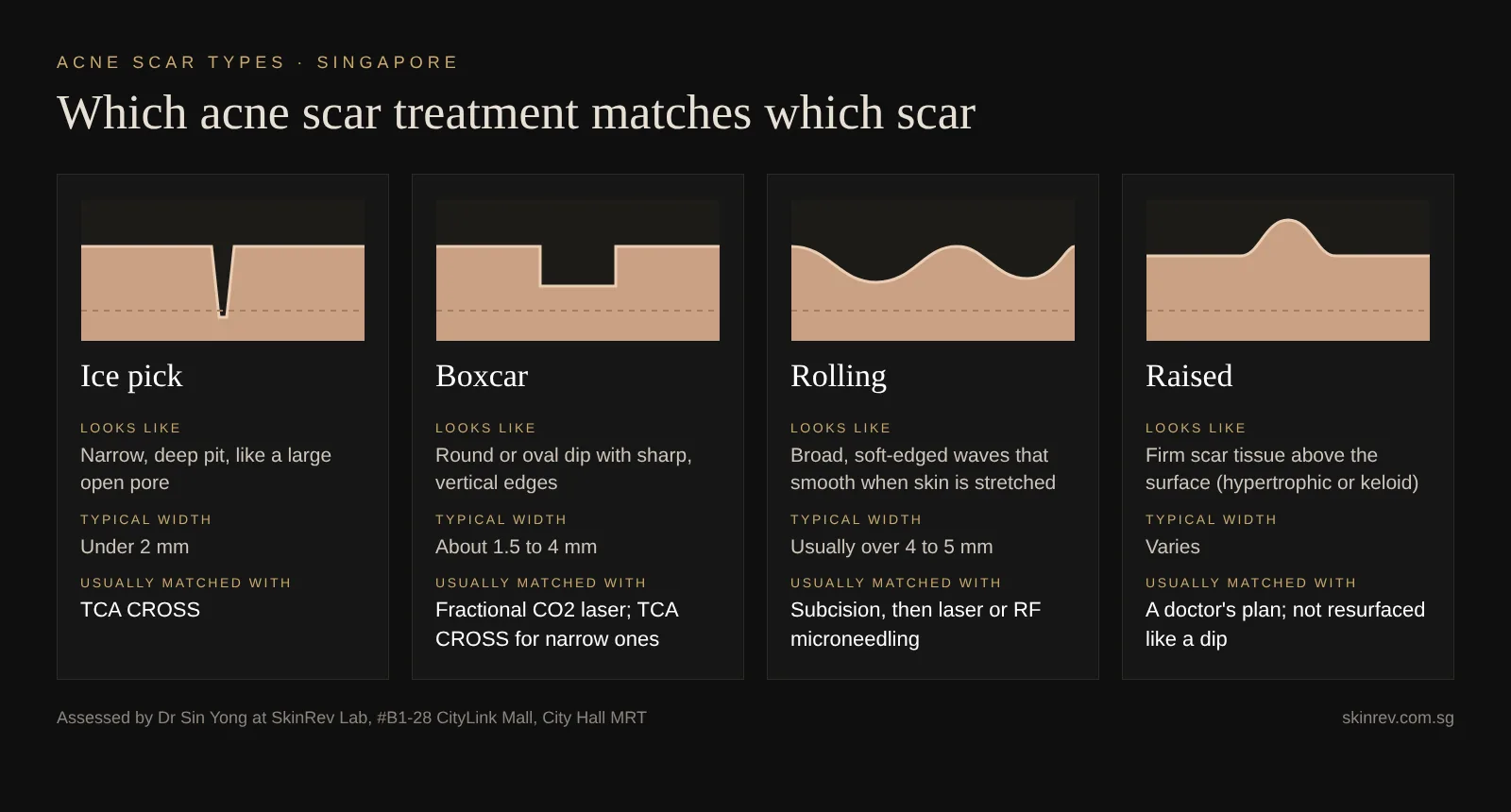
Searches for acne scar treatment in Singapore usually start after the breakouts have stopped and the skin has not recovered. The frustrating part is that “acne scars” is four different problems. Each has its own shape, its own cause and its own fix — and only one of the four is something a facial can meaningfully touch.
| Scar type | What it looks like | Usual route |
|---|---|---|
| Ice pick | Narrow, deep pits, often on the cheeks | TCA CROSS (doctor) |
| Boxcar | Wider depressions with defined edges | Fractional laser (doctor) |
| Rolling | Shallow, wave-like dips from fibrous tethering | Subcision (doctor) |
| Raised (hypertrophic or keloid) | Thickened scar tissue | Medical assessment |
| Surface marks and texture | Roughness, residual redness, uneven surface | Microplasma resurfacing and calming protocols (SkinRev Lab) |
SkinRev Lab is an aesthetic clinic at CityLink Mall. We refine the surface and calm active skin. Structural scars — the pits, the walled depressions, the tethered dips — are treated by Dr Sin Yong at SkinRev Lab. Here is how to tell which you have. Every scar type and option is compared in our guide to acne scar removal.
“A rolling scar is tethered, a boxcar is walled and an ice pick is a pit. No facial changes the structure of any of them — we can refine the surface, and we will say so.”
— SkinRev Lab Aesthetic Therapist
- Ice pick
- Narrow, deep pits, often on the cheeks; respond to TCA CROSS (doctor)
- Boxcar
- Wider depressions with defined edges; respond to fractional laser (doctor)
- Rolling
- Shallow, wave-like dips from fibrous tethering; respond to subcision (doctor)
- Raised (hypertrophic/keloid)
- Thickened scar tissue; medical assessment
- Surface marks and texture
- Roughness, residual redness, uneven surface; respond to microplasma resurfacing and calming protocols (SkinRev Lab)
Acne scar, dark mark or keloid: how to tell which you have
Not every mark left by acne is a scar, and raised scars behave differently from dents. Use what you can see to sort it:
| What you see | Likely type | Does it fade on its own? |
|---|---|---|
| Flat brown or dark mark, no dent | Post-inflammatory hyperpigmentation (a mark, not a scar) | Mild hyperpigmentation may fade within 3 to 6 months of self-treatment (HealthHub) |
| A dent, pit or rolling hollow | Atrophic scar: ice pick, boxcar or rolling | Over-the-counter products are unlikely to resolve atrophic scars (HealthHub) |
| Raised, firm, staying within the original spot; appears within weeks | Hypertrophic scar | More likely to regress and resolve than a keloid (DermNet, 2022) |
| Raised scar growing beyond the original spot, sometimes years later; often chest, shoulders or neck | Keloid | Tends to persist; cutting it out alone may leave a larger keloid (DermNet, 2022) |
Keloids are more frequent in Fitzpatrick skin types III to VI, and Chinese people are more likely to develop them than people of Indian or Malaysian origin (DermNet, 2022). At SkinRev Lab, raised scars are not filled; Dr Sin Yong assesses them separately from dents.
What goes where
The honest ladder:
surface here, structure with the doctor
At SkinRev Lab · non-invasive
SKINTIGHT® microplasma — resurfaces the surface layer for texture and shallow marks, S$588. Read more
SKINLDM® — dual-frequency ultrasound that calms inflamed, breakout-prone skin to help reduce new scarring, S$288. Read more Active acne is treated first; see acne treatment in Singapore.
HydraFacial Syndeo — keeps congestion down between sessions. Read more
Suits: surface texture, residual marks, active or recurring breakouts.
At SkinRev Lab · doctor-performed
Fractional CO2 laser (Tetra Pro S3 protocol) — for boxcar scars and overall texture. Related guide: acne scar laser treatment.
Subcision — releases the bands that tether rolling scars.
TCA CROSS — for ice pick scars.
4D scar reconstruction — a combined programme for mixed scarring, planned by the doctor.
Suits: established atrophic scars of any type, scarring that has not changed with surface treatment.
Where this happens
Assessment and treatment at SkinRev Lab — CityLink Mall #B1-28, 1 Raffles Link. Underground from City Hall MRT (East-West and North-South lines) and Esplanade MRT (Circle line); a short walk from Raffles Place, Marina Bay, Suntec and Bugis. Open daily 11am–8pm.
Dr Sin Yong also sees patients at SkinRev Lab: three stops on the North-South line from City Hall. WhatsApp .
Acne scar solutions compared: sessions and downtime
Most acne scar solutions are a course and not a single visit: plans usually run over three to nine months, with sessions spaced four to eight weeks apart. The figures below are the typical ones used across this site; your own plan is set at consultation.
| Solution | Used for | Usual sessions | Downtime |
|---|---|---|---|
| TCA CROSS | Ice pick scars; narrow, deep boxcar scars | Often three to six, weeks apart | Crusting for about a week |
| Subcision | Rolling scars | One to three, then energy sessions | Bruising that can take up to two weeks to fade |
| Fractional CO2 laser (Tetra Pro S3) | Shallow or wide boxcar scars, overall texture | Several, often a month or more apart | About 5 to 7 days of swelling and crusts |
| RF microneedling | Shallow boxcar scars, texture | A course, several weeks apart | From 1 to 3 days of redness |
| 4D Scar Reconstruction | Mixed scar types | A few combined sessions for some, more for others | About 1 to 2 weeks of social downtime |
| SKINTIGHT® microplasma | Surface texture and shallow marks only | A short course planned at your assessment | Pinpoint scabbing for a few days |
All except SKINTIGHT® are medical treatments performed by Dr Sin Yong and priced at consultation. SKINTIGHT® is S$588 per zone before GST and is performed by Aesthetic Therapists. Collagen keeps remodelling for three to six months after each session.
Why we refuse to oversell this
What the evidence
actually supports
The ice pick / boxcar / rolling classification comes from the dermatology literature and exists because the three respond to different procedures. Rolling scars are held down by fibrous strands and release when those strands are cut; ice picks are too narrow and deep for resurfacing and are treated by chemical reconstruction of the pit; boxcar scars respond to ablative fractional resurfacing. All three are procedures a doctor performs.
What a non-invasive centre can do is real but bounded: refine surface irregularity, fade residual marks and help reduce new scarring. We would rather tell you that on day one than sell you a course that cannot reach the problem.
References
Medical treatments
How the doctor treats it
Pitted acne scars are treated by Dr Sin Yong at SkinRev Lab with fractional CO₂ laser (Tetra Pro S3), RF microneedling, Luminescence Laser or 4D Scar Reconstruction, which combines subcision, TCA CROSS, laser and filler where needed. The method is matched to the scar type after examination; each page explains who it suits and the evidence.
These are performed by Dr Sin Yong at SkinRev Lab. Each page explains the mechanism, who it suits and the published evidence.
Fillers for acne scars in Singapore: when they help, and when they do not
Fillers for acne scars add volume beneath a depressed scar so that its floor sits closer to the surrounding skin; they support a plan and are rarely the whole plan. At SkinRev Lab a filler or collagen-stimulating injectable is used where a released scar has lost volume, as one part of 4D Scar Reconstruction, performed by Dr Sin Yong and priced at consultation.
| Scar type | Where fillers fit |
|---|---|
| Rolling scars | After subcision has released the bands, as volume support if needed |
| Soft, shallow boxcar scars | May help as support alongside resurfacing |
| Deep boxcar and ice pick scars | Usually treated inside the scar with TCA CROSS; a filler is not the main method |
| Raised scars | Not filled; fillers are used only beneath depressed scars |
How an injectable fits into a combined plan:
- Dr Sin Yong examines the scars under angled light and maps them by type.
- Subcision releases tethered scars first; it is done before laser.
- Where a released scar has lost volume, a filler or collagen-stimulating injectable may be placed beneath it.
- Resurfacing follows for texture, with sessions spaced weeks apart.
The American Academy of Dermatology notes that most fillers give temporary results, ranging from 3 months to 2 years. Fillers break down over time; collagen stimulators last longer.
Acne scar clinic in Singapore: who treats scars at SkinRev Lab, and what the first visit covers
At an acne scar clinic in Singapore, a doctor examines and names each scar type before any method is chosen. At SkinRev Lab, Dr Sin Yong, medical adviser, assesses and treats acne scars himself at #B1-28 CityLink Mall, 1 Raffles Link, by City Hall MRT, open daily 11am–8pm.
- Before you come: note any acne medicines, past keloids and cold sores.
- Assessment: Dr Sin Yong examines the scars under angled light, names each type, and checks for active acne and flat marks.
- Plan: which methods, in what order, how many sessions are usual, the expected downtime, and what the plan cannot change. Medical treatment is priced at this consultation.
- Treatment day: numbing cream or local anaesthetic as needed, then the chosen method.
- Afterwards: written aftercare, strict sun protection, and a review before the next session.
To book, WhatsApp +65 8266 9585. Surface treatments such as SKINTIGHT® are performed by Aesthetic Therapists and do not change the structure of a scar.
Causes
What causes acne scars, and how to lower the risk
Acne scars are the structural change left when skin repairs inflammation. When collagen is lost, the surface sinks into ice pick, boxcar or rolling scars; when too much is laid down, raised hypertrophic scars or keloids form. Flat red or brown marks are not scars and usually fade with time and sun protection.
How each scar type is treated is set out in acne scar treatment in Singapore.
- How deep the inflammation goes: Deep, long-lasting spots such as nodules and cysts damage dermal collagen and are the ones most likely to leave pitted scars.
- Delay in treatment: The longer acne goes uncontrolled, the higher the chance of scarring, so early treatment is the main way to prevent them.
- Squeezing and picking: Pushes inflammation deeper and adds infection and dark marks.
- Your own healing tendency: Some people scar or form keloids more easily; a family history is a useful clue.
Sources: Fabbrocini G, et al. Acne scars: pathogenesis, classification and treatment. Dermatol Res Pract. 2010;2010:893080; Jacob CI, Dover JS, Kaminer MS. Acne scarring: a classification system and review of treatment options. J Am Acad Dermatol. 2001;45(1):109-117.
How common acne scars are, and who is most at risk
Acne scars are common even when acne is not severe. In a US study of 1,972 people seeing dermatologists for active acne, 43% already had acne scars, and 69% of those with scars had only mild or moderate acne at that visit (Tan et al., 2017).
The same study linked scarring to four factors:
- how severe the acne is, or has been;
- the time between acne starting and the first effective treatment;
- acne that keeps coming back;
- male sex.
An expert group later turned the main risk factors into a four-question self-check: worst-ever acne severity, how long acne has lasted, a family history of atrophic acne scars, and picking or squeezing spots. It sorts people into lower or higher risk; it picked up 82% of people with scars (sensitivity) but had a specificity of only 43%, so a “higher risk” result is a prompt to act, not a diagnosis (Tan et al., 2017, JEADV).
Of these factors, the one most people can change is the delay before effective treatment, which is why active acne is treated before scars.
Common questions
Your questions,
answered
What are the types of acne scars?
Four, broadly. Ice pick scars are narrow, deep pits. Boxcar scars are wider depressions with defined edges. Rolling scars are shallow, wave-like dips caused by fibrous bands tethering the skin down. Hypertrophic or keloid scars are raised. Most people have a mix, and the mix decides the treatment: ice picks respond to TCA CROSS, rolling scars to subcision, boxcar scars to fractional laser — all doctor-performed.
Can SkinRev Lab treat acne scars?
We can improve surface texture and the marks around scars, and we can calm skin that is still breaking out. SKINTIGHT® microplasma resurfaces the surface layer; SKINLDM® settles active inflammation so new scars are not being made. What facials cannot do is change the depth or structure of an established atrophic scar — that is laser, subcision or TCA CROSS territory, performed by Dr Sin Yong at SkinRev Lab.
What does a doctor do for acne scars?
At SkinRev Lab the doctor maps the scar types and builds a programme: fractional CO2 laser (the DEKA Tetra Pro S3 protocol) for boxcar and general texture, subcision to release tethered rolling scars, TCA CROSS for ice picks, and a combined 4D scar reconstruction approach for mixed scarring. Suitability and the number of sessions are decided at the consultation there.
Should I treat active acne first?
Yes. Scars cannot be reconstructed while new ones are forming. Calming active acne — at SkinRev Lab with SKINLDM® and HydraFacial, or with a doctor's prescription treatment at the clinic if it is severe — comes first; scar work follows once the skin is quiet.
How long before I see a change?
Surface texture work at SkinRev Lab shows within a few sessions. Structural scar treatment is slower: collagen remodelling after laser or subcision continues for months, and most programmes run several sessions spaced weeks apart. Anyone promising scar removal in one visit is describing something else.
Where are you, and where is the clinic?
SkinRev Lab is at CityLink Mall #B1-28, underground from City Hall and Esplanade MRT and a short walk from Raffles Place, Marina Bay, Suntec and Bugis.
What causes acne scars?
Deep, inflamed acne that damages collagen in the dermis. Nodules and cysts, delayed treatment, squeezing and a personal tendency to scar all raise the risk. Too little collagen during healing leaves a pit; too much leaves a raised scar.
Can you prevent acne scars?
Largely, yes. Treating acne early and adequately, especially deep or painful spots, is the key step. Avoid squeezing, protect the skin from the sun to limit dark marks, and see a doctor if spots are leaving dents.
Are acne scars and dark marks the same thing?
No. Dark or red marks are flat colour changes that usually fade over months. Acne scars change the skin's texture, as dents or raised bumps, and need procedures rather than creams to improve.

Acne scars: key facts
| Fact | Detail | Source |
|---|---|---|
| What they are | Scarring is the fibrous process in which new collagen is laid down to heal a full-thickness injury; with acne, if healing is disrupted the body produces too little or too much collagen and a scar forms. | DermNet, n.d.; HealthHub, 2024 |
| Types | Atrophic (indented): ice pick, boxcar and rolling; raised: hypertrophic and keloid. Ice pick scars are the most common atrophic type, at 60–70%. | DermNet, n.d. |
| Who gets them | People with deep acne such as cysts or nodules, people who pick, pop or squeeze spots, and people with a close blood relative who has acne scars. Raised scars are more common in darker skin tones. | AAD, 2023 |
| What the evidence shows | A systematic review (89 studies) found fractional lasers and radiofrequency offer significant improvement in most types of atrophic acne scars; high-quality data are lacking. | Bhargava et al., 2018 |
| Sessions, interval and downtime | Some lasers require more treatment sessions than others. Fillers for depressed scars: most need a series of treatments, with temporary results of 3 months to 2 years. Some treatments require downtime. | AAD, 2023 |
| Marks versus scars | Mild scarring such as hyperpigmentation may resolve within 3 to 6 months of self-treatment; over-the-counter products are unlikely to resolve atrophic scars. Treat the acne outbreak before treating scars. | HealthHub, 2024 |
| Cost at SkinRev Lab | Doctor-led treatments (subcision, TCA CROSS, fractional CO₂ laser, RF microneedling, 4D Scar Reconstruction, fillers) are priced at consultation. SKINTIGHT® microplasma, which refines the surface only, is S$588 per zone before GST. | SkinRev Lab (this page) |
| Who performs it at SkinRev Lab | Dr Sin Yong, medical adviser, assesses scars and performs the medical treatments. Aesthetic Therapists perform SKINTIGHT®, which does not change scar structure. | SkinRev Lab (this page) |
Acne scar laser treatment on Asian skin: the pigmentation risk
The main extra risk of laser resurfacing for acne scars in Asian skin is post-inflammatory hyperpigmentation (PIH): temporary darkening after the skin heals. A study of 37 Chinese patients, 119 sessions in all, treated with a 1,540 nm non-ablative fractional laser for acne scarring, skin rejuvenation or pigment measured how often it happened (Chan et al., 2007):
| Setting | Average energy and density | Generalised PIH rate |
|---|---|---|
| High energy, low density (68 sessions) | 16.3 mJ, 1,000 treatment zones | 7.1% |
| Low energy, high density (51 sessions) | 8.2 mJ, 2,000 treatment zones | 12.4% |
The difference was not statistically significant, but the authors concluded that both the density and the energy of treatment determine PIH risk in darker skin, with density possibly the more important. Cooling mattered too: localised PIH around the mouth occurred in patients who did not receive air cooling.
This is why density, energy and cooling are set for the individual skin type. At SkinRev Lab, fractional CO₂ laser and RF microneedling for acne scars are planned by Dr Sin Yong after assessment and priced at consultation.
What decides your acne scar plan: type, number, skin tone and goals
Two people with acne scars rarely get the same plan, because the plan is built from a few things a doctor checks first. The American Academy of Dermatology lists the type of scars, how many there are, your age and your skin tone, and notes that your dermatologist may use more than one treatment (American Academy of Dermatology, 2023).
| What is checked | Why it matters |
|---|---|
| The type of each scar, and where the scars are | Each type needs a different tool; ice pick scars are treated differently from rolling scars |
| How many scars there are, and how visible they are | Grading looks at the scars' shape and how many there are, including whether they can be disguised at a social distance, and the grade guides which treatments are suggested (Goodman and Baron, 2006) |
| Skin tone | Asian skin can darken after laser, so settings and preparation change; the pigmentation-risk section on this page explains why |
| Active acne, and acne treatment in the last two years | Scar treatment usually starts once acne is under control, and some combinations of acne treatment and procedures can cause side effects |
| How the scars affect you, and what you expect | The doctor asks, so the plan targets what you most want to change |
Grades 1 to 4, and what each usually means for treatment, are explained in our acne scar grading guide.
Questions people ask
What acne scar solutions are available in Singapore?
Acne scar solutions in Singapore are fractional laser, RF microneedling, subcision, TCA CROSS and injectables such as fillers, usually combined according to scar type. At SkinRev Lab these medical treatments are performed by Dr Sin Yong and priced at consultation; SKINTIGHT® microplasma for surface texture is S$588 per zone before GST, performed by Aesthetic Therapists.
Do fillers work for acne scars?
Fillers can add volume beneath depressed acne scars, mainly rolling scars after subcision and soft, shallow boxcar scars. They are a support and not the whole plan: ice pick and deep boxcar scars are usually treated inside the scar with TCA CROSS, and raised scars are not filled. Dr Sin Yong decides at consultation.
How long do fillers for acne scars last?
Most fillers for acne scars give temporary results: the American Academy of Dermatology gives a range of 3 months to 2 years. Fillers break down over time, while collagen-stimulating injectables last longer. At SkinRev Lab, Dr Sin Yong explains which injectable, if any, a released scar needs at consultation.
What are boxcar scars?
Boxcar scars are round or oval depressed acne scars with sharp, vertical edges and a flat floor, usually about 1.5 to 4 mm across. Shallow ones respond to resurfacing such as fractional CO2 laser; narrow, deeper ones may also need TCA CROSS. The full guide to boxcar scars covers shallow and deep plans.
Is laser treatment for acne scars in Singapore enough on its own?
Laser treatment for acne scars is often not enough on its own. Fractional laser suits shallow boxcar scars and uneven texture, but rolling scars usually need subcision first and ice pick scars need TCA CROSS, because a laser rarely reaches their base. See laser treatment for acne scars Singapore for which laser suits which scar.
How do I choose an acne scar clinic in Singapore?
Choose an acne scar clinic in Singapore where a doctor examines your scars, names each type, and explains which methods are planned, in what order, how many sessions are usual, the downtime and what the plan cannot change. At SkinRev Lab, Dr Sin Yong does this himself at consultation, and medical treatment is priced then.
Can acne scars go away on their own?
Flat marks often fade, but indented acne scars usually do not. HealthHub notes that mild scarring such as hyperpigmentation may resolve within 3 to 6 months of self-treatment, while over-the-counter products are unlikely to resolve atrophic (indented) scars. These need a doctor's assessment; at SkinRev Lab, Dr Sin Yong, medical adviser, assesses them.
Who is more likely to get acne scars?
People whose acne goes deep, such as cysts and nodules, people who pick, squeeze or pop spots, and people with a close blood relative who has acne scars, according to the American Academy of Dermatology. Raised scars are more common in darker skin tones. Treating acne early, before it goes deep, lowers the chance of scarring.
What does research say about acne scar removal treatments?
A 2018 systematic review of 89 studies found that fractional lasers and radiofrequency offer significant improvement in most types of indented acne scars, though high-quality data are lacking. Because each scar type responds differently, many plans combine methods. At SkinRev Lab, Dr Sin Yong, medical adviser, matches the method to each scar type after an assessment.
Can acne scars be removed completely?
Not with treatments available today. A large US study concluded that no currently available treatment completely resolves acne scars, and over-the-counter products are unlikely to resolve dented (atrophic) scars. Treatment aims to make them shallower and less visible. Flat dark marks differ: mild hyperpigmentation may fade within 3 to 6 months of self-treatment.
How common are acne scars?
Common. In a study of 1,972 people seeing dermatologists for active acne, 43% already had acne scars, and 69% of those had only mild or moderate acne at the time. Scarring was linked to acne severity, delay before effective treatment, acne that keeps returning, and male sex.
What is the difference between a keloid and a hypertrophic acne scar?
Both are raised. A hypertrophic scar stays within the area of the original spot, usually appears within weeks and is more likely to flatten over time. A keloid grows beyond the original spot, can appear years later, tends to persist, and favours the chest, shoulders and neck.
Does picking spots cause acne scars?
It raises the risk. Picking or squeezing spots is one of four risk factors in an expert-developed acne scar risk tool, alongside worst-ever acne severity, how long acne has lasted and a family history of atrophic scars. Treating acne early and leaving spots alone are the factors most within your control.
Are pockmarks the same as acne scars?
Usually, yes. 'Pockmarks' is an everyday word for pitted acne scars: the narrow ice pick, sharp-edged boxcar and wave-like rolling dips described on this page. Flat red or brown marks are not pockmarks, because they leave no dent and often fade. Raised scars and keloids are a different problem and are treated differently.
How much does acne scar removal cost in Singapore?
At SkinRev Lab, scar treatments by Dr Sin Yong, such as subcision, TCA CROSS, fractional CO2 laser, RF microneedling and 4D Scar Reconstruction, are priced at consultation, because the plan depends on your scar types and how many sessions they need. SKINTIGHT® microplasma for surface texture, by Aesthetic Therapists, is S$588 per zone before GST; it does not change scar structure.
References
- Tan J, Kang S, Leyden J (2017). Prevalence and Risk Factors of Acne Scarring Among Patients Consulting Dermatologists in the USA. Journal of Drugs in Dermatology 16(2):97-102. PMID 28300850. Source
- Tan J, Thiboutot D, Gollnick H, Kang S, Layton A, Leyden JJ, Torres V, Guillemot J, Dréno B (2017). Development of an atrophic acne scar risk assessment tool. Journal of the European Academy of Dermatology and Venereology 31(9):1547-1554. doi:10.1111/jdv.14325. PMID 28499079. Source
- Chan HHL, Manstein D, Yu CS, Shek S, Kono T, Wei WI (2007). The prevalence and risk factors of post-inflammatory hyperpigmentation after fractional resurfacing in Asians. Lasers in Surgery and Medicine 39(5):381-385. doi:10.1002/lsm.20512. PMID 17518354. Source
- Yoong NKM, Numan H (2022). Keloid and hypertrophic scar. DermNet. Source
- National Medication Information workgroup (2024). Acne scars. HealthHub, Ministry of Health Singapore (last reviewed 24 June 2024). Source
- American Academy of Dermatology (2023). Acne scars: causes. AAD (last updated 8 December 2023). Source
- Bhargava S, Cunha PR, Lee J, Kroumpouzos G (2018). Acne scarring management: systematic review and evaluation of the evidence. American Journal of Clinical Dermatology, 19(4):459-477. doi:10.1007/s40257-018-0358-5. Source
- American Academy of Dermatology (2023). Acne scars: diagnosis and treatment. AAD (last updated 8 December 2023). Source
- Goodman GJ, Baron JA (2006). Postacne scarring: a qualitative global scarring grading system. Dermatologic Surgery 32(12):1458-1466. doi:10.1111/j.1524-4725.2006.32354.x. PMID 17199653. Source