Guide · Closed comedones
Closed comedones and whiteheads what they are, and what actually clears them
Closed comedones are the small, skin-coloured bumps that make skin feel rough and never quite come to a head. Here is how they differ from milia and fungal acne, what clears them, what not to do, and when an extraction facial or a doctor helps.
Quick answer
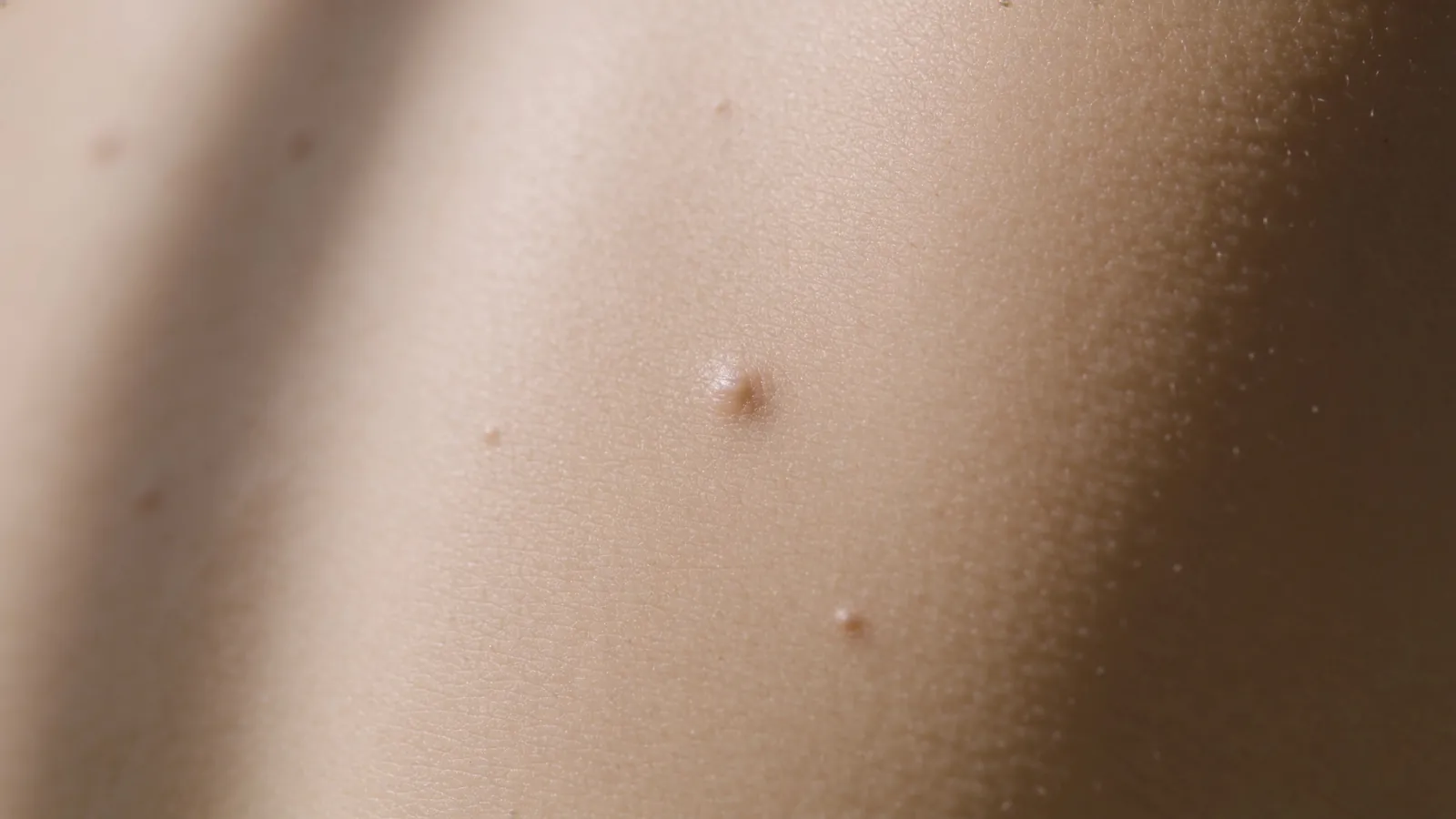
- Closed comedones, usually called whiteheads, are pores plugged with oil and dead skin cells under a thin layer of skin, so they show as small white or skin-coloured bumps with no visible opening. They are the earliest, non-inflamed stage of acne, common on the forehead, chin and jawline.
- They are not the same as milia, which are hard, pearly keratin cysts with no pore opening, or fungal acne, which is itchy, same-sized bumps caused by yeast in the follicle. Each needs a different approach, so it is worth knowing which one you have.
- What clears closed comedones is a retinoid such as adapalene, often alongside salicylic acid or benzoyl peroxide, used steadily for six to twelve weeks. Gentle professional extraction clears existing plugs sooner. Squeezing at home tends to turn them into inflamed spots and dark marks.
- At SkinRev Lab, every HydraFacial Syndeo tier includes vacuum extraction (45 minutes, S$288 to S$438 before GST). SkinRev Lab does not prescribe; stubborn, widespread or inflamed comedones are assessed by Dr Sin Yong at IN Eternity Clinic, where prescription treatment is priced at consultation.
The basics
What closed comedones (whiteheads) are
A comedone is a hair follicle blocked by a plug of sebum (skin oil) and skin cells that have not shed properly. When the opening stays wide, the top of the plug darkens at the surface and you have a blackhead, or open comedone. When the opening is tiny or covered by skin, the plug stays white or skin-coloured: that is a closed comedone, the everyday whitehead.
Closed comedones are often easier to feel than to see. The skin looks bumpy under side lighting and feels rough, especially on the forehead, chin, jawline and cheeks. They do not hurt and, on their own, they are not inflamed. The trouble is that a closed comedone can burst inside the skin, and that is when a red bump or a pus-filled pimple appears.
The word whitehead is also used loosely for a pimple with a yellow-white head of pus. That is a pustule, an inflamed spot, and it is handled a little differently. This guide is about the small, flat-topped bumps that never seem to come to a head.
Causes
Why closed comedones form, especially in Singapore
Four things usually combine in acne: oil glands making more sebum, often under hormonal influence; skin cells inside the follicle sticking together instead of shedding; skin bacteria multiplying in the blocked, oily space; and inflammation once a plug bursts. Closed comedones are the stage before the last two take hold.
Daily habits add to it. Heat and humidity keep skin oily all year, and some of the products used to cope with that make congestion worse.
- Heavy or occlusive products: rich creams, thick sunscreens, foundation and balms that are not labelled non-comedogenic.
- Hair products such as pomades, oils and serums that spread onto the forehead and hairline.
- Friction and occlusion from masks, helmets, headbands and a phone pressed to the jaw.
- Hormonal shifts: many adult women notice comedones along the chin and jaw around their cycle.
- Picking and over-scrubbing, which inflame the follicle and make plugs harder to clear.
- Stopping treatment too early: comedones take weeks to form, so they take weeks to clear.
Look-alikes
Closed comedones vs milia vs fungal acne
The difference matters in the tropics. In a study of 68 people with yeast (pityrosporum) folliculitis in the Philippines, the most typical lesion was a small comedone-like bump, and more than half also had ordinary acne; adding antifungal treatment to their acne regimen cleared the lesions markedly. If your bumps itch and do not budge with acne products, ask a doctor to check.
Sebaceous filaments, the even grey dots on the nose, and sebaceous hyperplasia, soft yellowish bumps with a central dip, are two other common look-alikes. Neither is a whitehead, and neither should be squeezed.
| Closed comedones (whiteheads) | Milia | Fungal acne (Malassezia folliculitis) | |
|---|---|---|---|
| What it is | A pore plugged with sebum and dead skin cells | A tiny keratin cyst with no opening to the surface | Yeast overgrowth inflaming the hair follicle |
| Look and feel | Soft white or skin-coloured bumps of varying size; skin feels rough | Hard, pearly white grains, about 1–2 mm | Small red or skin-coloured bumps, all about the same size, sometimes with tiny pustules |
| Itch | No | No | Often itchy, worse with heat and sweat |
| Usual sites | Forehead, chin, jawline, cheeks | Around the eyes, eyelids, cheeks, nose | Forehead, chest, back, upper arms |
| Can it be extracted? | Yes, gently, once softened | Only by a doctor, who opens the skin with a sterile instrument | Extraction does not help |
| What helps | Retinoid, salicylic acid or benzoyl peroxide; extraction facial | Removal by a doctor, or leave alone | Antifungal treatment from a doctor |
What clears them
What clears closed comedones: retinoids, BHA and patience
Retinoids are the main treatment because they act on the cause: they normalise how skin cells shed inside the follicle, so plugs loosen and new ones form less easily. The American Academy of Dermatology's 2024 acne guideline gives a strong recommendation to topical retinoids and to benzoyl peroxide, and a conditional one to salicylic acid and azelaic acid.
Adapalene is often the first retinoid tried because it tends to be gentler. In a 12-week randomised trial of 323 people, adapalene 0.1% gel reduced non-inflamed lesions (blackheads and whiteheads) by 46%, against 33% with tretinoin 0.025% gel, and was better tolerated. In Singapore, adapalene 0.1% is classed as a prescription-only medicine, although pharmacists may supply it for acne without a prescription under set conditions; tretinoin needs a prescription.
Salicylic acid is a beta hydroxy acid (BHA) that dissolves in oil, so it works inside the pore, and it is comedolytic, meaning it helps break up comedones. Benzoyl peroxide reduces acne bacteria and helps stop comedones turning into pimples. Expect dryness and some flaking in the first weeks, and sometimes a short-lived flare as plugs come to the surface. Give any routine six to twelve weeks before judging it. Retinoids are not used in pregnancy.
| Option | How it helps closed comedones | Practical notes |
|---|---|---|
| Adapalene 0.1% | Retinoid; loosens plugs and slows new ones forming | A pea-sized amount at night over the whole area; start every other night |
| Tretinoin (prescription) | Stronger retinoid with the same action | Prescribed by a doctor; more irritation at first |
| Salicylic acid (BHA), 0.5–2% | Oil-soluble exfoliant that works inside the pore | Cleanser or leave-on; can alternate nights with a retinoid |
| Benzoyl peroxide, 2.5–5% | Reduces acne bacteria; limits inflamed spots | A short-contact wash suits sensitive skin; bleaches fabric |
| Azelaic acid | Mildly comedolytic and anti-inflammatory; helps dark marks | Often tolerated by sensitive skin |
| Niacinamide | Supports the skin barrier and may lower oil output | A helper alongside the above, not a treatment on its own |
Hands off
What not to do with whiteheads
Closed comedones are tempting to squeeze because they look so close to the surface. But the opening is tiny, so pressing tends to burst the plug sideways into the skin rather than out of it. That is how a quiet whitehead becomes a red, sore pimple, and in Asian skin it often leaves a dark mark (post-inflammatory hyperpigmentation) that outlasts the spot by months.
If you have already squeezed one, keep it clean, leave any scab alone and use sunscreen on the area, which helps the mark fade.
- Do not squeeze, pick, or use needles or extractor tools at home.
- Skip harsh scrubs, brushes and peel-off masks; friction inflames follicles without clearing the plugs.
- Do not stack several strong actives at once; irritated skin tends to break out more, not less.
- Pore strips do little for whiteheads, because closed comedones have no open top for the adhesive to grip.
- Keep heavy oils and balms off comedone-prone areas, and remove sunscreen and make-up every night.
- Do not give up after two weeks; most routines need six to twelve weeks.
Spot treatment
Spot treatment: when a whitehead turns into a pimple
Spot treatment is for inflamed pimples, not for closed comedones. Dabbing a product on one whitehead does little, because comedones form across the whole oily zone; treat the whole area with your routine, and keep spot treatment for the occasional red spot.
For a single inflamed pimple, a thin layer of benzoyl peroxide 2.5–5% once or twice a day is a common over-the-counter spot treatment. A hydrocolloid patch on a spot that has come to a head mainly stops you picking it and absorbs fluid. Avoid toothpaste, undiluted essential oils and alcohol, which irritate.
A deep, painful lump is not a whitehead and should not be squeezed. A doctor may inject a small dose of diluted corticosteroid (triamcinolone) into a large inflamed spot to settle it faster, and recurring deep lumps need proper acne treatment rather than spot fixes.
Extraction
When an extraction facial or HydraFacial helps
Topical treatments stop new comedones forming, but existing plugs can take weeks to work loose. Gentle professional extraction clears them sooner. Closed comedones need softening first and careful technique, because the opening is so small; done badly, extraction leaves marks.
HydraFacial Syndeo at SkinRev Lab uses a mild glycolic and salicylic acid step to soften plugs, then vortex suction to lift congestion while infusing hydrating serum, rather than squeezing. Every tier includes this vacuum extraction: Signature S$288, Deluxe S$388 and Platinum S$438 before GST, each about 45 minutes, with the first-timer rate given at the counter. Every four to six weeks is a common rhythm while congestion is the main issue.
The evidence is modest. In a 12-week open-label study of 20 adults with mild to moderate acne, six clarifying HydraFacial treatments two weeks apart raised the share with clear or almost clear skin from 20% to 65% on investigator rating. There was no control group, so treat it as encouraging rather than proof. Inflamed spots are not extracted, and anyone on isotretinoin should wait until their doctor says exfoliating facials are safe.
| Your skin | Sensible starting point |
|---|---|
| A few scattered whiteheads | Home routine with a retinoid or salicylic acid |
| Widespread congestion on the forehead and chin | Home routine plus HydraFacial every four to six weeks |
| Whiteheads with many red or painful spots | See a doctor first; facials as support only |
| Itchy, same-sized bumps | See a doctor; this may be fungal |
| Hard white grains around the eyes | See a doctor; these are likely milia |
| No change after three months of steady care | See a doctor about prescription treatment |
See a doctor
When to see a doctor about whiteheads
For many people closed comedones are a cosmetic nuisance, but some patterns are better seen by a GP or dermatologist. A doctor can prescribe stronger retinoids or combination treatments, extract stubborn comedones with sterile instruments and, for very persistent closed comedones, use light cautery under numbing cream, a technique described for whiteheads in a 1991 report. Chemical peels and, for more severe acne, oral treatment are other options.
At IN Eternity Clinic this is done by Dr Sin Yong after a consultation. SkinRev Lab itself does not prescribe, inject or perform medical procedures. See a doctor if you notice any of the following.
- Little or no change after about three months of consistent home care.
- Comedones together with many inflamed, painful or deep spots.
- Dark marks or small dents appearing where spots have been.
- Itchy, uniform bumps that may be fungal, or hard white grains that may be milia.
- Acne starting suddenly in adulthood with irregular periods or extra hair growth, which can point to a hormonal cause.
- Breakouts after starting steroid creams, steroid tablets or bodybuilding supplements.
Where to go
Extraction facials and doctor-led care in our network
SkinRev Lab is a non-invasive aesthetic centre at #B1-28 CityLink Mall, on the underground link between City Hall and Esplanade MRT, open daily 11am to 8pm. For congested, comedone-prone skin, HydraFacial Syndeo includes vacuum extraction in every tier (S$288 to S$438 before GST). If your skin is red and reactive from breakouts or strong acne products, SKINLDM, a calming ultrasound micro-massage facial of about 30 minutes, is S$288 before GST, with a first session at S$68. WhatsApp +65 8266 9585.
Prescription treatment is separate. Dr Sin Yong, SkinRev Lab's Medical Adviser, assesses acne and prescribes where appropriate at IN Eternity Clinic, 9 Scotts Road, #12-01 Pacific Plaza, beside Orchard MRT; treatment is priced at consultation by the clinic (WhatsApp +65 8815 3008). Results vary, and most plans combine home care, occasional extraction and, when needed, medical treatment.
Sources
References & sources
- Reynolds RV, Yeung H, Cheng CE, et al. Guidelines of care for the management of acne vulgaris. J Am Acad Dermatol. 2024;90(5):1006.e1-1006.e30.
- Shalita A, Weiss JS, Chalker DK, et al. A comparison of the efficacy and safety of adapalene gel 0.1% and tretinoin gel 0.025% in the treatment of acne vulgaris: a multicenter trial. J Am Acad Dermatol. 1996;34(3):482-485.
- Arif T. Salicylic acid as a peeling agent: a comprehensive review. Clin Cosmet Investig Dermatol. 2015;8:455-461.
- American Academy of Dermatology. How to treat different types of acne.
- Jacinto-Jamora S, Tamesis J, Katigbak ML. Pityrosporum folliculitis in the Philippines: diagnosis, prevalence, and management. J Am Acad Dermatol. 1991;24(5 Pt 1):693-696.
- Storgard R, Mauricio-Lee J, Mauricio T, Zaiac M, Karnik J. Efficacy and tolerability of HydraFacial clarifying treatment series in the treatment of active acne vulgaris. J Clin Aesthet Dermatol. 2022;15(12):42-46.
- Pepall LM, Cosgrove MP, Cunliffe WJ. Ablation of whiteheads by cautery under topical anaesthesia. Br J Dermatol. 1991;125(3):256-259.
Common questions
Your questions,
answered
What are closed comedones?
Closed comedones are hair follicles blocked by a plug of oil and dead skin cells, with the opening covered by a thin layer of skin. They look like small white or skin-coloured bumps and make skin feel rough. They are the non-inflamed starting point of acne.
Are closed comedones the same as whiteheads?
Yes. Whitehead is the everyday name for a closed comedone. People also use it for a pimple with a head of pus, but that is a pustule, an inflamed spot, which is treated slightly differently.
How do I get rid of closed comedones fast?
There is no safe overnight fix. A retinoid such as adapalene, with salicylic acid or benzoyl peroxide, stops new ones forming over six to twelve weeks, and gentle professional extraction clears existing plugs sooner. Squeezing at home usually makes them inflamed.
Should I pop whiteheads?
It is better not to. The opening of a closed comedone is tiny, so squeezing tends to burst it into the skin, causing a red pimple and often a dark mark. Leave extraction to trained hands, and see a doctor about deep or painful spots.
How long does adapalene take to clear closed comedones?
Usually six to twelve weeks of steady use. Skin may be dry and flaky at first, and some people see a brief flare as plugs come up. If there is little change after about three months, see a doctor.
Is it closed comedones or fungal acne?
Closed comedones vary in size, do not itch and sit mainly on the forehead, chin and jaw. Fungal acne tends to be small, itchy bumps of the same size, often worse with sweat, that do not improve with acne products. A doctor can confirm which it is.
Is it milia or a whitehead?
Milia are hard, pearly white grains, often around the eyes, with no opening, so they cannot be squeezed out. Whiteheads are softer and sit where skin is oily. Milia need a doctor to open them with a sterile instrument; SkinRev Lab does not remove milia.
What spot treatment works on a pimple?
For a single inflamed pimple, benzoyl peroxide 2.5–5% applied thinly once or twice a day is a common over-the-counter option, and a hydrocolloid patch can stop you picking a spot that has come to a head. For closed comedones, treat the whole area rather than single spots.
Does HydraFacial help closed comedones?
It can help clear existing congestion. HydraFacial Syndeo softens plugs with a mild acid step and lifts them with suction rather than squeezing. It works better alongside a home retinoid or salicylic acid routine, every four to six weeks; at SkinRev Lab it is S$288 to S$438 before GST.