Medical Treatments · Fillers & Injectables · Dr Sin Yong
Collagen Biostimulators in Singapore
Injectable PLLA and PCL work differently from hyaluronic acid filler: rather than filling a space directly, they prompt your own tissue to build collagen over months, restoring support and volume gradually.
By Dr Sin Yong · 8 October 2026
Doctor-led · City Hall
Collagen Biostimulators with Dr Sin Yong
Assessment first
Dr Sin Yong examines the area and explains which options suit it.
Performed by Dr Sin Yong
Medical treatments at SkinRev Lab are carried out by Dr Sin Yong, medical adviser.
Priced at consultation
The fee is explained before any treatment, so the decision stays with the patient.
Results vary from person to person.
What are collagen biostimulators, and who gives them in Singapore?
Collagen biostimulators are injectables that prompt your skin to build its own collagen over time, rather than filling a line straight away. At SkinRev Lab in Singapore they are a medical treatment performed by Dr Sin Yong, priced at consultation. Change usually builds over two to three months. Expect a few days of swelling or small bruises; nodules are uncommon but can form weeks later.
- Who performs: Dr Sin Yong
- Where: SkinRev Lab, #B1-28 CityLink Mall, 1 Raffles Link, Singapore 039393, near City Hall MRT
- Price: priced at consultation (depends on the product, vials and number of sessions)
- Sessions and downtime: often two or three sessions a few weeks apart, about 30 to 45 minutes each; most return to work the next day
- Not suitable for: deep folds that need instant volume, pregnancy or breastfeeding, or an infection or active acne in the area
- CaHA (Radiesse): described on this page for comparison only; it is not offered at SkinRev Lab. See our Radiesse guide
- Related page: collagen stimulator vs filler
Medically reviewed by Dr Sin Yong, medical adviser · Last reviewed 8 October 2026
This page is part of our guide to skin booster in Singapore: every related page, in one place.
Related: Collagen Drinks in Singapore
At a glance
| Performed by | Dr Sin Yong, Global Key Opinion Leader for CLASSYS, DEKA, Fotona, Alma, HIRONIC, ilooda and Lutronic · MBBS (Singapore), MRCS (Edinburgh), MSc Practical Dermatology (Cardiff), Professional Diploma in Obstetrics and Gynaecology (RCPI) |
|---|---|
| Where | SkinRev Lab, #B1-28 CityLink Mall (City Hall MRT) |
| Before treatment | A consultation and examination by Dr Sin Yong |
| Price | Priced at consultation |
| Book | WhatsApp +65 8266 9585 · daily, 11am to 8pm |
Your doctor
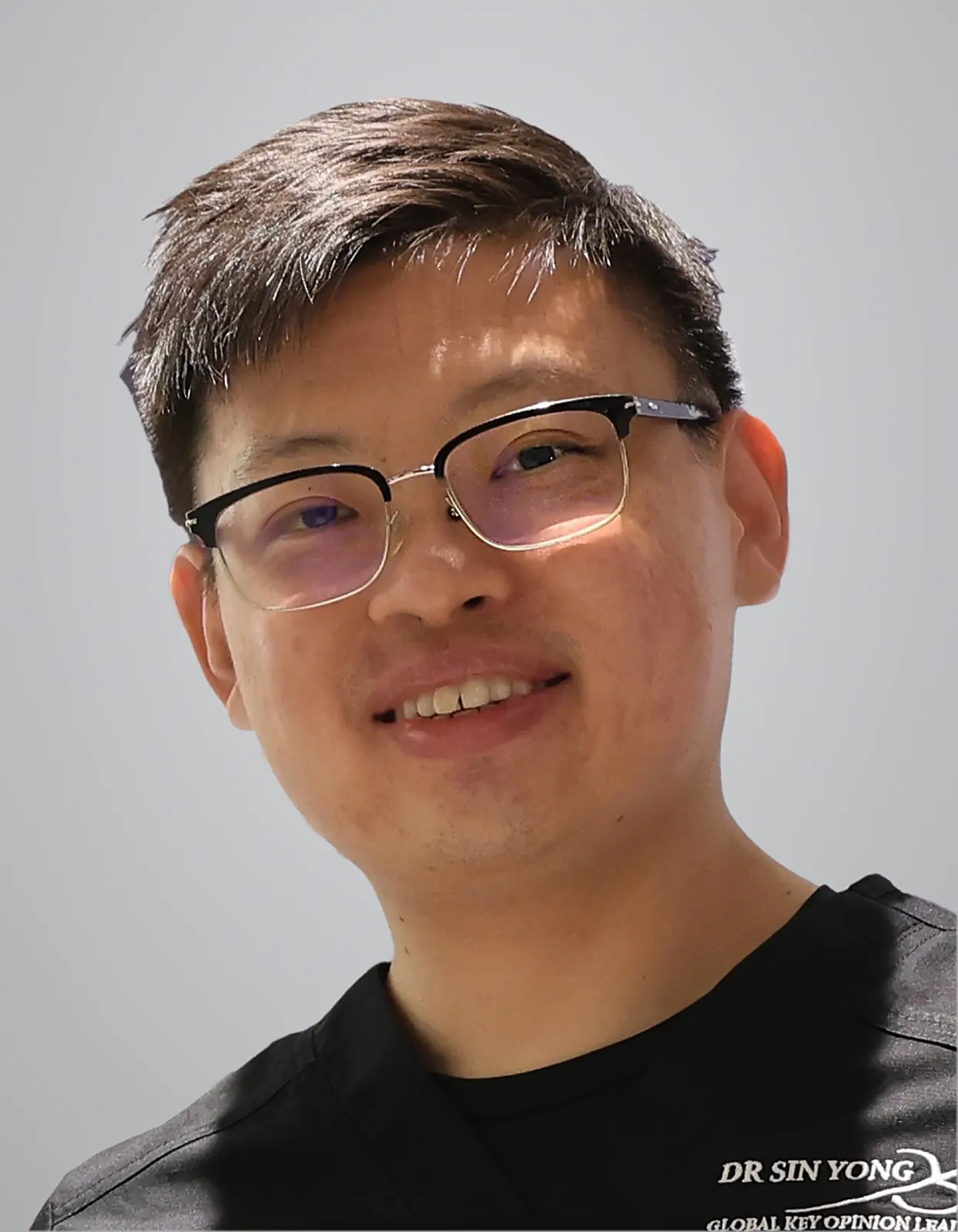
Dr Sin Yong
This treatment is performed by Dr Sin Yong, after a consultation. Dr Sin Yong is a Global Key Opinion Leader for seven device makers and has been invited to teach doctors in São Paulo, Bangkok, Seoul, Taipei, Dubai and Singapore.
Invited to present or train: DEKA Academy 2026, Florence 2026 · CLASSYS Academy, São Paulo 2026 · 7th CLASSYS APAC Symposium, Bangkok 2026
MBBS (NUS) · MRCS (Edinburgh) · MSc Aesthetic Medicine, Distinction (London) · MSc Practical Dermatology (Cardiff) · Professional Diploma in Obstetrics and Gynaecology (RCPI) · Profile · KOL brands & devices
Quick answer
- Collagen biostimulator in Singapore: a collagen stimulator injection, PLLA (such as Sculptra) or PCL (such as Ellansé), prompts your own tissue to build collagen over months. Dr Sin Yong performs them at SkinRev Lab, priced at consultation.
- Injectable PLLA and PCL work differently from hyaluronic acid filler: rather than filling a space directly, they prompt your own tissue to build collagen over months, restoring support and volume gradually.
- Used for: Sagging Face & Jowls, Hollow Cheeks & Temples.
- Performed by: Dr Sin Yong at SkinRev Lab, #B1-28 CityLink Mall (City Hall MRT).
- Book: WhatsApp SkinRev Lab on +65 8266 9585.
- Suitability, number of sessions and pricing are decided at consultation; individual results vary.
Collagen biostimulators are injectable treatments that encourage the skin and deeper tissues to make new collagen. If you are researching a collagen biostimulator in Singapore, the two main types you will come across are poly-L-lactic acid (PLLA) and polycaprolactone (PCL). Both are biocompatible, biodegradable polymers with long histories in medicine, including dissolving sutures. At SkinRev Lab, biostimulator treatment is performed by Dr Sin Yong after a full facial assessment. How these differ from HA filler is set out in collagen stimulator vs filler. The PCL product Ellansé has its own guide. How Sculptra builds collagen, and what to do about lumps, is covered on its own page.
Biostimulators are used for two related problems: loss of volume, such as hollow temples, flattened cheeks and a gaunt look after weight loss, and the loss of support that lets the lower face sag into early jowls. They are different from hyaluronic acid filler, which adds volume by occupying space the day it is injected. With a biostimulator, the change is gradual, built by your own collagen over weeks to months, which many people find looks natural because it is. A polynucleotide booster such as a Rejuran salmon DNA injection is different again: it supports skin repair and texture and does not add volume. How Radiesse stimulates collagen, and why it cannot be dissolved, is covered on its own page. The evidence on collagen drinks is reviewed separately.


Full guides: Regenerative facials in Singapore · Collagen facials in Singapore
How it works
The mechanism,
in plain English
PLLA comes as microparticles that are mixed with sterile water before treatment. Once injected, the water is absorbed within days, so any early fullness fades. The particles then trigger a controlled, low-grade tissue response: immune cells and fibroblasts gather around them and lay down new collagen, especially type I, in the extracellular matrix. As the particles slowly break down, that collagen remains. Because the effect depends on this biology, PLLA is given in measured amounts and results are judged over months.
PCL is supplied as smooth microspheres suspended in a gel carrier. The gel gives some immediate correction, then is absorbed over the following weeks while the microspheres act as a scaffold around which new collagen forms. PCL therefore combines an early visible effect with a slower collagen-driven one.
Placement depends on the problem. For volume, product is placed in deeper planes over bone or in the fat layer of the temples and cheeks. For support and skin quality in the lower face, it is spread more evenly in a fan-like pattern. Depth, dilution and technique are chosen by the doctor to suit the area.
“A biostimulator rebuilds support slowly; anyone who needs an immediate change for an event next week is better served by something else.”
— Dr Sin Yong, SkinRev Lab
- Energy / product
- Poly-L-lactic acid (PLLA) or polycaprolactone (PCL) collagen biostimulator
- Target layer
- Deep subcutaneous fat and supraperiosteal plane for volume; subdermal plane for support and skin quality
- Typical session
- About 30–45 minutes, including numbing
- Downtime
- Usually a few days of swelling, tenderness or bruising at injection points
- Performed by
- Dr Sin Yong, SkinRev Lab
Is it right for you
Who it suits,
and who it does not
Collagen biostimulators usually suit adults with gradual volume loss or early sagging who want a subtle change that builds over time: hollow temples, flattened mid-cheeks, a tired or gaunt look, early jowls from loss of deep support, or thin, crepey skin that needs more substance. They suit people who prefer not to see a sudden change, and those who have lost facial volume after weight loss. They also fit well alongside energy treatments, threads or wrinkle-relaxing injections as part of a staged plan.
Biostimulators are not suitable during pregnancy or breastfeeding, with active skin infection or inflammation in the area, with active autoimmune disease, or with a known allergy to any component. Tell the doctor about keloid scarring, bleeding disorders or blood thinners, recent dental infection and previous fillers or non-absorbable implants in the same area. They are generally not used in the lips or for very superficial lines around the eyes because of the risk of lumps. People who need an immediate result, or who are not able to return for staged sessions, may be better served by hyaluronic acid filler. Heavy sagging with excess skin is better discussed in terms of lifting or surgery.
Non-invasive alternative at SkinRev Lab
SKINLIFT® — SKINLIFT® at SkinRev Lab is a 30-minute N-pulse focused ultrasound session for the jowls, jawline and double chin, with no injections, performed by a trained therapist. It may help where early lower-face laxity is the main issue, as heat also stimulates collagen in the skin. It does not restore lost volume, so for hollow temples or flattened cheeks a biostimulator at SkinRev Lab is a different, not interchangeable, treatment. Read more: SKINLIFT® Non-Surgical Face Lift Singapore
What to expect
Consultation, session
and aftercare
Treatment begins with a consultation at SkinRev Lab. Dr Sin Yong assesses where volume and support have been lost, skin thickness and any previous injectables, and explains whether PLLA, PCL or a different option suits you. Photographs are taken, because the change is gradual and easy to forget. Risks, including bruising, lumps and the rare but serious risk of a blocked blood vessel with any injectable, are explained. A course is usually planned at consultation.
On the day, numbing cream is applied and the product is placed with a fine needle or blunt cannula. Some swelling usually appears straight away; with PLLA this early fullness goes down within a few days, which is expected. You may be advised to massage the area for a period after PLLA. Bruising, tenderness and swelling usually settle within a week. Avoid strenuous exercise, saunas and facial treatments for a few days, and attend the review so the next step can be judged properly.
Where this happens
Medical and non-invasive treatments — SkinRev Lab, CityLink Mall #B1-28, 1 Raffles Link, Singapore 039393. Underground from City Hall MRT and Esplanade MRT; a short walk from Raffles Place, Marina Bay, Suntec and Bugis. Open daily 11am–8pm. Medical treatments by Dr Sin Yong; facials and body treatments by trained therapists.
Dr Sin Yong performs medical treatments at SkinRev Lab, CityLink Mall (City Hall).
What the research says
The evidence,
with sources
The biology is supported by human tissue data. In a study of 14 adults with skin biopsies at 3, 6 and 12 months after injectable PLLA, collagen type I increased significantly at 3 and 6 months, with no or only mild inflammation. A review of PLLA's physical and chemical properties explains how particle size and chemistry drive the controlled tissue response that leads to collagen deposition. For PCL, a review describes how its microspheres, carried in a temporary gel, give immediate correction and then act as a scaffold for new collagen.
A 2025 systematic review and meta-analysis of biostimulators, including PLLA and PCL, pooled 25 studies. It found high satisfaction overall and frequent minor side effects, chiefly pain and bruising, with nodules reported in roughly 5% of treated people across pooled studies. The authors called the evidence promising but noted wide variation between studies. This is why technique, dilution, depth and patient selection matter, and why results are described as gradual and individual.
References
- Goldberg D, Guana A, Volk A, et al. Single-arm study for the characterization of human tissue response to injectable poly-L-lactic acid. Dermatol Surg. 2013;39(6):915-922.
- Fitzgerald R, Bass LM, Goldberg DJ, et al. Physiochemical characteristics of poly-L-lactic acid (PLLA). Aesthet Surg J. 2018;38(suppl_1):S13-S17.
- Christen MO, Vercesi F. Polycaprolactone: how a well-known and futuristic polymer has become an innovative collagen-stimulator in esthetics. Clin Cosmet Investig Dermatol. 2020;13:31-48.
- Smith L, Rahmati M, Pizzol D, et al. Biostimulants in aesthetic medicine: a systematic review and meta-analysis of efficacy, safety, and patient satisfaction. Aesthet Surg J. 2025;45(12):1278-1284.
Collagen stimulating injections in Singapore: four types compared with HA filler
Collagen stimulating injections, or biostimulators, leave particles that the body breaks down slowly while building collagen around them; hyaluronic acid (HA) filler holds water and fills on the day. In a 2026 randomised trial of 252 people in China, HA did better at week 4, while poly-L-lactic acid did better from week 36, after more early sessions.
Nodules are the risk to ask about: early lumps usually relate to dilution, depth or uneven placement, and rarer inflamed lumps can appear months later. Biostimulators suit gradual volume loss or early laxity in people who can return for staged sessions. At SkinRev Lab, Dr Sin Yong offers PLLA and PCL biostimulators and PDLLA skin boosters, priced at consultation; at SkinRev Lab, CityLink Mall, these include Sculptra (PLLA) and Juvelook (PDLLA).
| Type | What it is | Early effect | Points to know |
|---|---|---|---|
| Poly-L-lactic acid (PLLA) | Powder mixed with sterile water | Swelling fades within days | A series about four weeks apart; results can last up to about two years |
| Polycaprolactone (PCL) | Smooth microspheres in a gel | Some shape from the gel | Collagen then forms around the microspheres |
| Calcium hydroxylapatite (CaHA) | Mineral microspheres in a gel carrier | Some immediate lift | Results usually last 12 to 18 months |
| Poly-D,L-lactic acid (PDLLA) | A mix of the D and L forms of lactic acid | Gradual | Often placed more superficially, for skin quality; the evidence is newer |
| HA filler, for comparison | A water-binding gel | Immediate | Can be dissolved with hyaluronidase; biostimulators cannot |
Collagen biostimulator results: a month-by-month timeline
The result often appears, fades, then slowly returns. This table shows what is normal at each stage and when to contact us.
| When | What is normal | Call us if |
|---|---|---|
| Day 1 to 3 | Fullness from swelling and the carrier gel; mild tenderness or small bruises. | Swelling keeps getting worse, pain is severe, or the skin turns pale, dusky or blotchy. Call straight away. |
| Week 1 to 2 | The early fullness settles and the face may look almost as before. This is expected. | You see redness, warmth or pus at a point. |
| Week 4 to 8 | Review, and the next session if your plan has more than one. | You can feel a firm lump that was not there before. |
| Month 2 to 6 | Skin starts to look firmer and better supported, then the result settles. | One side looks clearly different from the other. |
| After a year or more | A gradual return towards your baseline as ageing continues. Maintenance is optional. | A lump appears late. Late nodules are uncommon but should be checked. |
Timings vary by product, area and person. Unlike hyaluronic acid filler, a biostimulator cannot be dissolved with an enzyme (hyaluronidase). CaHA (Radiesse) usually behaves a little differently: its gel adds some volume from the first day, so the early dip seen with PLLA is smaller. Dr Sin Yong will give you the timeline for your plan at consultation.
How collagen biostimulators fit with other treatments
A biostimulator is rarely the whole plan. It works on collagen in the deeper layers, so other treatments are often added for the surface or for lift.
| Concern | Biostimulator role | Often paired with |
|---|---|---|
| Dull, thin or dehydrated skin | Supports thickness over time | Skin boosters for surface hydration |
| Mild jowls and loss of firmness | Adds support in the mid and lower face | SKINLIFT® (from S$888 per face session, before GST) by our Aesthetic Therapists |
| A deep fold or hollow needing instant change | Slow support in the background | A small amount of HA filler, if suitable |
| Crepey neck or hands | Gradual collagen support | Neck and hand rejuvenation planned at consultation |
Treatments are usually spaced a few weeks apart rather than done on the same day. Your plan sets the order.
PLLA collagen biostimulator side effects and risks, in one table
Most side effects of PLLA injections are mild and settle within days. A few are less common and need a review. One is rare and urgent. Broadly the same risks apply to CaHA (Radiesse), which SkinRev Lab does not offer; the last column shows where it differs. Dr Sin Yong goes through each of them at consultation, before any injection.
| Effect | How often | When it shows | What happens next | CaHA (Radiesse) too? |
|---|---|---|---|---|
| Swelling, tenderness, small bruises | Common | The first few days | Settles on its own. A cold compress helps; Dr Sin Yong will advise how long to avoid hard exercise and alcohol. | Yes |
| Early fullness that fades | Common | The first one to two weeks | Expected. The carrier fluid is absorbed before new collagen builds. | Less so: its gel gives volume from day one, and part of it stays while collagen builds |
| Small lumps you can feel but not see | Uncommon | Weeks to months later | Book a review. Many soften with time; some need treatment. | Yes; neither can be dissolved with an enzyme |
| Visible nodules or uneven areas | Uncommon to rare | Months later, sometimes after a year | Book a review promptly. Treatment depends on the type of lump. | Yes |
| Infection | Rare | Days after treatment | Redness, heat, pain or pus: contact us the same day. | Yes |
| Product entering a blood vessel | Rare but serious | During or soon after | Pale, dusky or blotchy skin, or severe pain: call straight away. | Yes |
Lumps are more likely when product sits too close to the surface, in thin-skinned areas, or when it is mixed or spread unevenly. Careful dilution, depth and spacing lower this risk, but cannot remove it.
Common questions
Your questions,
answered
Is Sculptra a collagen biostimulator?
Yes. Sculptra is a well-known brand of poly-L-lactic acid (PLLA), one of the two main biostimulator types explained on this page; PCL products work on a similar principle. Which product is used, and whether a biostimulator suits you at all, is decided by Dr Sin Yong at SkinRev Lab after assessing your skin and volume loss. At SkinRev Lab these include Sculptra (PLLA) and Juvelook (PDLLA).
How much does a collagen biostimulator in Singapore cost?
Pricing for collagen biostimulators is given at consultation at SkinRev Lab. It depends on the product chosen, the amount needed for your areas and how the treatment is staged. Because the effect builds gradually, Dr Sin Yong explains the whole plan and its fees up front rather than session by session, so you know what you are committing to before you begin.
What is the difference between a biostimulator and filler?
Hyaluronic acid filler adds volume directly, so the change is visible the same day, and it can be dissolved if needed. A biostimulator prompts your own tissue to make collagen, so the change appears gradually over weeks to months. PCL gives some early correction from its gel carrier; PLLA's early swelling fades before the collagen effect builds. Biostimulators cannot be dissolved in the same way, which makes careful planning important.
PLLA or PCL — which is right for me?
Both stimulate collagen, but they behave differently. PLLA is diluted and spread over an area, with no lasting immediate effect, and suits gradual, broad restoration of support and skin quality. PCL has a gel carrier that gives some immediate shape and suits more defined correction. The choice depends on your anatomy, the area, your timeline and previous treatments, and is made by Dr Sin Yong at consultation.
When will I see results?
With PLLA, initial swelling settles within days, and most people notice gradual improvement over the following weeks to few months as collagen forms. With PCL, some correction is visible straight away from the gel, then the collagen effect develops. Results vary with age, skin quality, metabolism and lifestyle. Review visits are built into the plan so that each next step is based on how your tissue has actually responded.
What are the risks of collagen biostimulators in Singapore?
Common effects are swelling, tenderness and bruising for several days. Small lumps or nodules can occur, more often with superficial placement or incorrect dilution, and sometimes need treatment. As with any injectable, there is a rare but serious risk of product entering a blood vessel, which is why anatomy, technique and an experienced injector matter. Dr Sin Yong explains these risks and the warning signs before treatment.
Can biostimulators help with jowls and sagging?
They can help where sagging is driven partly by lost deep support and thinning skin, because new collagen improves structure and firmness. They do not lift heavy, loose skin, and they work more slowly than threads or energy treatments. For many faces, a combined plan works better — for example, a biostimulator for support with energy-based tightening — and Dr Sin Yong will explain the order and spacing.
How common are lumps or nodules after collagen biostimulators?
Nodules are a known side effect: a 2025 meta-analysis pooling 25 studies reported them in roughly 5% of treated people. They are more likely with superficial placement or incorrect dilution, which is why biostimulators are generally not used in the lips or for very superficial lines around the eyes. Unlike hyaluronic acid filler, biostimulators cannot be dissolved in the same way, and some nodules need treatment. Dr Sin Yong explains these risks at SkinRev Lab before treatment.
How long do collagen biostimulator results last?
There is no fixed duration: in a randomised study of PLLA for nasolabial folds, improvement was reported up to 25 months after the last treatment. The change builds gradually as your own collagen forms, and that collagen remains as the particles slowly break down; a course usually needs more than one session. How long it holds varies with age, skin quality, metabolism and lifestyle. Dr Sin Yong plans the course at SkinRev Lab, where it is priced at consultation.
Who should not have collagen biostimulators?
Collagen biostimulators are not suitable during pregnancy or breastfeeding, with active skin infection or inflammation in the area, with active autoimmune disease, or with a known allergy to any component. Tell the doctor about keloid scarring, bleeding disorders or blood thinners, recent dental infection, and previous fillers or non-absorbable implants in the same area. If you need an immediate result, hyaluronic acid filler may suit better. Dr Sin Yong assesses this at SkinRev Lab.
What is a biostimulator filler?
A biostimulator is an injectable, such as poly-L-lactic acid (PLLA) or polycaprolactone (PCL), that prompts the skin to make its own collagen over weeks to months, rather than adding volume straight away like hyaluronic acid filler. At SkinRev Lab it is performed by Dr Sin Yong and priced at consultation.
What does a PLLA biostimulator treatment in Singapore involve?
Dr Sin Yong first assesses where support has been lost, then injects diluted poly-L-lactic acid (PLLA) in small amounts at the planned depth. Change builds over weeks to months, commonly across two to four sessions spaced several weeks apart, and PLLA cannot be dissolved. At SkinRev Lab, CityLink Mall, it is priced at consultation.
What is a collagen stimulator?
A collagen stimulator is an injectable, such as poly-L-lactic acid or polycaprolactone, that triggers your own tissue to make collagen over months. Unlike hyaluronic acid filler, the result builds slowly and it cannot be dissolved, so dosing and placement matter.
Which collagen biostimulator in Singapore does SkinRev Lab offer?
Dr Sin Yong offers poly-L-lactic acid (Sculptra) and PDLLA (Juvelook) as collagen biostimulator injections at SkinRev Lab, CityLink Mall, priced at consultation. Calcium hydroxylapatite and polycaprolactone products are described on this page for comparison.
Related