Medical Treatments · Face Lifting · Dr Sin Yong
LCLR Laser in Singapore: Time Freeze Laser LCLR®
A dual-wavelength laser protocol that uses controlled heat to firm skin along the jowls and jawline and to remodel small pockets of fat under the chin. Gradual change, little downtime, no incisions.
By Dr Sin Yong, medical adviser · Updated 21 November 2026
Doctor-led · City Hall
Time Freeze Laser LCLR® with Dr Sin Yong
Assessment first
Dr Sin Yong examines the area and explains which options suit it.
Performed by Dr Sin Yong
Medical treatments at SkinRev Lab are carried out by Dr Sin Yong, medical adviser.
Priced at consultation
The fee is explained before any treatment, so the decision stays with the patient.
Results vary from person to person.
Main guide: Jowls treatment in Singapore
Medically reviewed by Dr Sin Yong, medical adviser · Last reviewed 16 November 2026
LCLR laser (Laser Collagen Lipo Remodelling) is the Time Freeze Laser LCLR® protocol: a long-pulsed laser treatment using 755 nm and 1064 nm heat for loose skin along the jowls, jawline and neck and small fat pockets under the chin, without incisions. At SkinRev Lab, CityLink Mall (City Hall MRT), Dr Sin Yong, medical adviser, performs it, priced at consultation.
This page is part of our guide to body contouring treatment in Singapore and face lifting treatment in Singapore: every related page, in one place.
LCLR laser: key facts
| Fact | Detail | Source |
|---|---|---|
| How laser tightening works | Some lasers send heat deep into the skin without wounding the top layer of the skin. | American Academy of Dermatology, 2026 |
| Sessions and when change shows | You may need 3 to 5 treatments; results gradually appear between 2 and 6 months after the last treatment. The ASDS notes the number varies by device, area and patient, and results can often take at least 3–6 months. | American Academy of Dermatology, 2026; ASDS, Non-invasive skin tightening, 2026 |
| Downtime | Redness typically resolves within a few hours; swelling or bruising, if it occurs, can last up to 1–2 weeks; many patients return to normal activities later that day or the next day. | ASDS, Non-invasive skin tightening, 2026 |
| Who it suits | It suits people with a small amount of sagging skin; with lots of sagging skin, skin tightening may not be helpful. Not for anyone who is pregnant, has a skin infection or takes certain medications. | American Academy of Dermatology, 2026 |
| Fat under the chin: what a study measured | In 42 subjects given a single treatment with a combined 1060 nm and 635 nm laser device, ultrasound fat thickness fell by 26.4% under the chin and 18.62% on the abdomen at 12 weeks; mild to moderate tenderness subsided within 1 to 3 weeks. | Moon et al., Lasers Med Sci 2022 |
| Main risks | Common: swelling, bruising and redness. Uncommon: skin burns, infection, numbness, muscle weakness, inflammatory or allergic reactions and contour changes. | ASDS, Non-invasive skin tightening, 2026 |
| Cost at SkinRev Lab | Priced at consultation. | SkinRev Lab |
| Who performs it at SkinRev Lab | Dr Sin Yong, medical adviser, who sets the 755 nm and 1064 nm long-pulsed laser for each zone; about 45 minutes for full face and neck; change builds over four to eight weeks; fat-targeted zones may be tender for 1–2 days. | SkinRev Lab |
At a glance
| Performed by | Dr Sin Yong, Global Key Opinion Leader for CLASSYS, DEKA, Fotona, Alma, HIRONIC, ilooda and Lutronic · MBBS (Singapore), MRCS (Edinburgh), MSc Practical Dermatology (Cardiff), Professional Diploma in Obstetrics and Gynaecology (RCPI) |
|---|---|
| Where | SkinRev Lab, #B1-28 CityLink Mall (City Hall MRT) |
| Before treatment | A consultation and examination by Dr Sin Yong |
| Price | Priced at consultation |
| Book | WhatsApp +65 8266 9585 · daily, 11am to 8pm |
Ask about Time Freeze clinical cases
Clinical photographs are not shown on this website. If you would like to see clinical case photographs of Time Freeze Laser LCLR® from Dr Sin Yong's practice, ask us on WhatsApp and our team will send them to you privately as a one-page PDF. Every route for nasolabial fold treatment, matched to the cause, is compared on our main page. How it compares with microliposuction is explained separately.
The cases are shared with each patient's consent and for information only. Every face is different, results vary, and the photographs are not a prediction of your result; Dr Sin Yong explains what is realistic for your own face at consultation.
I want to see Time Freeze clinical cases
Opens WhatsApp to +65 8023 7170 with your request written in. Our team replies with the PDF.
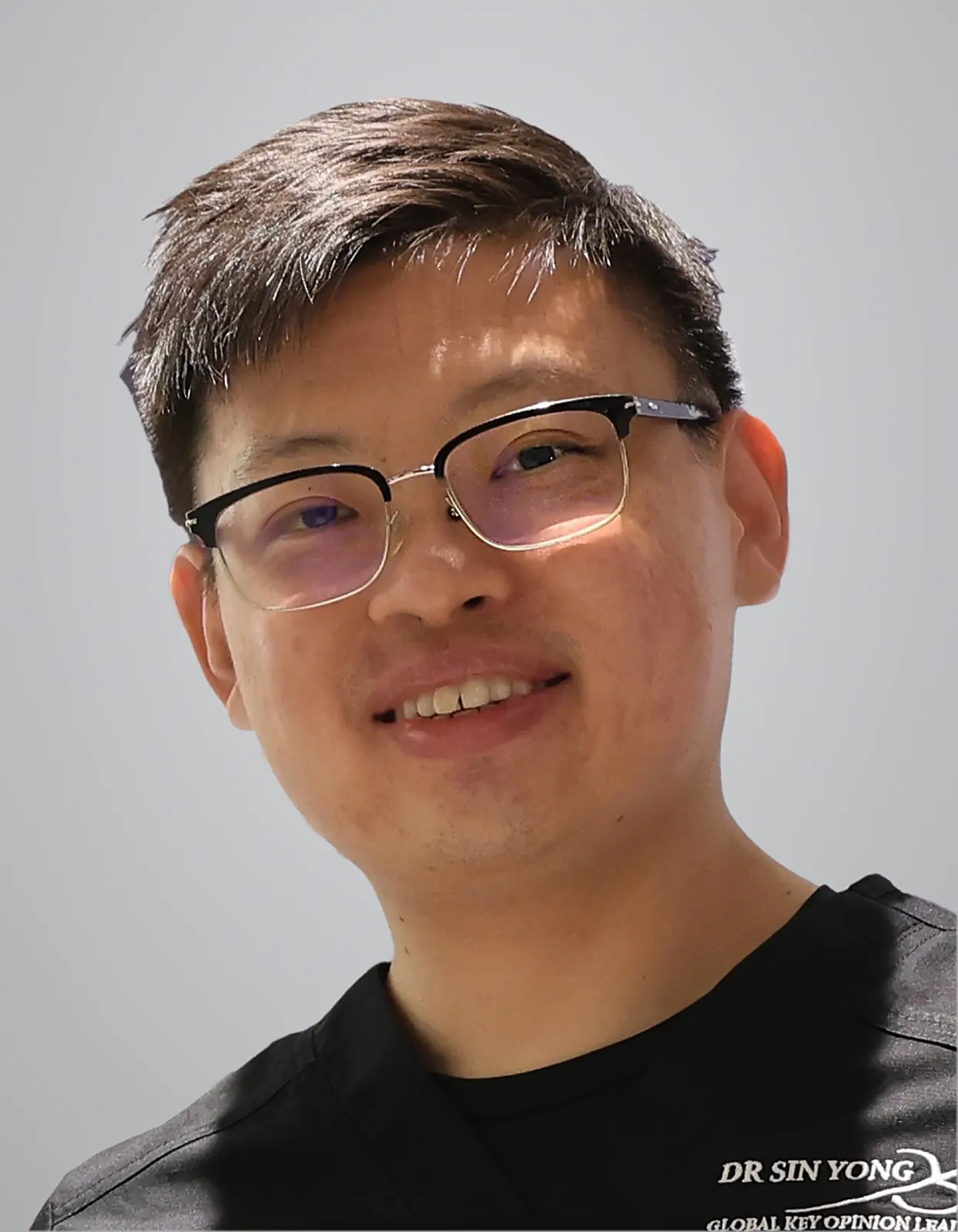
Your doctor
Dr Sin Yong
This treatment is performed by Dr Sin Yong, after a consultation. Dr Sin Yong is a Global Key Opinion Leader for seven device makers and has been invited to teach doctors in São Paulo, Bangkok, Seoul, Taipei, Dubai and Singapore.
Invited to present or train: DEKA Academy 2026, Florence 2026 · CLASSYS Academy, São Paulo 2026 · 7th CLASSYS APAC Symposium, Bangkok 2026
MBBS (NUS) · MRCS (Edinburgh) · MSc Aesthetic Medicine, Distinction (London) · MSc Practical Dermatology (Cardiff) · Professional Diploma in Obstetrics and Gynaecology (RCPI) · Profile · KOL brands & devices
The device is a tool: why planning and technique matter
Dr Sin Yong explains it to patients this way. In surgery, how neatly a wound heals depends not only on the suture material but on how it is placed. Laser and injectable treatments follow the same principle.
Energy devices and fillers are no different. The same device or product can be used in different ways: where the energy or product goes, how much, at what depth and in what order all affect how the skin responds. This is why settings are planned for each face, and why filler depth matters, since filler placed in an unsuitable layer can cause bulges or uneven folds.
Time Freeze Laser LCLR® is Dr Sin Yong's protocol rather than a fixed setting. Dr Sin Yong maps each face first, separating loose skin, fat, excess filler and bone support, then sets the two wavelengths and the passes zone by zone for that face. Results still vary from person to person.
Signature protocol · Dr Sin Yong
One of the ten signature protocols developed by Dr Sin Yong, SkinRev Lab's doctor, and performed by Dr Sin Yong at SkinRev Lab. All signature treatments → · On Dr Sin Yong's website →
Quick answer
- LCLR laser: LCLR stands for Laser Collagen Lipo Remodelling. A Time Freeze LCLR facelift uses laser heat to firm the jowls, jawline, neck and double chin and to remodel small fat pockets, and it is a no-thread alternative to a thread lift for some faces.
- A dual-wavelength laser protocol that uses controlled heat to firm skin along the jowls and jawline and to remodel small pockets of fat under the chin. Gradual change, little downtime, no incisions.
- Used for: Sagging Face & Jowls, Double Chin.
- Performed by: Dr Sin Yong at SkinRev Lab, #B1-28 CityLink Mall (City Hall MRT).
- Book: WhatsApp SkinRev Lab on +65 8266 9585.
- Suitability, number of sessions and pricing are decided at consultation; individual results vary.
Watch · Dr Sin Yong explains
Time Freeze Laser LCLR® is Dr Sin Yong's laser skin-tightening protocol, performed at SkinRev Lab. LCLR stands for Laser Collagen Lipo Remodelling, which describes its two jobs: tightening skin through collagen, and remodelling small areas of fat. If you are comparing Time Freeze Laser in Singapore with other lifting options, the key difference is the energy source — this is a laser scanned across a treatment zone, rather than focused ultrasound points or radiofrequency.
It is used most often on the lower face, for early jowls, a softening jawline and a double chin where both loose skin and a little fat are involved, and Dr Sin Yong also uses it on the neck, the upper-eyelid and under-eye skin, and body areas such as the arms, abdomen and thighs. The protocol runs on a long-pulsed 755 nm and 1064 nm laser platform, with both wavelengths set by the doctor for each zone. As with any energy-based treatment, the change builds over weeks and is modest. It does not remove excess skin, it is not a substitute for liposuction, and it will not replace a surgical facelift for heavy sagging.


How it works
The mechanism,
in plain English
Time Freeze LCLR® uses long-pulsed 755 nm and 1064 nm laser light. The 755 nm wavelength is absorbed mainly by melanin and blood, and the 1064 nm wavelength passes deeper and warms the dermis as a whole; both turn light into heat in the tissue. When dermal collagen is warmed to the right range, its fibres shorten and tighten — the immediate firming some people feel on the day. The heat also acts as a controlled injury signal: over the next four to eight weeks, fibroblasts lay down new collagen, which is where most of the lasting change comes from. Deeper volumetric heating of the dermis is the principle shared by laser, infrared and RF tightening devices.
Time Freeze LCLR® is not a fractional laser. Fractional lasers heat the skin in thousands of microscopic columns with untreated skin in between; Time Freeze instead delivers long-pulsed bulk heating, scanned across a zone, so the skin surface is not broken. That also differs from HIFU, which places isolated focal points of heat at set depths.
For the lipo-remodelling part, controlled heat is directed at selected fat zones, such as under the chin. Fat cells are more sensitive to sustained heat than skin, and those that are damaged are cleared gradually by the body over weeks. This is a contouring effect on small, pinchable areas, not weight loss.
“A laser can firm the skin and trim a small pocket of fat; it cannot take away a fold of loose skin or replace lost bone and volume.”
— Dr Sin Yong, SkinRev Lab
- Energy / product
- Long-pulsed 755 nm and 1064 nm laser energy delivered as a scanning protocol (Time Freeze Laser LCLR®)
- Target layer
- Superficial to deep dermis for collagen; superficial fat in selected lipo-remodelling zones
- Typical session
- About 45 minutes for full face and neck
- Downtime
- Usually none — the skin surface is not broken and warmth fades within minutes; zones where fat was targeted may feel tender for a day or two
- Performed by
- Dr Sin Yong, SkinRev Lab
Is it right for you
Who it suits,
and who it does not
Time Freeze Laser LCLR® usually suits adults with early to moderate laxity along the jowls and jawline, a mildly loose neck, or a double chin made up of soft, pinchable fat with some skin looseness. It suits people who want gradual, natural-looking change with little time off, who prefer to avoid needles, or who have tried focused ultrasound and want a different kind of heating. It can also be part of a wider plan with injectables or other energy treatments, decided at consultation.
This treatment is not suitable during pregnancy, over active infection, open wounds, cold sores or inflamed skin in the area, or soon after significant sun exposure or a tan. Tell the doctor about melasma, a tendency to dark marks after inflammation, keloid scars, photosensitising medicines, recent fillers or threads, and any history of laser burns. A double chin that is mainly due to a short jaw, low chin position, large neck glands or a heavy band of muscle will not respond well to a skin-and-fat laser. Heavy jowls with folded skin are better discussed in terms of surgical options.
Non-invasive alternative at SkinRev Lab
SKINLIFT® — SKINLIFT® at SkinRev Lab is a 30-minute N-pulse focused ultrasound lifting session for the jowls, jawline and double chin, done without a doctor. It is a sensible starting point for early change or maintenance. It uses ultrasound rather than laser, does not include a medical assessment of fat, muscle and bone, and is not a substitute for a doctor-planned laser protocol when laxity or fat is more established. Read more: SKINLIFT® Non-Surgical Face Lift Singapore
What to expect
Consultation, session
and aftercare
Treatment starts with a consultation at SkinRev Lab. Dr Sin Yong examines the jawline and neck to separate skin laxity, fat, muscle and bone structure, because each needs a different approach. Dr Sin Yong checks your skin type and pigment history to set the laser safely for your skin. Photographs are taken for later comparison, and a course is usually planned at consultation with spacing between sessions.
On the day, the skin is cleansed and eye protection is worn. The laser is passed across each zone in a planned sequence; most people feel waves of heat, with the lipo-remodelling areas feeling warmer. Warmth in the treated zones fades within minutes, and the skin is not left red or broken. Zones where fat was targeted may feel tender for a day or two. Most people go back to work the same day. Strict sun protection matters for the following weeks, and it is wise to skip saunas or very hot exercise until the skin settles.
Where this happens
Medical and non-invasive treatments — SkinRev Lab, CityLink Mall #B1-28, 1 Raffles Link, Singapore 039393. Underground from City Hall MRT and Esplanade MRT; a short walk from Raffles Place, Marina Bay, Suntec and Bugis. Open daily 11am–8pm. Medical treatments by Dr Sin Yong; facials and body treatments by trained therapists.
Dr Sin Yong performs medical treatments at SkinRev Lab, CityLink Mall (City Hall).
What the research says
The evidence,
with sources
Time Freeze Laser LCLR® is a clinic protocol, and no published study has tested this exact protocol, so the evidence here supports the principles it uses rather than the branded treatment. A review of deep heating for skin rejuvenation explains how volumetric heating of the deep dermis, by laser-type infrared light or RF, is used for non-surgical tightening, while stressing patient selection and realistic expectations. The original study of fractional photothermolysis is listed for contrast: it showed tightening from microscopic thermal columns, whereas Time Freeze uses long-pulsed bulk heating that leaves the surface intact.
In a small split-face study, a single high-fluence treatment with a long-pulsed 1064 nm laser improved facial laxity at least as much as an RF device, though the author called for larger studies. For fat, a clinical study of a non-invasive 1060 nm laser device found ultrasound-measured reductions in submental and abdominal fat 12 weeks after one session, with transient tenderness as the main side effect. Together, these support modest, gradual tightening and contouring, with individual results varying.
References
- Dierickx CC. The role of deep heating for noninvasive skin rejuvenation. Lasers Surg Med. 2006;38(9):799-807.
- Manstein D, Herron GS, Sink RK, et al. Fractional photothermolysis: a new concept for cutaneous remodeling using microscopic patterns of thermal injury. Lasers Surg Med. 2004;34(5):426-438.
- Key DJ. Single-treatment skin tightening by radiofrequency and long-pulsed, 1064-nm Nd: YAG laser compared. Lasers Surg Med. 2007;39(2):169-175.
- Moon IJ, Choi JW, Jung CJ, et al. Efficacy and safety of a novel combined 1060-nm and 635-nm laser device for non-invasive reduction of abdominal and submental fat. Lasers Med Sci. 2022;37(1):505-512.
Long-pulsed 1064 nm laser for wrinkles and laxity: what studies measured
The 1064 nm wavelength used in Time Freeze Laser LCLR® has been studied for wrinkles and skin quality in Asian patients, with measurable but gradual change. Both studies used other long-pulsed or near-infrared 1064 nm settings, not the LCLR® protocol itself:
| Study | Who and how | What was found |
|---|---|---|
| Hong et al., 2015 | 20 Korean participants; one side of the face treated; three sessions 4 weeks apart, three passes each | Wrinkle grades on the treated side fell by an average of 45.1% four weeks after the last session; pain was mild and no anaesthetic was needed |
| Tanaka et al., 2011 | 50 Japanese patients treated with a near-infrared 1064 nm laser; skin samples from 4 volunteers | Measures of pores, texture and wrinkles all improved significantly; elastin rose by day 30 and was still raised at day 90; 96% or more of volunteers reported satisfaction; no treatment-related side effects |
Neither study measured jowl lift or fat, and both were small. The change built over weeks, in line with the four to eight weeks over which collagen change is described on this page. At SkinRev Lab, the 755 nm and 1064 nm settings for each zone are chosen by Dr Sin Yong, medical adviser, and treatment is priced at consultation.
Zones Dr Sin Yong treats: jowls, folds, jawline, neck and chin
Dr Sin Yong uses Time Freeze Laser LCLR® across the lower face and neck, and each zone is planned for what it needs rather than treated with one setting.
- Jowls: skin and soft tissue that have started to drop over the jaw. Heat is aimed at tightening, with fat reduction added where a soft pad sits in the jowl.
- Jawline: a blurred line between jaw and neck. Tightening along the jaw is often planned together with the jowl and under-chin zones.
- Nasolabial folds: the lines from nose to mouth, which deepen as the cheek descends. Tightening the cheek and the skin beside the fold may help soften it; a deep fold caused mainly by volume loss may need another route (see nasolabial folds treatment).
- Double chin: soft, pinchable fat with some loose skin, treated for fat and tightening together (see double chin).
- Neck: mild looseness and crepey skin. Vertical muscle bands and neck glands do not respond to laser heat.
At consultation Dr Sin Yong shows you which zones the doctor would treat and which the doctor would leave alone.
Sagging and loose fat treated in the same session
Sagging and loose fat often sit in the same place. A jowl is usually a mix of loosened skin and a soft fat pad, and a double chin is often soft fat under skin that has lost some spring. Tightening alone can leave the fat behind, and reducing fat alone can leave the skin looking looser.
With Time Freeze LCLR®, Dr Sin Yong treats both in one session. The laser is used in two ways: bulk heating of the dermis, without breaking the surface, for tightening; and heat directed into selected fat zones for gradual reduction. Heat-affected fat cells are thought to be cleared by the body over the following weeks, and new collagen builds over four to eight weeks; how much change you see varies.
This is contouring of small, soft fat pockets, not weight loss. Fat zones may feel tender for a day or two. Where the fat is large or firm, Dr Sin Yong will tell you that liposuction is the better fit.
Reducing excess filler with Time Freeze LCLR®
Dr Sin Yong also uses Time Freeze LCLR® to reduce excess filler in areas that look overfilled, such as the lower cheeks, jowls and around the mouth. Part of the change can often be seen on the day, with more over the following weeks; results vary. The signs to look for are listed under overfilled face.
What was injected matters:
- Hyaluronic acid filler can also be dissolved with an enzyme, hyaluronidase. Dr Sin Yong discusses both options with you, and dissolving is often the more direct route for a single defined lump (see dissolving filler).
- Collagen stimulators, such as poly-L-lactic acid or calcium hydroxylapatite, cannot be dissolved with an enzyme, so heat-based remodelling is one of the few non-surgical options (see collagen biostimulators).
Bring the product name, the areas and the dates if you have them. Lumps that are hard, red, painful or growing need medical review, not laser. No published trial has tested Time Freeze as a protocol for reducing filler, so this is Dr Sin Yong's clinical approach, explained to you before you decide. How the enzyme route works is explained under dissolve filler Singapore.
Time Freeze LCLR® or micro-liposuction?
Time Freeze LCLR® is used where some people might otherwise consider micro-liposuction for small, soft fat under the chin or along the jaw. It removes less fat than liposuction and is not a substitute for it when the fat is large.
| Time Freeze LCLR® | Micro-liposuction | |
|---|---|---|
| Incision | None; the skin surface is not broken | Small entry points for a fine cannula |
| Anaesthetic | No general anaesthetic | Local anaesthetic with fluid infiltrated into the fat; sometimes sedation |
| Downtime | Usually none; fat zones tender for 1–2 days | Swelling, bruising and a compression garment, often for one to two weeks |
| How much fat | Small, soft pockets, reduced gradually over weeks | More fat removed in one procedure |
| Skin tightening | Collagen is heated in the same session | Not the aim; relies on the skin's own recoil |
| Its own risks | Temporary pigment change, more likely in Asian skin; tenderness for a day or two; rare burns or blisters | Bruising, swelling, uneven contour, infection, temporary numbness; rarely, injury to the nerve that moves the lower lip |
Dr Sin Yong advises which route fits at consultation. For the surgical side, read chin liposuction versus non-surgical options.
How a Time Freeze course is planned
A Time Freeze course is planned at consultation, not set in advance as a fixed number of sessions. Dr Sin Yong examines skin, fat, muscle and bone, checks your pigment and medication history, and takes photographs so change can be compared later under the same light.
Dr Sin Yong then sets out:
- which zones are treated, and in what order of priority;
- whether tightening, fat reduction or filler remodelling is the main aim in each zone;
- how far apart sessions are spaced, so each has time to build over four to eight weeks;
- when the review is, and what would lead Dr Sin Yong to stop or change the plan.
Because collagen and fat changes are gradual, results are judged against your photographs at review rather than in the mirror on the day. The price is given at consultation, once the plan is clear.
Alternatives
Time Freeze Laser LCLR or a thread lift?
Dr Sin Yong performs both face thread lifts and Time Freeze Laser LCLR, so the choice is made on your face, not on what is available. The two work in different ways.
| Thread lift (Bliss Lift) | Time Freeze Laser LCLR | |
|---|---|---|
| How it works | Absorbable cog threads reposition descended tissue | Laser heat tightens skin and remodels small fat zones |
| Matched to | Tissue that has slid down | Loose skin and small fat pockets along the jaw and chin |
| Needles or threads | Yes, under local anaesthetic | No threads or incisions |
| Recovery | A few days of swelling or bruising | Redness and warmth on the day, usually |
| When change shows | Lift on the day, settles over weeks | Builds over four to eight weeks |
Some faces need both, in sequence. See thread lift in Singapore for how threads are planned.
Laser fat reduction under the chin: how long does it last?
Laser heat can thin a small pocket of fat under the chin, but in one pilot study the measured change had faded by six months. Twenty people with localised fat under the chin had a single session of a 1060 nm diode laser, and fat thickness was measured by ultrasound (Wanitphakdeedecha et al., 2022):
| When | What was found |
|---|---|
| Who took part | Mean age 34.6; 95% women |
| During treatment | Mean pain 3.9 out of 10, with energy adjusted to each person's tolerance |
| 3 months | Fat thickness significantly reduced |
| 6 months | Fat thickness slightly higher again; the change from baseline was no longer significant |
| 6 months, patients' view | Most still reported improvement |
| Side effects | No severe adverse events |
This was a small pilot study of a different device from the long-pulsed 755 nm and 1064 nm laser in Time Freeze Laser LCLR®, so it describes laser fat reduction in general, not LCLR® results. It does suggest judging any change in chin fat over months, not weeks.
Questions people ask about Time Freeze Laser
How much does Time Freeze Laser in Singapore cost?
Time Freeze Laser is priced at consultation at SkinRev Lab, because the cost depends on which zones are treated, whether fat or filler is part of the plan and how sessions are spaced. Dr Sin Yong examines you first and gives you the price before anything is done, so you can decide without pressure.
What is Time Freeze Laser LCLR?
Time Freeze Laser LCLR® is a doctor-performed laser treatment. LCLR stands for Laser Collagen Lipo Remodelling: long-pulsed 755 nm and 1064 nm light heats the skin in bulk to tighten collagen and heats selected fat zones for gradual reduction. It involves no incisions and little downtime, and it does not remove excess skin or replace a facelift.
How is Time Freeze Laser different from HIFU?
HIFU focuses ultrasound at fixed points and depths under the skin. Time Freeze scans laser heat evenly across a wider zone of the dermis without breaking the surface, and it can also heat selected fat. Dr Sin Yong chooses between them by skin thickness, where the fat sits and how you tolerate heat; some people suit both.
Can Time Freeze Laser in Singapore treat a double chin?
It can help when a double chin is soft, pinchable fat with some loose skin, because fat reduction and tightening are done in the same session. It will not correct a double chin caused by a set-back chin, jaw shape, neck glands or muscle bands. Dr Sin Yong examines the area first and tells you which applies.
How is Time Freeze set for darker or Asian skin?
Settings are adjusted to your skin type, because heat can trigger temporary dark marks, especially if you are prone to melasma or post-inflammatory pigmentation. Dr Sin Yong takes a full pigment and medication history first and does not treat over a fresh tan. Strict sun protection before and after treatment lowers the chance of marks.
When will I see results?
Some firmness may be noticed soon after treatment, but most of any change builds over four to eight weeks as new collagen forms and heat-affected fat is gradually cleared. Where excess filler is treated, part of the change can often be seen on the day, with more over the following weeks. Results vary with age, skin quality and weight stability.
Can Time Freeze Laser reduce excess filler on the same day?
Dr Sin Yong uses it this way, and part of the change can often be seen on the day, with more over the following weeks; results vary. Dr Sin Yong uses it for hyaluronic acid filler and collagen stimulators, which no enzyme reliably dissolves. No published trial has tested Time Freeze for this, and Dr Sin Yong also explains dissolving for hyaluronic acid.
Is Time Freeze Laser an alternative to micro-liposuction?
For small, soft fat under the chin or along the jaw, it can be. There is no incision, cannula or general anaesthetic, there is usually little downtime, and skin tightening is done in the same session. It removes less fat than liposuction, has its own risks such as temporary pigment change, and does not replace liposuction for large fat.
Can Time Freeze Laser treat nasolabial folds?
It may help soften nasolabial folds in suitable people by tightening the cheek and the skin beside the fold, as part of treating the lower face. A deep fold caused mainly by volume loss may need filler or another route instead. Dr Sin Yong examines why the fold has deepened before suggesting what to treat.
Can Time Freeze Laser tighten the neck?
It is used for mild looseness and crepey skin on the neck, and for soft fat under the jaw, with change building over four to eight weeks. It does not treat vertical muscle bands, neck glands or heavy folded skin; those need a different plan. Dr Sin Yong examines the neck before including it.
How many Time Freeze LCLR sessions will I need?
There is no fixed number: Dr Sin Yong, medical adviser, plans the course at consultation, with sessions spaced apart, and change builds over four to eight weeks after each. For laser skin tightening in general, the American Academy of Dermatology says you may need 3 to 5 treatments, with results appearing 2 to 6 months after the last.
Is there downtime after Time Freeze LCLR?
Usually none. Most people return to work the same day; zones treated for fat may feel tender for a day or two. For non-invasive skin tightening in general, the ASDS says redness typically resolves within a few hours, and swelling or bruising, if it occurs, can last up to 1–2 weeks.
Does Time Freeze LCLR® give a microliposuction-like effect?
Yes, that is how SkinRev Lab uses it: Dr Sin Yong applies Time Freeze Laser LCLR® for a microliposuction-like effect on small, soft fat under the chin and along the jaw, without incisions, cannulas or general anaesthetic. Fat reduces gradually over weeks. It removes less fat than liposuction and is not a substitute for it when the fat is large.
Does laser fat reduction under the chin last?
Not always on its own. In a pilot study of 20 people given one session of a 1060 nm diode laser, fat under the chin was significantly thinner at 3 months, but by 6 months the change from baseline was no longer significant, although most still reported improvement (Wanitphakdeedecha et al., 2022).
What did studies of long-pulsed 1064 nm laser find for wrinkles?
Gradual improvement. In 20 Korean participants treated on one side of the face, three sessions four weeks apart reduced wrinkle grades by an average of 45.1% four weeks after the last session (Hong et al., 2015). In 50 Japanese patients, pore, texture and wrinkle measures improved (Tanaka et al., 2011).
Is long-pulsed laser tightening painful?
Usually only mildly. In a split-face study of long-pulsed 1064 nm laser for wrinkles, pain was mild and no anaesthetic was needed (Hong et al., 2015), and in a 1060 nm laser study for chin fat the mean pain score was 3.9 out of 10 (Wanitphakdeedecha et al., 2022).
Time Freeze Laser in Singapore: how it differs from other lasers
Short answer: Time Freeze LCLR® heats deep tissue with long-pulsed 755 nm and 1064 nm light while the skin surface stays intact, so downtime is short. Resurfacing lasers break the surface and need days to heal. The name alone does not tell you which kind of laser you are getting, so ask for the wavelength and whether the surface is broken.
| Treatment | What it aims to do | Skin surface | Usual downtime | Typical use |
|---|---|---|---|---|
| Time Freeze LCLR® (long-pulsed 755 nm and 1064 nm) | Gentle deep heating to tighten and reduce small areas of loose fat | Stays intact | Little; warmth or redness for hours, tender fat zones for a day or two | Jowls, jawline, under the chin, neck |
| Fractional resurfacing laser, such as fractional CO2 (10,600 nm) | Makes tiny columns of injury so the skin remodels | Broken in tiny dots | Several days of redness and flaking | Acne scars and rough texture |
| Pigment laser | Breaks up pigment in spots and patches | Stays intact or nearly so | Hours to a few days | Sun spots; melasma only with caution |
| Focused ultrasound (HIFU), for comparison | Heats deeper layers with sound energy, not light | Stays intact | Little; tenderness for a few days in some people | Jowls and brow, as a different heating method |
Which treatment suits you depends on the problem, not the device. Dr Sin Yong explains the choice at consultation. Time Freeze LCLR® is priced at consultation.
Time Freeze Laser downtime and results, week by week
Most people go back to work the same day. Change is gradual, so it helps to know what is normal at each stage. This is the usual pattern; Dr Sin Yong gives you your own plan.
| When | What you may notice | What to do |
|---|---|---|
| Same day | Warmth and redness for a few hours | Sunscreen; skip saunas and very hot exercise until the skin settles |
| Days 1 to 2 | Fat-targeted zones, such as under the chin or along the jowls, can feel tender | Gentle skincare; do not massage the area hard |
| Weeks 1 to 2 | Any mild swelling or a small bruise settles | Contact us if swelling grows, or if blisters or crusts appear |
| Weeks 4 to 8 | A firmer jawline and less fullness start to show | Next session as planned |
| After the course | Change keeps building for some months | A review against your first photos; maintenance as advised |
Strict sun protection matters for the weeks after each session, especially if you have melasma or pigment that reacts easily.
Time Freeze LCLR® on the body: arms, abdomen and thighs
Time Freeze LCLR® is mostly used for the jaw and neck, but Dr Sin Yong also uses it on body areas such as the arms, abdomen and thighs. On the body it aims at mild looseness with a little soft fat, one area at a time. It is not a substitute for weight loss or surgery.
| What you notice | Time Freeze LCLR® | Other options at SkinRev Lab |
|---|---|---|
| Mild loose skin with a little soft fat on the upper arms | Can be used, planned per area | 4K Body Lift (Dr Sin Yong), priced at consultation |
| A soft lower belly after weight loss or pregnancy | Can be used for mild looseness | 4K Body Lift for looser skin |
| Mild looseness on the inner thighs | Can be used, planned per area | SKINLIFT® Body (Aesthetic Therapists), from S$288 per 15 × 15 cm area before GST |
| Large fat areas or heavy folds of skin | Not the right tool | Surgery by a surgeon elsewhere; Dr Sin Yong can refer you |
Body sessions with Time Freeze LCLR® are priced at consultation, after Dr Sin Yong has checked the skin, the fat and your goals.
References
- American Academy of Dermatology (2026). Firm, sagging skin: what helps. aad.org. Source
- American Society for Dermatologic Surgery (2026). Non-invasive skin tightening treatments. asds.net. Source
- Moon IJ, Choi JW, Jung CJ, Kim S, Park E, et al., Won CH (2022). Efficacy and safety of a novel combined 1060-nm and 635-nm laser device for non-invasive reduction of abdominal and submental fat. Lasers in Medical Science 37:505-512. doi:10.1007/s10103-021-03288-z Source
- Hong JS, Park SY, Seo KK, Goo BL, Hwang EJ, Park GY, Eun HC (2015). Long pulsed 1064 nm Nd:YAG laser treatment for wrinkle reduction and skin laxity: evaluation of new parameters. Int J Dermatol 54(9):e345-50. doi:10.1111/ijd.12626. PMID 25515708. Source
- Tanaka Y, Matsuo K, Yuzuriha S (2011). Objective assessment of skin rejuvenation using near-infrared 1064-nm neodymium: YAG laser in Asians. Clin Cosmet Investig Dermatol 4:123-30. doi:10.2147/CCID.S22841. PMID 21833163. Source
- Wanitphakdeedecha R, Evangelista KER, Yan C, Apinuntham C, Techapichetvanich T, Eimpunth S, Lektrakul N, Manuskiatti W (2022). The Efficacy of Noninvasive 1060-Nm Diode Lasers for Submental Lipolysis: A Pilot Study. Clin Cosmet Investig Dermatol 15:2775-2783. PMID 36569419. Source
Main guide
SKINLIFT® non-surgical face lifting treatment Singapore
See SKINLIFT®, our needle-free face lifting treatmentRelated questions: Does face lifting treatment work?How long does a non-surgical face lift last?
Related