Guide · Hair Loss
Hair Loss Treatment in Singapore: find the cause, then the route
Hair loss is a symptom with several possible causes, and the right treatment follows the diagnosis. This guide helps you read what your hair is doing, decide whether to see a doctor first, and see what each route costs and cannot do. For a receding hairline the same applies: where fine hairs remain, medical treatment aims to keep and thicken them.
By Dr Sin Yong, medical adviser · Updated 17 November 2026
Medically reviewed by Dr Sin Yong, medical adviser · Last reviewed 17 November 2026
Hair loss treatment in Singapore starts with a diagnosis, because pattern loss, shedding and patchy loss each need a different route. At SkinRev Lab, Dr Sin Yong, medical adviser, examines the scalp, orders blood tests where needed and offers prescription medicine, H2LT laser and Regenera Activa, priced at consultation. Rejuran® Scalp Care by Aesthetic Therapists is S$348 before GST.
Quick answer
- Hair loss treatment in Singapore starts with the cause: pattern loss, shedding after illness, stress or childbirth, patchy autoimmune loss or scarring conditions each need a different route, from doctor-prescribed medicines to lasers or a surgical referral.
- Most thinning in men and women is pattern hair loss (androgenetic alopecia). It is progressive, and medical treatment aims to protect the follicles that are still working, so a doctor's assessment comes first.
- Sudden shedding, round bald patches, a red, scaly or sore scalp, shiny or scarred patches, or loss after childbirth, illness or a new medicine: see a doctor before booking anything else.
- Doctor-led route: Dr Sin Yong at SkinRev Lab, CityLink Mall (City Hall), with assessment, blood tests where needed, prescription treatment, H2LT laser and Regenera Activa. Priced at consultation.
- Non-medical, at SkinRev Lab in CityLink Mall: Rejuran® Scalp Care (90 minutes, S$348 before GST) for scalp condition. Neither regrows hair.
SMP hairline gone wrong? See scalp micropigmentation removal with T2 laser.
For shedding after pregnancy, see our postpartum hair loss treatment Singapore guide before starting any medicine.
If you are weighing an FUE hair transplant, our guide sets out how often each complication happens and what to try first.
Tests, timelines and the doctor-led plan for women are set out on our female hair loss treatment Singapore page.
What Regenera Activa involves, and why it is not a laboratory-grown stem cell hair treatment, is explained step by step in our Regenera Activa guide.
Start here
Why hair loss treatment starts with a diagnosis
Hair loss is not one condition. Pattern thinning, shedding after a shock to the body, patchy autoimmune loss and scarring conditions look different and are treated differently, so effective treatment begins with finding the cause. For postpartum hair loss treatment, see the separate guide.
Shedding that starts months after a trigger is explained in our guide to telogen effluvium.
Some shedding settles once the trigger has passed. Pattern loss is progressive and easier to hold back while fine hairs remain. A few types damage follicles for good and need prompt specialist care. For PRP, electrolysis and surgery, see treatments we do not offer.
Use this page as a map: find the pattern that fits, then the route. That is either the doctor-led route at SkinRev Lab, or the non-medical options at SkinRev Lab, our aesthetic centre at CityLink Mall. Many people use both.
The hair growth cycle, and why lost follicles do not return
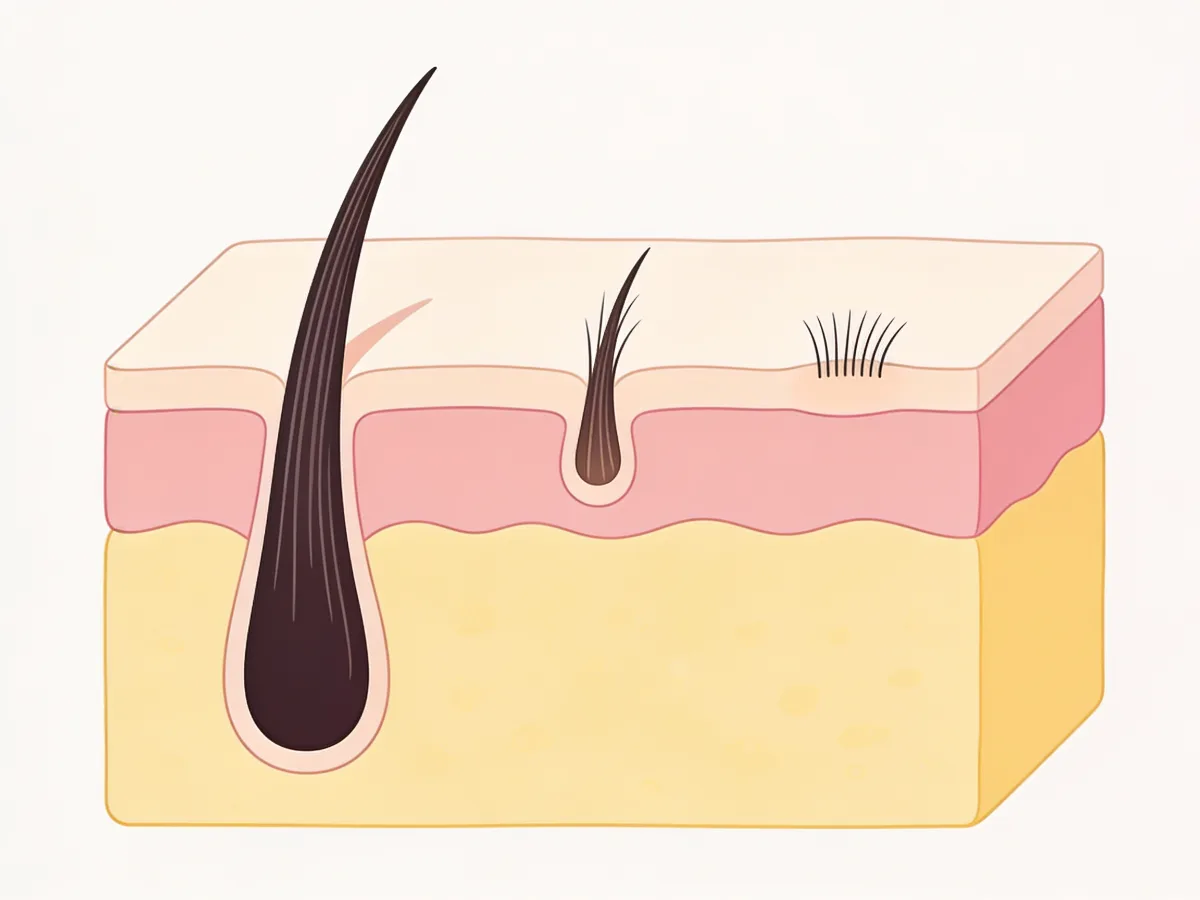
Each follicle cycles through three phases. Anagen, the growing phase, lasts years and sets how long a hair can grow. Catagen is a short transition of a few weeks. Telogen is a resting phase of a few months, after which the hair is shed and a new one starts in the same follicle. Most scalp hairs are in anagen at any time, so some daily shedding is normal.
In pattern hair loss, follicles that are sensitive to dihydrotestosterone (DHT) spend less time in anagen and produce a shorter, finer hair with each cycle, a process called miniaturisation. A miniaturised follicle is still alive and can be treated. A follicle that has stopped cycling altogether and left smooth scalp cannot be brought back by any lotion, light or injection, which is why timing matters more than the choice of product.
Causes at a glance
Common causes of hair loss, and the usual route
This is a guide to what to ask, not a diagnosis. Many people, women especially, have more than one cause at once.
| Cause | What it often looks like | Usual first route |
|---|---|---|
| Pattern hair loss in men (androgenetic alopecia) | Receding temples, a thinning crown, back and sides spared; often runs in families | Doctor's assessment and medical treatment; SMP for the look of density once the hairline has settled |
| Pattern hair loss in women | Wider parting, thinner ponytail, more scalp over the crown; front hairline usually kept | Doctor's assessment with blood tests for iron, thyroid and hormonal causes |
| Telogen effluvium (shedding) | Heavier shedding all over, two to four months after childbirth, illness, high fever, crash dieting, surgery or stress | Doctor's review to find and correct the trigger; often settles once it passes |
| Alopecia areata | Smooth, round bald patches on the scalp, beard or eyebrows | Doctor first; not for scalp care or SMP while active |
| Traction alopecia | Broken hairs and thinning where buns, braids or extensions pull tight | Ease the pulling early and see a doctor; long-standing loss may not grow back |
| Scarring alopecias | Shiny patches without follicle openings, sometimes with burning, itching, redness or scaling | Prompt doctor review and specialist care, to limit loss that cannot be reversed |
| Low iron, thyroid problems, hormonal conditions, some medicines | Shedding or thinning, sometimes with tiredness, weight change or irregular periods | Blood tests and medical review; correcting the cause can settle shedding |
| Scalp inflammation, such as seborrhoeic dermatitis | Itching, flaking and redness, with or without extra shedding | Doctor to diagnose and settle it; scalp care for comfort once calm |
Receding hairline, thinning or shedding: what each usually means
Three patterns cover most hair loss, and each points to a different first step.
- Receding hairline. The temples move back first, often leaving an M-shape, and the frontal hairs become shorter and finer before they go. In men this is the classic early sign of pattern hair loss; in women frontal recession is less common and needs traction and frontal fibrosing alopecia ruled out. Our receding hairline guide covers the home check, the Norwood stages, the causes and the options in detail.
- Diffuse thinning. A widening parting, a thinner ponytail or more scalp showing at the crown, with no bald patches. This is how pattern hair loss usually shows in women and in many men, and it is a medical question first.
- Shedding. Noticeably more hair on the pillow or in the drain, usually starting two to four months after a trigger such as illness, fever, childbirth, crash dieting or a new medicine. See telogen effluvium. Shedding with round patches, scaling or scalp pain needs a doctor promptly.
Who is most at risk, and at what age
Pattern hair loss runs in families on either side, and the strongest predictor is a parent or grandparent who thinned early. In men it can begin in the late teens and twenties and becomes more common with each decade. In women it most often becomes noticeable after the menopause, though it can start earlier, particularly where there is a hormonal condition such as polycystic ovary syndrome. It is common in Singapore in both sexes.
Other risks are separate from genes: tight hairstyles worn daily, severe illness or surgery, rapid weight loss, iron deficiency, thyroid disease, some medicines, and autoimmune conditions. Each produces a different pattern of loss, which is why Dr Sin Yong takes a history before examining the scalp rather than assuming the cause from your age.
Receding hairline and thinning in women
Women rarely lose hair in the M-shaped pattern seen in men, and frontal thinning in women usually has one of three causes. Pattern hair loss widens the parting and thins the crown while the front line stays. Traction alopecia from tight ponytails, braids or extensions thins the temples and the edge of the hairline, and the pulling has to stop before anything else helps. Frontal fibrosing alopecia moves the hairline back as a smooth, pale band, often with eyebrow loss; it is a scarring condition that needs a doctor early. Hormonal change after childbirth, with the menopause or with polycystic ovary syndrome can also play a part. Our female hair loss page describes what to look for, and female hair loss treatment explains how Dr Sin Yong checks iron, thyroid and hormones before prescribing.
Hair loss treatment in Singapore: the options compared
Hair loss treatment in Singapore falls into four groups: prescription medicine to slow loss and thicken hairs still growing, in-clinic procedures that support those follicles, surgery that moves follicles, and non-medical care for the scalp. Which suits depends on the cause, so the table assumes a doctor has diagnosed it.
| Option | What it does | Usually suits | At SkinRev Lab |
|---|---|---|---|
| Prescription medicine, on the scalp or by mouth | Aims to slow loss and thicken hairs that are thinning | Pattern hair loss in men and women | Dr Sin Yong, medical adviser; priced at consultation |
| H2LT laser | A low-level red laser protocol for follicles | Thinning where follicles remain | Dr Sin Yong; priced at consultation |
| Regenera Activa | Micrografts from your own scalp, injected into thinning areas | Thinning where follicles remain | Dr Sin Yong; priced at consultation |
| Platelet-rich plasma (PRP) | Injections of your own concentrated platelets | Still under investigation, so not a routine option | Not offered |
| Hair transplant | Moves follicles from the back of the scalp | Stable loss with enough donor hair | Not performed; referral to a surgeon |
| Rejuran® Scalp Care | Scalp care without needles, for scalp condition and comfort; does not grow hair | Scalp comfort alongside medical care | Aesthetic Therapists; S$348 per 90-minute session before GST |
Medical routes are judged over months, not weeks. The doctor-led options are set out on the medical hair loss treatment page.
The doctor-led route
Medical hair loss treatment at SkinRev Lab
At SkinRev Lab, CityLink Mall (City Hall), Dr Sin Yong (MBBS Singapore, MRCS Edinburgh, MSc Practical Dermatology Cardiff, Prof Dip Obstetrics and Gynaecology RCPI) treats hair loss in men and women. The consultation covers when the loss started, family history, illness, diet and medicines, then a magnified scalp examination and baseline photographs. Blood tests such as iron and thyroid are arranged where indicated.
Medical treatment aims to slow loss and thicken hair that is still growing. It cannot revive follicles that have gone, and areas smooth and bald for years usually do not respond; there, a hair transplant opinion or SMP may be more practical. Pattern loss is long-term, so treatment is continued for as long as the benefit is wanted; when it stops, the underlying loss usually resumes, with a fair review usually at around six months.
The plan follows the diagnosis. Pricing is given at consultation, and you see the full plan and cost before agreeing.
- Prescription treatment, by mouth or applied to the scalp, chosen after a review of your health and medicines. Mention if you are planning a family, pregnant or breastfeeding.
- Correcting what blood tests find; sometimes that alone settles shedding.
- H2LT laser: a low-level red laser protocol for follicles that are thinning but still present, in visits of about 15 to 20 minutes as part of a planned course.
- Regenera Activa: three samples of about 2.5 mm from the back of the scalp are processed into micrografts and injected into thinning areas in one visit under local anaesthetic. It supports existing follicles rather than moving them; expect a few days of tenderness.
Corticosteroid injections for patchy and scarring hair loss
Round, smooth bald patches are usually alopecia areata, an autoimmune condition in which the body's immune cells attack growing follicles. For a few patches, a doctor can inject a dilute corticosteroid into the patch itself to calm the inflammation, repeated at intervals of several weeks. It is a different treatment from the medicines used for pattern hair loss, which do nothing for alopecia areata. Corticosteroid injections are also used, with other anti-inflammatory medicines, to slow frontal fibrosing alopecia and other scarring types, where the aim is to stop further loss rather than to regrow what has scarred. Dr Sin Yong confirms the diagnosis before treating, and refers widespread or rapidly spreading cases to a dermatologist.
Microneedling and derma rolling for hair: what the evidence shows
Microneedling uses fine needles to make tiny controlled injuries in the scalp, with the aim of triggering growth signals and helping topical hair-loss medicine penetrate. The published trials are small, short and differ in technique, and most pair it with a topical hair loss medicine instead of testing it alone, so it is not a stand-alone treatment. The 2018 S3 guideline, which sets out the first-line options for pattern hair loss, rests on two prescription medicines, one applied to the scalp and one taken by mouth. Home derma rollers carry a risk of infection and scarring if used on an unclean scalp or pressed too hard, and they are not suitable for an inflamed or patchy scalp. If you want to try microneedling, ask Dr Sin Yong whether it fits your plan rather than adding it on your own.
Hair transplant and hairline lowering: when a surgeon is the right referral
SkinRev Lab does not perform hair transplants, hairline lowering surgery or scalp reductions. Dr Sin Yong will say so and refer you when they are the right route: long-standing bald areas where the follicles have gone, a hairline that has settled and no longer changes with medicines, or a wish for density that only moving follicles can meet. Follicular unit extraction (FUE) takes individual follicles from the back of the scalp and places them at the front; surgeons usually prefer to operate once the loss has stabilised on medical treatment, because transplanted hair does not stop the surrounding hairs from thinning. Our hair transplant alternatives page sets out what to try first and what surgery can and cannot change.
Non-medical options at SkinRev Lab
SkinRev Lab is an aesthetic centre at CityLink Mall. Alongside Dr Sin Yong's medical treatment it offers Rejuran® Scalp Care, performed by our Aesthetic Therapists. Neither grows hair or slows loss, and we will say so before you book.
- Rejuran® Scalp Care, S$348 per 90-minute session before GST, is a non-medical scalp care session performed by our Aesthetic Therapists for the condition and comfort of the scalp skin. It suits a scalp that feels oily, dry or irritated, or gentle care alongside a doctor's plan. For scalp care rather than regrowth, see scalp treatment Singapore: scalp care, the look of density, or a doctor.
If your loss is still progressing, start with the medical plan, so that a hairline drawn today is not left stranded as the hair behind it thins.
What to expect at a visit and during treatment
The first visit with Dr Sin Yong takes a history, examines the scalp under magnification, includes a gentle pull test and, where indicated, arranges blood tests for iron, thyroid and other causes. Baseline photographs are taken so that change can be measured rather than guessed. If medicines are prescribed, follow-up is by review visits over months, and treatment is continued for as long as the benefit is wanted. H2LT low-level laser is a course of visits of about 15 to 20 minutes with no downtime. Regenera Activa takes three small samples of about 2.5 mm from the back of the scalp under local anaesthetic, and the micrografts are placed in the same visit; the sampled area can be tender for a day or two. Progress on any route is reviewed at around six months, and results vary.
See a doctor first
Signs your hair loss needs a doctor before anything else
If any of these apply, book a doctor's review first. Our Aesthetic Therapists will point you to a doctor rather than book a scalp session.
- Sudden or heavy shedding, or loss that is getting worse quickly.
- Round bald patches on the scalp, or in the beard or eyebrows.
- Smooth, shiny or scarred patches, or a scalp that burns, itches, hurts, looks red or scales.
- Shedding after childbirth that has not settled within six to twelve months, or a parting that keeps widening after pregnancy.
- Hair loss that began after a new medicine, an illness, surgery or a crash diet.
- Thinning together with tiredness, weight change, irregular periods, acne or new facial hair.
- Losing hair quickly at a young age, for example under 25.
- Being pregnant, breastfeeding or planning a family while considering any hair loss treatment.
Prevention and lifestyle: what helps and what does not
No habit prevents pattern hair loss, but several make other types worse or hide an early change.
- Loosen tight ponytails, buns, braids and extensions; daily pulling thins the temples and the edge of the hairline over time.
- Limit heat and chemical styling, which breaks hairs rather than causing loss from the root, but makes thinning look worse.
- Do not smoke; it is associated with earlier greying and thinning.
- Avoid crash diets. Shedding often follows rapid weight loss or very low protein intake.
- Have iron, vitamin D and thyroid checked if shedding is new; supplements help only where a deficiency is found.
- Protect sleep and manage stress; severe stress can trigger shedding months later.
Hats do not cause hair loss; a hat would have to be tight enough to cut the blood supply to the scalp for hours a day. Sun protection for an exposed scalp is a good reason to wear one.
Can a receding hairline grow back without treatment?
It depends on the cause. Shedding from telogen effluvium usually settles on its own over several months once the trigger has passed, and density returns as the new hairs grow in. Traction alopecia can recover if the pulling stops before the follicles scar. Small patches of alopecia areata sometimes regrow without treatment, though a doctor should still confirm the diagnosis. Pattern hair loss does not reverse on its own: a receding hairline from DHT sensitivity continues to move, slowly or quickly, unless the process is interrupted by treatment, and follicles that have already closed do not reopen. That is the practical reason for an early diagnosis: it tells you whether waiting is reasonable or whether waiting costs hair.
How to judge a hair loss clinic in Singapore
Before paying for any course, ask five questions.
- Will a doctor examine my scalp under magnification before anything is sold to me?
- What is the likely cause, and what would change that view?
- What can this treatment not do, and when would you refer me elsewhere?
- How will progress be measured, and when will we decide whether it is working?
- What is the full cost per month or per course, before GST, and what happens if I stop?
A clinic that answers all five plainly is doing the job properly. Be cautious of packages offered before a diagnosis, of promises of regrowth, and of anyone unwilling to say what they do not offer; our own list is at what we do not offer.
Prices and getting there
Costs, locations and how to enquire
At SkinRev Lab, Rejuran® Scalp Care is S$348 per 90-minute session before GST (currently 9%). Medical hair loss treatment at SkinRev Lab is priced at consultation, because the plan depends on the diagnosis.
SkinRev Lab: #B1-28 CityLink Mall, 1 Raffles Link, Singapore 039393, on the underground link between City Hall MRT and Esplanade MRT. Open daily, 11am to 8pm. WhatsApp +65 8266 9585.
Mature hairline or receding hairline?
Most men's hairlines move up a little between the late teens and the mid-twenties, settle into a gentle curve and then stop. That is a mature hairline, not hair loss, and it needs no treatment. A receding hairline keeps moving, deepens at the temples, and the hairs along its edge become finer and shorter rather than simply stopping at a new line. Thinning at the crown alongside it points more firmly to pattern hair loss.
Doctors grade men's recession on the Norwood scale and women's diffuse thinning on the Ludwig scale; the stage table and a step-by-step home check sit on our receding hairline guide, so this page does not repeat them. If you are unsure which you have, baseline photographs taken now make the comparison in six months far easier than memory.
Female hair loss treatment in Singapore: tests first, then a plan
Female hair loss treatment in Singapore starts with finding the cause, because thinning in women may be female pattern hair loss or shedding linked to low iron, thyroid disease, hormonal change, childbirth or illness, and each needs a different plan. DermNet notes that around 40% of women show signs of hair loss by age 50.
- History. Periods, pregnancy and childbirth, diet, recent illness or stress, and medicines.
- Scalp examination. Dr Sin Yong, medical adviser, examines the scalp under magnification and takes baseline photographs.
- Blood tests, where indicated. Iron stores and thyroid function, with hormones checked when there are irregular periods, acne or excess hair growth.
- Treatment. Correcting a deficiency, prescription medicine applied to the scalp or taken by mouth where suitable, H2LT laser or Regenera Activa. Some prescription options are unsuitable in pregnancy, while breastfeeding or when pregnancy is planned, and Regenera Activa is not performed during pregnancy.
- Review. Photographs at the same angles and lighting. Less shedding often comes first, with thickening over months; DermNet advises at least six months of treatment before judging benefit.
Treatment is priced at consultation. More detail is on the female hair loss treatment page.
Stem cell hair treatment: what the term covers, and what SkinRev Lab offers instead
Stem cell hair treatment is a loose label for regenerative treatments that use cells, or products made from cells, to support hair follicles. SkinRev Lab does not offer stem cell hair treatment. Its nearest option is Regenera Activa, micrografting from your own scalp tissue, which is not a laboratory-grown stem cell product.
| Type | What it is | At SkinRev Lab |
|---|---|---|
| Autologous micrografting (Regenera Activa) | Small samples from the back of the scalp are processed into a suspension of micrografts and injected into thinning areas in one visit, under local anaesthetic | Offered as Regenera Activa, not a stem cell product; Dr Sin Yong, medical adviser; priced at consultation |
| Laboratory-grown stem cell products | Cells, or products from cells, grown outside the body | Not offered |
| Platelet-rich plasma (PRP) | Your own platelets; not a stem cell treatment | Not offered |
Published studies are small: the authors of one 27-person trial of scalp micrografts called for larger controlled studies. How the treatment offered here is done is on the Regenera Activa page.
How common hair loss is in Singapore and Asia, by age
Pattern hair loss (androgenetic alopecia) is common in Asia and rises steeply with age. A 2012 review of Asian studies reports the following (Lee and Lee, 2012):
| Group | Prevalence reported |
|---|---|
| Korean men (Norwood III or above) | 14.1% overall: 2.3% in their 20s, 4.0% in their 30s, 10.8% in their 40s, 46.9% over 70 |
| Korean women (Ludwig I or above) | 5.6% overall: 0.2% in their 20s, rising to 24.7% over 70 |
| Chinese men / Chinese women | 19.9% / 3.1% |
| Singapore (all Norwood types, I to VII) | 63% overall, from 32% in young adults to almost everyone in their eighties |
The Singapore figure counts even the earliest Norwood stage, so it is higher than figures that count only visible thinning. The review also notes that Japanese men develop pattern hair loss about a decade later than Europeans, and that rates in Chinese men are lower than in European men but similar to Korean men. In practice, thinning that starts in your twenties or progresses quickly is less typical for your age group, and is a reason to have the cause checked before choosing a treatment.
How long hair loss treatment takes to work: month by month
Hair grows slowly, so hair loss treatment is judged over months, not weeks.
| Time from starting | What usually happens |
|---|---|
| 0 to 3 months | Little visible change. Shedding after a trigger such as fever, childbirth, major surgery or emotional strain typically begins 3–4 months after the event, so it can appear after the cause has passed (Rebora, 2019). |
| 3 to 6 months | With medical treatment for pattern hair loss, a reduction in hair loss is usually seen (Lee and Lee, 2012). |
| 6 to 12 months | Visible regrowth typically appears. Shedding that lasts more than 6 months is classed as chronic telogen effluvium. |
| After stopping | For pattern hair loss, stopping treatment leads to renewed hair loss after several months (SingHealth). |
A 2017 meta-analysis found that low-level laser therapy in men, as well as topical and oral medicines, performed better than placebo, although the studies varied widely (Adil and Godwin, 2017). At SkinRev Lab, Dr Sin Yong, medical adviser, reviews progress at around six months; prescription medicine, H2LT laser and Regenera Activa are priced at consultation. Rejuran® Scalp Care (S$348 per 90-minute session before GST) is a non-medical scalp treatment by Aesthetic Therapists and does not grow hair.
Normal shedding or telogen effluvium: a shedding-count guide
Some shedding is normal; the question is how much. A 2019 review uses a modified wash test: you avoid shampooing for five days, then count the hairs shed at the next wash (Rebora, 2019).
| Hairs shed at the wash after 5 days | What it may mean | Usual first step |
|---|---|---|
| Between 10 and 100 | The range the review gives for pattern hair loss | Look for thinning at the crown, parting or hairline |
| More than 100 | Telogen effluvium can be considered | Look back 3–4 months for a trigger: fever or illness, childbirth, major surgery or emotional strain |
| Around 300 | The median count in telogen effluvium | See a doctor, especially if shedding has lasted more than 6 months |
The same review cites earlier work showing that visible thinning appears only once about 40% of hairs have been shed, so by the time a gap shows, shedding has usually been going on for a while. Patchy loss, a red, scaly or sore scalp, or shiny scarred areas need a doctor before any count.
Questions people ask about hair loss treatment
Can you regrow a receding hairline?
Sometimes partly, if the follicles are still alive. Doctor-prescribed hair loss medicines aim to slow loss and thicken hairs that are miniaturising; they do not revive follicles that have already gone. Dr Sin Yong examines the scalp first to tell the two apart, which is why treatment starts with a diagnosis.
Why is Gen Z balding so fast?
There is no evidence that younger people lose hair faster than earlier generations. Pattern hair loss can start in the late teens and twenties, and it is noticed earlier now because of photos and social media. Stress-related shedding, crash diets and tight hairstyles also cause temporary loss at this age, and each is assessed separately.
How to stop frontal hair loss?
Start with a diagnosis, because frontal loss can be pattern hair loss, traction from tight styles, or frontal fibrosing alopecia, and each has a different route. For pattern loss Dr Sin Yong may prescribe hair loss medicine and add low-level laser or micrografting; traction needs the pulling to stop. Earlier assessment means more follicles are still there to treat.
How to make a hairline look fuller?
Two routes exist. Medical treatment aims to thicken the hairs you still have over months. Scalp micropigmentation at SkinRev Lab adds pigment dots that mimic the shadow of short hair along the hairline, so thinning is less visible straight away; it does not grow hair. Styling, fibres and a lower parting help in the short term.
Do I need blood tests for hair loss?
Not always. Dr Sin Yong orders blood tests when the history or the scalp examination suggests a cause beyond pattern hair loss: new or heavy shedding, diffuse thinning in a woman, fatigue, irregular periods or a restrictive diet. The usual checks are iron stores, thyroid function and, where relevant, hormones. A clear receding hairline in a man with a family history often needs none.
Should I see a hair loss doctor or a hair clinic first?
A doctor first, if hair is thinning, receding or shedding. Only a doctor can diagnose the cause and prescribe medicines; a non-medical scalp session cannot slow loss, and our Aesthetic Therapists will say so rather than book you. A hair clinic or scalp centre comes afterwards, for scalp comfort or the look of density, once the cause is known.
Does stem cell treatment work for hair loss?
The evidence is too limited to say. Published studies are small, and the authors of a 27-person randomised half-head trial of micrografts from patients' own scalp tissue called for larger controlled studies. SkinRev Lab does not offer stem cell hair treatment. Its nearest option is Regenera Activa by Dr Sin Yong, medical adviser, priced at consultation.
Can female hair loss grow back?
Often partly, depending on the cause. Shedding from a trigger such as childbirth, illness or low iron may improve once the cause is corrected, while female pattern hair loss needs ongoing treatment to slow it; DermNet advises at least six months of treatment before judging benefit. Dr Sin Yong assesses the cause first, and treatment is priced at consultation.
How common is hair loss in women?
Common. DermNet notes that around 40% of women show signs of hair loss by age 50. In women it usually appears as diffuse thinning rather than a receding hairline at the front, and it can also come from shedding after childbirth, illness, low iron or thyroid disease, so a doctor's assessment comes first.
Is PRP offered for hair loss at SkinRev Lab?
No. SkinRev Lab does not offer platelet-rich plasma (PRP) for hair loss, and lists it among the treatments it does not offer. DermNet describes PRP for female pattern hair loss as still under investigation. Options offered under Dr Sin Yong, medical adviser, include prescription medicine, H2LT laser and Regenera Activa, all priced at consultation.
How long does hair loss treatment take to work?
Usually three to twelve months. A 2012 review of hair loss in Asians found that a reduction in hair loss is usually seen after 3–6 months of medical treatment, with visible regrowth typically after 6–12 months. At SkinRev Lab, Dr Sin Yong, medical adviser, reviews progress at around six months.
Does laser treatment for hair loss work?
It can help some people with pattern hair loss. A 2017 meta-analysis found that low-level laser therapy in men performed better than placebo, as did topical and oral medicines, although study designs varied widely. At SkinRev Lab, H2LT low-level laser is a doctor-led course of visits, priced at consultation.
How common is hair loss in Asian men?
Common, and more so with age. A 2012 review reported pattern hair loss (Norwood III or above) in 14.1% of Korean men overall, rising from 2.3% in their twenties to 46.9% over 70, and in 19.9% of Chinese men. Japanese men tend to develop it about a decade later than European men.
Does hair grow back after telogen effluvium?
Usually, yes. A 2019 review notes that shedding typically starts 3–4 months after a trigger, and that shedding after childbirth usually lasts about 2 months and is followed by full recovery. Shedding that continues beyond 6 months is classed as chronic and needs a doctor's assessment for an ongoing cause.
What is the most effective treatment for hair loss?
It depends on the cause, so diagnosis comes first. For pattern hair loss, a meta-analysis found that a medicine applied to the scalp, a tablet for men and low-level laser light in men all beat placebo (Adil and Godwin, 2017). In male pattern hair loss, the medicines work only while they are continued (British Association of Dermatologists, 2024).
Why is my hair so thin I can see my scalp?
Usually because follicles are shrinking rather than every hair falling out. In male pattern hair loss, a hormone called DHT changes scalp follicles so hairs grow gradually thinner and lighter (British Association of Dermatologists, 2024); in women, a widening parting is a common sign. Sudden, widespread shedding is a different problem, so a doctor checks which you have.
Can I reverse hair loss without using drugs?
Sometimes. Shedding after illness, stress or childbirth usually settles on its own once the trigger has passed. Pattern hair loss tends to progress, and the evidence for non-drug options is thinner: some research suggests low-level laser light may improve hair growth, but more is needed (British Association of Dermatologists, 2024). Lost follicles do not return, so early assessment matters.
Does blocking DHT stop hair loss?
Not for good. DHT drives the follicle changes in male pattern hair loss, and a tablet that lowers it beat placebo in men in a meta-analysis (Adil and Godwin, 2017). But hair loss restarts once the tablet is stopped, and benefit can take up to 14 months to show (British Association of Dermatologists, 2024). It needs a doctor's assessment.
Tracking your hairline at home
Take photos of your hairline every three months: same light, same angle, hair pulled back, from the front and both sides. Compare the temples and the crown rather than the middle of the hairline, which changes less. Bring the photos to your consultation; they show change more reliably than memory.
More questions, answered
Can tight hairstyles cause a receding hairline?
Yes. Tight ponytails, buns or braids can pull hair out at the hairline over time; loosening the style early helps it recover.
Does wearing a cap cause a receding hairline?
No. A normal cap does not cause hairline recession; a very tight one worn for long hours can rub, but it is not the cause of pattern hair loss.
References
- Lee WS, Lee HJ (2012). Characteristics of Androgenetic Alopecia in Asian. Annals of Dermatology 24(3):243-252. PMID 22879706. Source
- Rebora A (2019). Telogen effluvium: a comprehensive review. Clinical, Cosmetic and Investigational Dermatology 12:583-590. doi:10.2147/CCID.S200471. Source
- Adil A, Godwin M (2017). The effectiveness of treatments for androgenetic alopecia: A systematic review and meta-analysis. Journal of the American Academy of Dermatology 77(1):136-141.e5. PMID 28396101. Source
- Gentile P, Scioli MG, Cervelli V, Orlandi A, Garcovich S (2020). Autologous Micrografts from Scalp Tissue: Trichoscopic and Long-Term Clinical Evaluation in Male and Female Androgenetic Alopecia. BioMed Research International, 2020, 7397162. Source
- DermNet. Female pattern hair loss. Source
- Kanti V, Messenger A, Dobos G, et al. (2018). Evidence-based (S3) guideline for the treatment of androgenetic alopecia in women and in men - short version. J Eur Acad Dermatol Venereol, 32(1), 11-22. Source
- Suchonwanit P, Thammarucha S, Leerunyakul K. (2019). Minoxidil and its use in hair disorders: a review. Drug Des Devel Ther, 13, 2777-2786. Source
- British Association of Dermatologists (2024). Hair Loss Male Pattern (Androgenetic Alopecia). Patient information leaflet. Produced March 2016; updated January 2021 and June 2024; next review June 2027. Source