

Concerns · Face & skin · CityLink Mall
Melasma Treatment in Singapore
Melasma is a long-lasting pigment condition that causes symmetrical brown or grey-brown patches on the face. Which kind of dark patch you have decides who should treat it: melasma treatment in Singapore is given by Dr Sin Yong at SkinRev Lab, while facials clear and protect the surface.
By Dr Sin Yong · 30 October 2026
Main guide: Pigmentation treatment in Singapore
Can melasma be treated in Singapore, and who treats it?
Yes, melasma can be lightened and controlled, but not removed for good. It is one type of hyperpigmentation, driven by sun, heat and hormones, so plans include maintenance. At SkinRev Lab in Singapore, Dr Sin Yong diagnoses and treats it.
| Question | Short answer |
|---|---|
| Who performs it | Dr Sin Yong (diagnosis and medical treatment); Aesthetic Therapists (surface facials only) |
| What is used | Prescription creams, oral medicine if suitable after screening, and low-energy laser such as Laser Toning |
| How long | Creams take months; progress is judged over three to six months |
| Laser sessions | Spaced a few weeks apart, as your doctor advises |
| Downtime | Usually little; mild redness after laser for a few hours |
| Will it come back? | Often, with sun, heat or hormone changes; maintenance keeps it lighter |
| Price | Medical treatment priced at consultation; HydraFacial Syndeo from S$288; Needleless SkinBooster from S$288 per region; before GST |
| Where | SkinRev Lab, #B1-28 CityLink Mall, 1 Raffles Link, near City Hall MRT |
Laser can occasionally darken melasma or leave lighter spots, so settings are kept low.
Medically reviewed by Dr Sin Yong, medical adviser · Last reviewed 16 November 2026
Melasma treatment is a long-term plan to lighten and control symmetrical brown or grey-brown facial patches, combining daily tinted sunscreen, prescription creams or an oral medicine, and gentle low-energy laser. At SkinRev Lab, CityLink Mall, Dr Sin Yong, medical adviser, examines the patches and plans treatment, priced at consultation; facials by Aesthetic Therapists do not remove melasma.
Melasma treatment: key facts and sources
| Fact | Detail | Source |
|---|---|---|
| What melasma is | A common acquired skin disorder that presents as bilateral, blotchy, brownish facial pigmentation. It is separated into epidermal, dermal and mixed types; mixed melasma is the most common type. | DermNet, 2025 |
| Who gets it | Overall prevalence ranges widely at 1–50% (the general population at 1%, higher-risk populations at 9–50%); the generally accepted female to male ratio is 9:1. Onset is typically between the ages of 20 and 40. | Ogbechie-Godec & Elbuluk, Dermatol Ther, 2017; DermNet, 2025 |
| How it is treated | Lightening creams are usually the first-line management, with daily broad-spectrum SPF50+ sunscreen containing iron oxides; oral medicine, laser or light treatments can be discussed. | SingHealth (Sengkang General Hospital); DermNet, 2025 |
| Laser sessions and interval | As a monotherapy, low-fluence Q-switched Nd:YAG laser toning was performed in 5–15 sessions (usually 9–10), usually at intervals of 1–2 weeks, in most of the 42 studies (1,736 patients) of a systematic review. | Lee et al., Medicina, 2022 |
| Main risks | Mottled hypopigmentation occurred in 21 out of 177 patients (11.9%) within 10 sessions of laser toning in one study; two studies reported 81% and 64% recurrence rates. Chemical peels and lasers carry a risk of worsening melasma. | Lee et al., Medicina, 2022; DermNet, 2025 |
| Downtime at SkinRev Lab | After gentle low-energy laser, mild pinkness usually settles within hours; progress is judged over three to six months. | SkinRev Lab |
| Cost at SkinRev Lab | Medical melasma treatment (diagnosis, creams, oral medicine, laser) is priced at consultation. HydraFacial Syndeo (from S$288, S$388 or S$438) and Needleless SkinBooster (from S$288 per region), before GST, brighten the surface only and do not remove melasma. | SkinRev Lab |
| Who performs it at SkinRev Lab | Dr Sin Yong, medical adviser, diagnoses with a dermatoscope and Wood's lamp and prescribes creams, an oral medicine or gentle laser (Laser Toning at 1064 nm, or gentle 1064 nm pico laser), at SkinRev Lab, CityLink Mall (City Hall MRT). Aesthetic Therapists perform facials. Standalone chemical peels and IPL are not offered. | SkinRev Lab |
Looking for pigmentation treatment in Singapore? That page covers it in full.
Looking for post-inflammatory hyperpigmentation treatment? That page covers it in full.
Melasma is often confused with post-acne marks; if your darkening followed breakouts, read acne pigmentation treatment first.
In short: Melasma
Melasma treatment in Singapore aims to control melasma, not cure it. A doctor first confirms it is melasma, then combines daily tinted sunscreen, prescription creams, sometimes an oral medicine prescribed by a doctor, and gentle laser. At SkinRev Lab, City Hall, Dr Sin Yong plans and reviews it over months, because melasma tends to return.
Key facts
- Drivers: hormones, UV and visible light, heat, genetics
- Main tools: tinted SPF, prescription creams, gentle laser
- Lasers: Pico Laser (T2 Frax Radiance), Laser Toning, R2 Glow
- Price: priced at consultation
Updated
Quick answer: Pigmentation
Which kind of dark patch you have decides who should treat it. Melasma is a medical concern: Dr Sin Yong diagnoses it and plans prescription creams or tablets and, where suitable, low-energy laser at SkinRev Lab. Facials only clear and protect the surface, and daily sunscreen matters for every option. Medical treatment is priced at consultation.
The condition
What is melasma? Types and how a doctor tells them apart
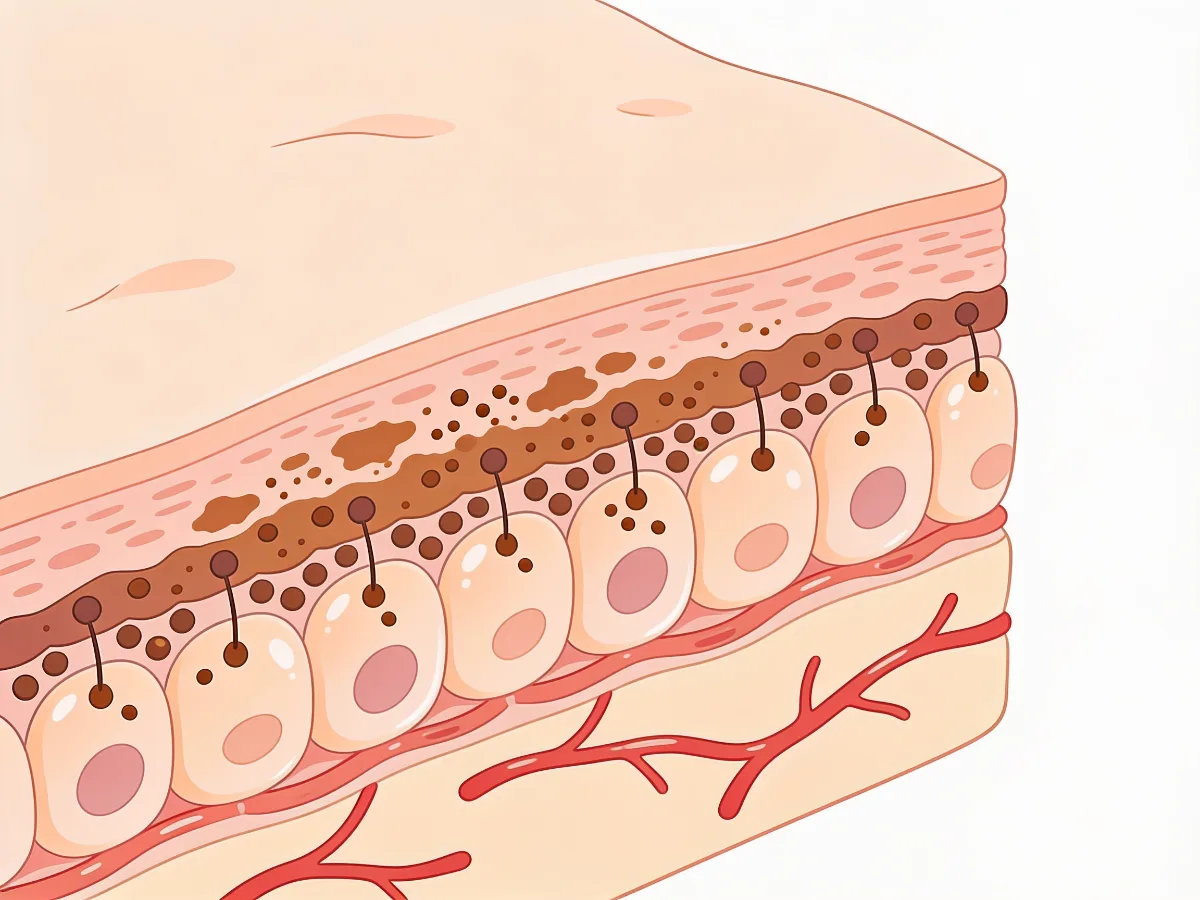
Melasma is a chronic, relapsing pigment condition in which pigment cells become overactive and lay down extra melanin in soft-edged patches, usually on both cheeks, the forehead, the upper lip or the bridge of the nose. It does not itch or hurt.
It is more common in women and in medium to deeper skin tones, and often starts in pregnancy or after hormonal contraception; men get it too.
Doctors group melasma by how deep the extra pigment sits, because depth predicts how well it responds. Dr Sin Yong assesses this with a dermatoscope and, as a guide, a Wood's lamp, and watches how the skin responds over the first months. The prescription option is explained in our guide to a prescription lightening cream cream.
| Type | How it looks | Under a Wood's lamp | Usual response |
|---|---|---|---|
| Epidermal | Well-defined, darker brown | Pigment looks more obvious | Usually responds well |
| Dermal | Ill-defined, light brown to blue-grey | No accentuation | Usually responds poorly |
| Mixed (most common) | Brown and blue-grey together | Partly accentuated | Partial improvement is typical |
Many faces have melasma alongside sun spots or freckles, which are planned differently: see melasma vs freckles and, for every other kind of brown mark, pigmentation treatment in Singapore. Why melasma needs a low-energy approach is explained in pico laser for melasma.
Melasma symptoms: what it looks like and where it appears
Melasma shows as flat, light to dark brown or grey-brown patches with irregular edges, usually on both sides of the face. It does not itch, hurt or feel raised. DermNet, a reference written by dermatologists, describes these patterns:
- Centrofacial: forehead, cheeks, nose and upper lip. This is the most common pattern.
- Malar: cheeks and nose.
- Mandibular: jawline and chin.
- Extrafacial: forearms, upper arms and shoulders, on sun-exposed skin.
Colour hints at depth. Well-defined, dark brown patches suggest pigment near the surface (epidermal). Blurred, lighter brown or blue-grey patches suggest deeper pigment (dermal). Most people have a mix of both. Dr Sin Yong checks the pattern and depth at consultation, because deeper pigment usually responds more slowly to treatment.
Causes
What causes melasma, and why it is common in Singapore
Melasma usually has several triggers working together: ultraviolet and visible light, including daylight through office and car windows, with no low-UV season near the equator; heat from saunas, hot workouts and time outdoors; hormones such as pregnancy, contraceptive pills, hormonal IUDs or implants and hormone replacement; family history in about 60% of people; and irritation from harsh products.
Melasma usually has several triggers working together. Knowing yours is part of keeping it under control.
- Light: ultraviolet and visible light both stimulate pigment, including daylight through office and car windows. Near the equator there is no low-UV season.
- Heat: saunas, hot workouts and time outdoors in Singapore's heat can cause flares, even in shade.
- Hormones: pregnancy, contraceptive pills, hormonal IUDs or implants and hormone replacement therapy. Thyroid disorders can also be associated.
- Family history: about 60% of people with melasma have affected relatives.
- Irritation: harsh products, unregulated whitening creams and aggressive treatments that inflame the skin can darken it.
Who gets melasma
Melasma is more common in women than in men, and it usually starts between the ages of 20 and 40. According to DermNet, it is seen most often in medium skin tones (Fitzpatrick types III and IV), which describes many people in Singapore. Men get it too, usually with the same sun-related pattern on the forehead and cheeks.
- Pregnancy, hormonal contraception and hormone therapy are common starting points.
- A family history of melasma raises the chance.
- Daily sun, visible light and heat keep it going once it has started.
Because the tendency stays with the skin, melasma is managed over the long term. That is why treatment at SkinRev Lab is planned by Dr Sin Yong with sun protection and maintenance built in, and not sold as a single fix.
Watch · Dr Sin Yong explains
Full guides: Why melasma keeps coming back · Oral sunblock in Singapore
Face & skin · pigment
Three kinds of dark patch,
and only one of them is a facial job
Most people who search for pigmentation treatment in Singapore are describing one of three things: scattered sun spots, marks left behind by breakouts, or melasma — the symmetrical, blotchy darkening across the cheeks and upper lip that gets worse in the heat. They look alike in a mirror. They do not respond to the same things.
SkinRev Lab is an aesthetic clinic at CityLink Mall. A facial can clear and brighten the surface and help protect it. Melasma is a medical concern, so it is assessed and treated by Dr Sin Yong with a doctor’s plan rather than with facials alone. So this page does the one thing a pigmentation page rarely does: it tells you which of the three you are likely looking at, and which room it belongs in. To tell the two apart, read melasma vs freckles.
“Melasma is the one pigment concern we will not promise to clear with a facial. If it is melasma, you need a doctor’s plan — and we will tell you that at the first visit, not after six sessions.”
— SkinRev Lab Aesthetic Therapist
- Sun spots (solar lentigines)
- Small, defined, scattered where the sun hits — cheekbones, temples, hands
- Post-inflammatory marks
- Flat brown or red marks exactly where a breakout or injury was
- Melasma
- Symmetrical, soft-edged patches on cheeks, forehead, upper lip; worsens with UV, heat and hormones
- Depth
- Epidermal pigment responds faster; dermal and mixed pigment needs a longer, doctor-led programme
- The one constant
- Daily broad-spectrum SPF — without it, every option works less well
What goes where
The honest ladder:
non-invasive first, medical when it is melasma
At SkinRev Lab · non-invasive
Needleless SkinBooster — brightening and hydrating actives delivered through the barrier, from S$288 per region. Read more: Needleless SkinBooster
HydraFacial Syndeo with a brightening booster — clears congestion and superficial unevenness in 45 minutes. Read more: HydraFacial Singapore
Heliocare 360° sunscreens from our shop — the daily protection that every pigment plan depends on. Shop
Suits: dullness, superficial sun damage, fading post-acne marks, keeping treated skin protected.
At SkinRev Lab · doctor-performed
Picosecond and Q-switched laser programmes — low-energy laser toning over several sessions, set by the doctor to the pigment type and depth. Which laser suits which pigment is set out in our guide to laser for pigmentation.
Prescription topical or oral treatment — the part of a melasma plan no facial can supply.
Diagnosis — a doctor confirms whether it is melasma, lentigines or something that needs checking.
Suits: melasma, deep or mixed pigment, pigment that has not shifted with surface care.
Where this happens
Assessment and treatment at SkinRev Lab — CityLink Mall #B1-28, 1 Raffles Link. Underground from City Hall MRT (East-West and North-South lines) and Esplanade MRT (Circle line); a short walk from Raffles Place, Marina Bay, Suntec and Bugis. Open daily 11am–8pm.
Dr Sin Yong also sees patients at SkinRev Lab: three stops on the North-South line from City Hall. WhatsApp .
Why we refuse to oversell this
What the evidence
actually supports
Melasma is described in the dermatology literature as a chronic, relapsing condition: it is managed, not cured, and photoprotection is the foundation of every regimen. Treatments that overheat the skin can trigger more pigment, which is why doctors use low-energy, repeated laser sessions rather than a single aggressive one, and why a facial that promises to “remove” melasma should make you cautious.
Sun spots and post-inflammatory marks are a different story: they are superficial, they respond to brightening actives and gentle resurfacing, and they are less likely to return if the skin is protected. That is the territory where facials and non-invasive treatments earn their keep; melasma itself is treated by Dr Sin Yong.
References
Melasma treatment side effects and how often they happen
Every melasma treatment carries a trade-off, and two studies in Asian patients give the clearest rates. A Singapore study of 561 patients on an oral medicine found side effects in 7.1%, mostly transient (Lee et al., 2016); a split-face study of low-energy laser toning in 22 patients recorded pale spots, rebound darkening and recurrence (Wattanakrai et al., 2010).
| Treatment | Who was studied | What happened |
|---|---|---|
| Oral medicine | 561 patients at a Singapore tertiary dermatology centre, median 4 months of treatment | 89.7% improved, 10.0% no improvement, 0.4% worse; side effects in 40 patients (7.1%), mostly transient; one deep vein thrombosis, in a patient later found to have a familial clotting-protein deficiency |
| 1,064 nm Q-switched laser toning, five weekly sessions | 22 Asian patients with dermal or mixed melasma, laser plus cream vs cream alone | Mottled pale spots (hypopigmentation) in 3; rebound darkening in 4; melasma recurred in all 22 during follow-up |
The Singapore authors advise careful screening for personal and family clotting risk before oral treatment. The laser study's authors concluded that laser toning alone gave only temporary improvement. At SkinRev Lab, Dr Sin Yong, medical adviser, prescribes the oral medicine only after clotting-risk screening and uses low-energy laser toning or gentle 1,064 nm pico laser in spaced sessions within a plan; all medical melasma treatment is priced at consultation.
Medical treatments
How the doctor treats it
These are performed by Dr Sin Yong at SkinRev Lab. Each page explains the mechanism, who it suits and the published evidence.
Cream first or laser first? Why the order matters
Starting with prescription cream and adding laser afterwards gave better results than the reverse in a small crossover study. Thirteen patients used a prescription combination cream on one side of the face and had 1,064 nm Q-switched laser on the other for 8 weeks, then the sides were swapped for 8 weeks. After 16 weeks, subjective results were better where laser followed 8 weeks of cream than where laser came first, with no significant adverse effects from the laser (Jeong et al., 2010).
| Option | Usual role | What the studies showed |
|---|---|---|
| Prescription cream | Core daily treatment, started first | Results were better when laser followed 8 weeks of cream (Jeong et al., 2010) |
| Laser toning added to cream | Added once the skin is prepared | 75.9% improvement in mMASI score on the laser side vs 24% with cream alone after five sessions, but melasma recurred in all 22 patients (Wattanakrai et al., 2010) |
| Oral medicine | For melasma that does not settle, after screening | Responders improved within 2 months; 27.2% of them later relapsed (Lee et al., 2016) |
This sequence matches the plan on this page, in which prescription creams are the core treatment and laser sessions are spaced and low-energy. mMASI is the modified Melasma Area and Severity Index, the score doctors use to track how much area is affected and how dark it is.
Treatment
How melasma is treated in Singapore, step by step
Melasma treatment aims to control it, not cure it. Most plans combine several steps and are judged in months, not sessions.
| Step | What it involves | Who provides it | What to expect |
|---|---|---|---|
| 1. Diagnosis | Confirms melasma, its type and depth, and checks for look-alikes | Dr Sin Yong | One consultation; any changing spot is examined |
| 2. Daily protection | Broad-spectrum SPF 50+ with iron oxides (tinted), shade, a hat | You, every day | Without it, every other step works less well |
| 3. Prescription creams | Prescription lightening creams or other pigment-control creams chosen by the doctor | Prescribed by Dr Sin Yong | Results usually take 3 to 12 months; possible irritation |
| 4. Tablets, if suitable | Oral prescription medicine | Prescribed after screening for clotting risk | Not for people with clotting risk factors |
| 5. Gentle laser, if suitable | Low-energy laser toning or pico laser at 1064 nm | Dr Sin Yong, SkinRev Lab | Mild pinkness for hours; a course, never one aggressive session |
| 6. Maintenance | Sunscreen continues; creams and laser step down | You and Dr Sin Yong | Flares after holidays or hormone changes are settled early |
Facials such as the Needleless SkinBooster or HydraFacial Syndeo can brighten the surface and keep skin calm alongside this plan; they do not remove melasma. Tablet and cream choices are explained in oral medicine for melasma and melasma creams.
Sources: Ogbechie-Godec OA, Elbuluk N. Melasma: an up-to-date comprehensive review. Dermatol Ther (Heidelb). 2017;7(3):305-318; Zhang L, et al. Tranexamic acid for adults with melasma: a systematic review and meta-analysis. Biomed Res Int. 2018;2018:1683414; Castanedo-Cazares JP, et al. Near-visible light and UV photoprotection in the treatment of melasma: a double-blind randomized trial. Photodermatol Photoimmunol Photomed. 2014;30(1):35-42; Feng J, et al. Efficacy and safety of picosecond laser for the treatment of melasma: a systematic review and meta-analysis. Lasers Med Sci. 2023;38(1):84.
Pregnancy and hormones
Melasma in pregnancy and after giving birth
Melasma that starts in pregnancy is sometimes called the mask of pregnancy (chloasma). It often fades within months of delivery as hormones settle, but it does not always clear completely, and it can return with the next pregnancy or with hormonal contraception.
During pregnancy and breastfeeding the usual steps are strict sun protection and gentle skincare; many prescription creams, tablets and lasers are postponed. If you are planning a pregnancy or have just given birth, tell Dr Sin Yong, so the plan can be timed around it.
Myths and facts
Melasma myths and facts
Melasma attracts a lot of advice in Singapore, from home remedies to overseas whitening creams. These are the beliefs we hear most often at SkinRev Lab, and what is actually known.
| Belief | What is known | What to do instead |
|---|---|---|
| Melasma is a liver problem | Melasma is a skin pigment condition driven by sunlight and visible light, heat, hormones and family history; it is not a sign of liver disease | Blood tests are not needed for typical melasma; unusual patches are examined first |
| A laser can remove melasma for good | No laser cures melasma; it often returns, and strong heat can make it darker | Laser, if used, is gentle and only one part of a plan |
| Whitening creams from overseas are a quick fix | Some contain steroids or mercury, which can thin skin or cause harm | Use only creams prescribed or checked by a doctor |
| Sunscreen alone is enough | UV filters do not block visible light, which also darkens melasma | A tinted SPF 50+ with iron oxides covers visible light too |
| Only women get melasma | It is more common in women, but men get it too | Men are assessed and treated the same way |
| Korean clinics have a secret treatment | Korean clinics use the same building blocks: sun protection, creams, an oral medicine and gentle laser toning | The plan matters more than the country |
If you are unsure whether a patch is melasma at all, read melasma vs freckles, or ask Dr Sin Yong to examine it.
Melasma treatment at SkinRev Lab: what is offered, by whom and at what price
Melasma treatment at SkinRev Lab is doctor-led: Dr Sin Yong diagnoses the type and prescribes creams, an oral medicine or gentle laser, all priced at consultation, while facials by Aesthetic Therapists brighten the surface only. Standalone chemical peels and IPL are not offered.
| Option | Who provides it | Price (before GST) | Role in melasma |
|---|---|---|---|
| Diagnosis with dermatoscope and Wood's lamp | Dr Sin Yong | At consultation | Names the type (epidermal, dermal or mixed) and rules out look-alikes |
| Prescription lightening or pigment-control creams | Dr Sin Yong | At consultation | Change usually takes 3 to 12 months; possible irritation |
| Oral prescription medicine, if suitable | Dr Sin Yong, after clotting-risk screening | At consultation | For stubborn melasma in suitable adults |
| Low-energy laser toning (1064 nm Q-switched Nd:YAG) or gentle 1064 nm pico laser | Dr Sin Yong | At consultation | A course of low-energy sessions weeks apart, within the plan |
| Needleless SkinBooster | Aesthetic Therapists | From S$288 per region | Surface brightness only; does not remove melasma |
| HydraFacial Syndeo | Aesthetic Therapists | From S$288, S$388 or S$438 | Surface brightness only; does not remove melasma |
| Standalone chemical peels, IPL | Not offered at SkinRev Lab | Not applicable | Creams and gentle laser are used instead |
Daily tinted broad-spectrum SPF 50 with iron oxides is part of every plan. More on the creams is in our melasma cream guide, and on laser in pico laser for melasma.
Prevention
Melasma triggers in Singapore that you can control
- Sun and visible light: Use a tinted broad-spectrum SPF 50 with iron oxides, reapply at midday, and add a hat outdoors. Window light and screens near a window still count.
- Heat: Saunas, hot yoga, cooking over strong heat and hot steam facials can darken melasma.
- Hormones: The pill, pregnancy and hormone therapy can trigger it. Discuss options with your doctor; do not stop a medicine on your own.
- Irritation: Scrubs, strong peels, waxing on the face and harsh products can set off darkening.
- Rushing laser: High-energy settings can cause rebound darkening. Gentle, spaced sessions do better over time.
An oral medicine prescribed by a doctor has been reviewed as an add-on for melasma, given after screening for clotting risk. Source: Bala HR, et al. Oral tranexamic acid for the treatment of melasma: a review. Dermatol Surg. 2018;44(6):814-825.
Does melasma come back after treatment? Relapse rates
Often, yes: melasma is controlled rather than removed, and studies that followed patients after treatment recorded frequent relapse. In the Singapore study, 503 of 561 patients improved on an oral medicine, but 27.2% of those who improved later relapsed (Lee et al., 2016). In the laser toning study, every one of the 22 patients had recurrence during follow-up (Wattanakrai et al., 2010).
| Study | Treatment | Improved | Came back |
|---|---|---|---|
| Lee et al., 2016, 561 patients | Oral medicine, median 4 months | 89.7% | 27.2% of responders relapsed |
| Wattanakrai et al., 2010, 22 patients | Laser toning plus cream | 75.9% mMASI improvement on the laser side | All 22 recurred; rebound darkening in 4 |
Family history also mattered: patients without a family history of melasma responded more often than those with one (90.6% vs 60.0%) (Lee et al., 2016). These figures are why the plan continues after the visible clearing, with daily sun protection, a maintenance cream and control of the triggers listed on this page, and why a flare after treatment is a reason to review the plan rather than to repeat strong laser.
Plan
Melasma treatment in Singapore: clear, consolidate, maintain
Melasma is a long-term condition, so a sound melasma treatment plan in Singapore runs in phases rather than as a one-off course:
| Phase | Aim | What it usually involves |
|---|---|---|
| Clear (first few months) | Lighten the patches | Prescription creams, sometimes an oral medicine after a medical check, strict sun protection; gentle laser only in selected cases |
| Consolidate | Hold the improvement | Fewer active treatments, continued creams, review of triggers such as heat and hormones |
| Maintain (long term) | Prevent relapse | Daily sunscreen with visible-light protection, a maintenance cream, early review if patches return |
Sources: Kwon SH, Hwang YJ, Lee SK, Park KC. Heterogeneous pathology of melasma and its clinical implications. Int J Mol Sci. 2016;17(6):824; Bala HR, Lee S, Wong C, et al. Oral tranexamic acid for the treatment of melasma: a review. Dermatol Surg. 2018;44(6):814-825; Passeron T, Picardo M. Melasma, a photoaging disorder. Pigment Cell Melanoma Res. 2018;31(4):461-465.
Melasma is rarely cured, but it can usually be brought under good control. Anyone promising permanent removal in one course is overselling.
Is it melasma or something else? When to see a doctor
Several conditions look like melasma, and each is treated differently. A doctor usually makes the diagnosis by looking at the skin, sometimes with a Wood lamp or a dermatoscope. The common look-alikes are:
- post-inflammatory marks left after acne, eczema or a burn;
- sun spots and freckles, which are smaller and sharply edged;
- Hori's naevus, blue-grey dots on the cheekbones;
- pigmentation caused by a medicine.
See a doctor before starting treatment if the patches are new and you are unsure what they are, if a cream bought online has irritated or darkened the skin, or if you are pregnant or planning to be. See a doctor promptly if a mark is on one side only, raised, changing in shape or colour, or bleeding. Those features are not typical of melasma. At SkinRev Lab the assessment is done by Dr Sin Yong. More on telling the common types apart is in melasma vs freckles.
Common questions
Your questions,
answered
Can a facial remove melasma?
No. A facial can brighten the surface — dullness, dryness, superficial unevenness — and that is worth having. Melasma sits deeper, is driven by hormones, heat and UV, and comes back when the trigger continues. The treatments that change it are doctor-led: prescription topicals, oral options and low-energy laser programmes, with strict sun protection. At SkinRev Lab we will tell you which category your pigmentation falls into before you spend anything.
How do I know if it is melasma or sun spots?
Melasma usually shows as symmetrical, blotchy patches across the cheeks, forehead, upper lip or bridge of the nose, with soft edges, and it darkens after sun or heat. Sun spots are smaller, more defined, scattered where the sun hits. Post-inflammatory marks sit where a breakout was. Only a doctor can diagnose; our Aesthetic Therapist can tell you what it looks like and which room it belongs in.
What can SkinRev Lab do for pigmentation?
Three things, honestly scoped. The Needleless SkinBooster delivers brightening and hydrating actives through the skin barrier without a needle. HydraFacial Syndeo with a brightening booster clears the surface and evens superficial tone. And we stock Heliocare 360° sunscreens, because no pigment plan survives without daily SPF. For sun spots and post-acne marks these help; for melasma they support a doctor's plan rather than replace it.
What does a doctor do for melasma?
At SkinRev Lab, the doctor assesses the type and depth, then builds a programme that may combine prescription topical or oral treatment, picosecond or Q-switched laser toning at low energy over several sessions, and strict photoprotection. Aggressive single treatments tend to make melasma worse, which is why it is a programme, not a one-off.
Where are you, and where is the clinic?
SkinRev Lab is at CityLink Mall #B1-28, reached underground from City Hall and Esplanade MRT — minutes from Raffles Place, Marina Bay, Suntec and Bugis. Assessment here, medical treatment there, maintenance back here.
Will pigmentation come back?
Sun spots and post-inflammatory marks, once cleared, are less likely to return if the skin is protected. Melasma is a chronic condition — it is controlled, not cured — so maintenance and daily SPF are part of the plan. Anyone who promises a permanent cure for melasma is overselling.
How can I remove melasma from my face?
Melasma can be faded and kept under control rather than removed for good. The approach with the strongest support is a tinted, iron-oxide SPF 50+ every day, a doctor-prescribed cream, and for some people tablets or gentle low-energy laser. Aggressive treatments can make it darker, so Dr Sin Yong confirms the type first at SkinRev Lab.
What is the main cause of melasma?
Melasma is caused by overactive pigment cells in people who are prone to it, usually triggered by ultraviolet and visible light, heat and hormones such as pregnancy or the contraceptive pill. About 60% of people with melasma have affected relatives. In Singapore, year-round sun and heat make flares common.
Does melasma ever go away?
Sometimes. Melasma from pregnancy or the pill can fade over months once the trigger stops, but most melasma is long-lasting and tends to return with sun, heat or hormone changes. With treatment and daily protection it usually becomes much lighter and easier to keep under control.
Can vitamin C remove melasma?
Vitamin C serum can support a melasma routine as an antioxidant and mild brightener, but it does not remove melasma on its own. Daily tinted sunscreen and prescription lightening creams or an oral medicine do more, under a doctor's supervision.
Can men get melasma?
Yes. Melasma is more common in women, but men get it too, usually on the cheeks, forehead and nose, with sun and heat as the main triggers. It is diagnosed and treated the same way, with sun protection, prescription creams and, where suitable, gentle laser.
What treatment helps with melasma?
No single treatment suits everyone. Guidelines combine strict sun protection with a tinted SPF, prescription lightening creams, an oral medicine for suitable adults, and gentle laser only as one part of a plan. Dr Sin Yong chooses the mix after examining the type and depth of your melasma.
Can melasma go away permanently?
Melasma can fade a lot, and some cases linked to pregnancy or the pill fade after the trigger stops, but it is a long-term condition that often returns with sun, heat or hormones. The realistic aim is to lighten it and keep it controlled with daily sun protection and maintenance.
Is melasma a liver problem?
No. Melasma is a skin pigment condition, not a sign of liver disease. It is driven mainly by sunlight, visible light, heat, hormones and genes. A doctor checks any unusual or changing patch, but typical melasma does not need liver tests.
What do Koreans do for melasma?
Korean clinics use the same building blocks as clinics elsewhere: sun protection, prescription creams, an oral medicine and low-energy laser toning over a course. There is no special Korean cure; what matters is a cautious plan that avoids irritating the skin.
How long does melasma treatment take?
Expect to judge progress over three to six months. Creams and sun protection work slowly, laser sessions are spaced weeks apart, and maintenance continues after the patches lighten because melasma tends to return.
Can heat make melasma worse?
Yes. Heat as well as sunlight can darken melasma, so saunas, hot yoga and long hot steam facials can undo progress. Keeping the skin cool is part of melasma care in Singapore's climate.
Is the oral medicine for melasma suitable for everyone?
The oral medicine for melasma is a prescription medicine. It helps some people with melasma, but it is not suitable for anyone with a history of blood clots or certain other risks, so a doctor screens you first.
Is laser bad for melasma?
Not necessarily, but aggressive laser can make melasma worse through heat and inflammation. Gentle, low-energy settings are used only alongside creams and sun protection, and some people do better without laser at all.
Can melasma be treated during pregnancy?
Most melasma treatments, including an oral medicine, a prescription lightening cream and laser, are postponed during pregnancy and often while breastfeeding. Sun protection and gentle skincare are the usual first steps; treatment can start later.
How do I stop melasma coming back after treatment?
Daily broad-spectrum sunscreen with visible-light protection, shade and hats, avoiding heat where possible, and a maintenance cream plan. Hormonal triggers are reviewed with the doctor.
How much does melasma treatment cost in Singapore?
Medical treatment by Dr Sin Yong, including creams, oral medicine or laser, is priced at consultation after the pigment is diagnosed. Supportive facials at SkinRev Lab start from S$288 before GST.
Oral supplements for melasma: what a study measured
An oral supplement can be added to a melasma plan, but it does not replace daily sunscreen or a doctor's treatment. One studied option is an extract of the tropical fern Polypodium leucotomos, often sold as an "oral sunblock". Only a few small trials have tested it in melasma, and the table shows what they measured.
| Study | Who was studied | What it found |
|---|---|---|
| Goh et al., 2018 | 40 adults with melasma in Singapore, all also using a prescription lightening cream and SPF 50+ sunscreen; fern extract or placebo for 12 weeks | Both groups improved; melasma scores were significantly lower with the extract than with placebo at weeks 8 and 12, quality-of-life scores improved more, and no significant side effects were reported. By the end, the overall improvement did not differ significantly between the groups |
| Zundell et al., 2025 | Systematic review of the oral fern extract for skin conditions: 21 articles | Only 2 of the 21 studies were in melasma; the authors describe the extract as an add-on (adjuvant) with an encouraging safety profile |
So the evidence supports a supplement as an add-on to cream and sunscreen, not as a treatment on its own, and it rests on small studies. If you already take one, tell Dr Sin Yong, medical adviser, at your consultation so it can be considered alongside anything else you take. Our guide to oral sunblock supplements explains what they do and do not do.
Melasma between visits: what to do and what to avoid
Melasma reacts to light, heat and irritation, so habits between visits matter as much as treatment.
| Do | Do not |
|---|---|
| Use a broad-spectrum, ideally tinted, sunscreen every morning, indoors near windows too | Rely on sunscreen only on sunny days |
| Reapply before going out again and after sweating | Spend long periods in saunas, hot yoga or very hot kitchens |
| Wear a wide-brimmed hat and keep to shade at midday | Scrub, or use lemon juice, vinegar or other home remedies on the patches |
| Keep skin care gentle and simple | Buy lightening creams from unknown sources; some contain harmful ingredients |
| For about a week after a laser session, be extra strict with shade and sunscreen | Book a beach holiday or long outdoor sport right after a session |
| Space laser sessions as Dr Sin Yong advises | Add extra or closer-spaced laser sessions to speed things up; this can darken melasma |
Ask Dr Sin Yong which sunscreen texture suits your skin. Improvement is gradual and can dip with sun, heat or hormones; that is expected.
Hyperpigmentation beyond the face: where it shows and what usually causes it
Melasma mostly affects the cheeks, forehead, upper lip and chin. Dark patches elsewhere on the body usually have other causes, and the plan follows the cause.
| Where | Usual cause | Could it be melasma? | Read more |
|---|---|---|---|
| Sides of the neck, forearms | Years of sun; sometimes a melasma-like pattern on sun-exposed skin | Sometimes; a doctor checks | This page |
| Underarms | Shaving, friction and product irritation | No | Underarm whitening |
| Inner thighs and bikini line | Friction and hair removal | No | Inner thigh whitening |
| Elbows, knees, knuckles | Pressure, friction and thicker skin | No | Dark elbows and knees |
| Velvety folds of the neck or groin | Often linked to raised insulin or blood sugar | No | See a doctor first |
| Anywhere after a spot, rash or burn | Post-inflammatory hyperpigmentation | No | Post-inflammatory pigmentation |
A new dark spot that grows, bleeds or has uneven edges is not a pigmentation problem to treat. Have it checked by a doctor first.
Pigmentation treatment in Singapore: questions to ask before you pay for a course
A pigmentation removal plan is only as good as the diagnosis behind it. Whichever clinic you choose, these questions show whether a plan fits your skin.
- What type of pigmentation is it, and how was that decided? Melasma, sun spots, freckles and post-inflammatory marks need different plans.
- Who does each step? Diagnosis, prescriptions and laser are medical. Facials are not.
- Why this laser and this setting for my type? Melasma usually needs low energy; sun spots often need a different approach.
- How many sessions, how far apart, and when is the review? Ask when the plan will be judged, not only how many visits are booked.
- What happens if my skin darkens? A good plan says when to pause laser and what to do instead.
- What does maintenance involve after the course? Melasma tends to return, so ask what keeping the result needs.
- Is the price per session or per course, and before or after GST? At SkinRev Lab, medical treatment is priced at consultation and prices are given before GST.
Bring photos of the patches over time, and a list of creams and medicines you use. Both change the plan.
References
- Lee HC, Thng TGS, Goh CL (2016). Oral tranexamic acid (TA) in the treatment of melasma: A retrospective analysis. Journal of the American Academy of Dermatology 75(2):385-392. PMID 27206758. Source
- Wattanakrai P, Mornchan R, Eimpunth S (2010). Low-fluence Q-switched neodymium-doped yttrium aluminum garnet (1,064 nm) laser for the treatment of facial melasma in Asians. Dermatologic Surgery 36(1):76-87. PMID 20298254. Source
- Jeong SY, Shin JB, Yeo UC, Kim WS, Kim IH (2010). Low-fluence Q-switched neodymium-doped yttrium aluminum garnet laser for melasma with pre- or post-treatment triple combination cream. Dermatologic Surgery 36(6):909-918. PMID 20384749. Source
- Doolan BJ, Gupta M, Oakley A. Melasma (facial pigmentation). DermNet (minor update December 2025). Source
- Ogbechie-Godec OA, Elbuluk N (2017). Melasma: an Up-to-Date Comprehensive Review. Dermatol Ther (Heidelb) 7:305-318. doi:10.1007/s13555-017-0194-1 Source
- SingHealth (Dermatology Service, Sengkang General Hospital). Melasma - Causes & Treatments. Source
- Lee YS, Lee YJ, Lee JM, Han TY, Lee JH, Choi JE (2022). The Low-Fluence Q-Switched Nd:YAG Laser Treatment for Melasma: A Systematic Review. Medicina 58(7):936. doi:10.3390/medicina58070936 Source
- Goh CL, Chuah SY, Tien S, Thng G, Vitale MA, Delgado-Rubin A (2018). Double-blind, Placebo-controlled Trial to Evaluate the Effectiveness of Polypodium Leucotomos Extract in the Treatment of Melasma in Asian Skin: A Pilot Study. The Journal of Clinical and Aesthetic Dermatology 11(3):14-19. PMID 29606995. Source
- Zundell MP, Katz A, Shah M, Burshtein J, Rigel D, Zakria D (2025). The Utility of Oral Polypodium Leucotomos Extract for Dermatologic Diseases: A Systematic Review. Journal of Drugs in Dermatology 24(4):346-351. doi:10.36849/JDD.8410. PMID 40196953. Source