Guide · Women's health
Stress incontinence in Singapore: why you leak when you cough or laugh, and the treatment ladder
Leaking with a cough, sneeze, jump or laugh is common, especially after childbirth and around menopause, and it is treatable. Here is the order in which treatment usually goes.
In short
- Stress incontinence is leaking urine when pressure in the tummy rises, such as with coughing, sneezing, laughing or exercise; it affects about one in five women at some point.
- It is usually caused by a weak pelvic floor and urethral support, often after childbirth, with menopause, excess weight or a chronic cough making it worse.
- Supervised pelvic floor muscle training is the first-line treatment, supported by a Cochrane review; vaginal oestrogen, pessaries and surgery such as a mid-urethral sling follow if needed.
- Vaginal laser and pelvic floor chairs are marketed for leakage, but the evidence for incontinence is limited. Dr Sin Yong assesses symptoms and refers to a urogynaecologist or urologist when needed.

By Dr Sin Yong · Updated 9 November 2026
Dr Sin Yong, Global Key Opinion Leader
MBBS (Singapore) · MRCS (Edinburgh) · MSc Practical Dermatology (Cardiff) · MSc Aesthetic Medicine (University of London) · 15+ years in clinical practice
This guide is prepared for SkinRev Lab. Dr Sin Yong sees patients at SkinRev Lab, CityLink Mall, and IN Eternity Clinic, and has been appointed a Global Key Opinion Leader by device makers including CLASSYS, DEKA and HIRONIC; he trains doctors at their academies in Europe, Asia and South America. General information only, not medical advice. Your own suitability is assessed at consultation.
Global Key Opinion Leader for
- CLASSYS
- DEKA
- HIRONIC
- FOTONA
- ALMA
- LUTRONIC
- ILOODA
 DEKA Academy, Florence 2026
 CLASSYS Academy, São Paulo 2026
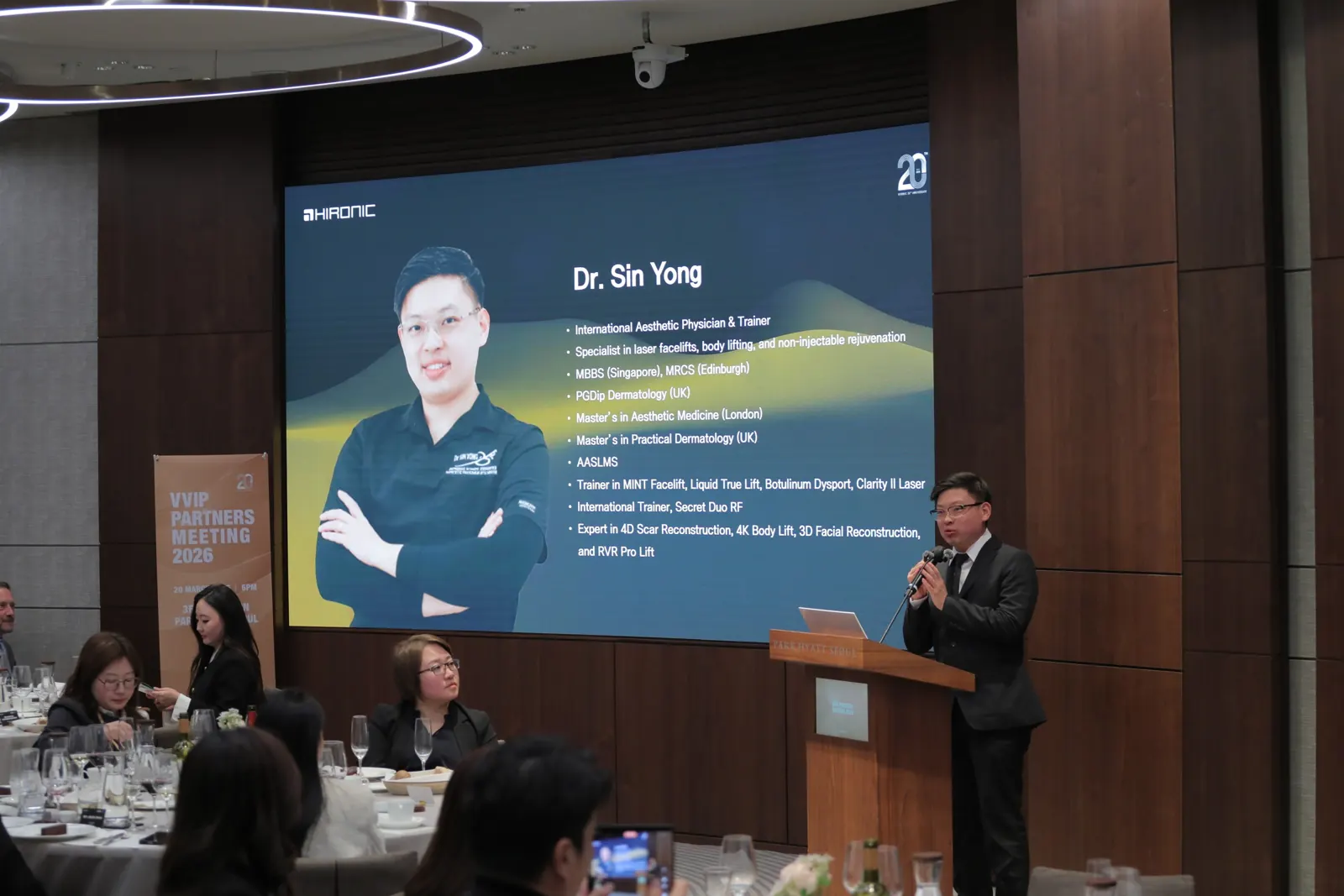 HIRONIC VVIP Partners Meeting, Seoul 2026
 CLASSYS APAC Symposium, Bangkok 2026
His conferences and KOL certificates →More about Dr Sin Yong →
Types
Stress, urge or mixed incontinence
| Type | What happens | First steps |
|---|---|---|
| Stress | Leaking with coughing, sneezing, laughing, lifting or exercise | Pelvic floor muscle training with a physiotherapist |
| Urge (overactive bladder) | A sudden, strong need to go, sometimes leaking before reaching the toilet | Bladder training, less caffeine, medicines |
| Mixed | Both of the above | Treat the more troublesome type first |
| Overflow and others | Dribbling, a weak stream, a bladder that does not empty | Medical assessment first |
Ladder
The treatment ladder for stress incontinence
- Pelvic floor muscle training: daily, correctly done exercises for at least three months, ideally taught by a pelvic floor physiotherapist. A Cochrane review found it can cure or improve stress incontinence in women.
- Lifestyle: weight loss if overweight, treating a chronic cough or constipation, sensible fluid intake.
- Vaginal oestrogen after menopause, as prescribed.
- Devices: a vaginal pessary can support the urethra during exercise.
- Surgery by a urogynaecologist or urologist, such as a mid-urethral sling or colposuspension, for persistent symptoms.
Energy devices
Vaginal laser and pelvic floor chairs: what the evidence says
Energy-based treatments are marketed for leakage. Fractional CO₂ vaginal laser has been studied mainly for dryness after menopause; in a sham-controlled trial it did not improve symptoms more than sham treatment. High-intensity electromagnetic chairs have small, mostly uncontrolled studies. Neither replaces pelvic floor training or a proper assessment. At SkinRev Lab, SKINGLIFT® supports intimate comfort and pelvic floor engagement but does not treat urinary incontinence, and G Lift (vaginal laser) is for genitourinary symptoms such as dryness, where evidence for leakage is limited. See also Emsella in Singapore.
Who to see
Who to see in Singapore
Start with your GP, a gynaecologist, a urogynaecologist or a urologist, and ask for a pelvic floor physiotherapist. See a doctor promptly for blood in the urine, pain, recurrent infections, a bulge in the vagina, or leakage with a weak stream. Dr Sin Yong, who holds a Professional Diploma in Obstetrics and Gynaecology (RCPI), can assess intimate and pelvic symptoms and refer when needed; more in urinary incontinence treatment for women and pelvic floor recovery after birth. What non-invasive feminine rejuvenation can and cannot do is explained on the SKINGLIFT page.
Sources
References & sources
- SingHealth. Stress incontinence: symptoms, causes and treatment
- Dumoulin C, Cacciari LP, Hay-Smith EJC. Pelvic floor muscle training versus no treatment, or inactive control treatments, for urinary incontinence in women. Cochrane Database Syst Rev. 2018;10:CD005654
- Li FG, et al. Effect of fractional carbon dioxide laser vs sham treatment on symptom severity in women with postmenopausal vaginal symptoms: a randomized clinical trial. JAMA. 2021;326(14):1381-1389
- Samuels JB, et al. Safety and efficacy of a non-invasive high-intensity focused electromagnetic field (HIFEM) device for treatment of urinary incontinence and enhancement of quality of life. Lasers Surg Med. 2019;51(9):760-766
Common questions
Your questions,
answered
Is stress incontinence curable?
For many women it can be cured or greatly improved. Pelvic floor muscle training helps most, and surgery is effective for persistent cases.
How long do pelvic floor exercises take to work?
Usually at least three months of daily, correctly done exercises. Many women need a physiotherapist to check they are using the right muscles.
Can laser treat stress incontinence?
The evidence is limited. Vaginal laser has been studied mainly for dryness after menopause, and it should not replace pelvic floor training or a medical assessment.
What surgery is done for stress incontinence?
The most common is a mid-urethral sling; colposuspension and bulking injections are alternatives. They are done by urogynaecologists or urologists.
Is leaking after childbirth normal?
It is common, especially in the first months, but it is not something you have to accept. Pelvic floor training helps most women, and persistent leakage deserves an assessment.
What is the difference between stress and urge incontinence?
Stress incontinence is leaking with effort such as coughing or exercise. Urge incontinence is leaking with a sudden, strong need to go. They are treated differently.
Does SkinRev Lab treat urinary incontinence?
SkinRev Lab does not treat urinary incontinence. Dr Sin Yong can assess symptoms and refer to a urogynaecologist, urologist or pelvic floor physiotherapist.