Concerns · Breakouts, Scars & Texture · CityLink Mall
Back Acne (Bacne) Treatment in Singapore
Spots on the back, chest and shoulders are common, often missed and not always acne. Getting the diagnosis right comes before choosing the treatment.
By Dr Sin Yong · 8 October 2026
Medically reviewed by Dr Sin Yong, medical adviser · Last reviewed 17 November 2026
Back acne, or bacne, is acne on the upper back, shoulders and chest, and not every bump there is acne: fungal acne, friction bumps and folliculitis look similar but need different care. SkinRev Lab does not run a dedicated body acne session; Dr Sin Yong, medical adviser, assesses back acne and its scars and prescribes where suitable, priced at consultation.
In short: Body acne treatment in Singapore
Back acne treatment in Singapore starts with working out what the bumps are: true acne, fungal acne, friction acne or folliculitis each need a different plan. Mild bacne often settles with washes and clothing changes; moderate or scarring back acne needs prescription treatment from a doctor, with marks and scars treated once breakouts are controlled.
Key facts
- Common causes: oil glands, sweat, friction, Malassezia yeast
- First step: tell acne apart from fungal or friction bumps
- When to see a doctor: painful lumps, scarring, or no change after 6 to 8 weeks
- Scars: back and chest are prone to raised scars and keloids
- At SkinRev Lab: assessed by Dr Sin Yong; priced at consultation
Updated
Quick answer
- Spots on the back, chest and shoulders are common, often missed and not always acne. Getting the diagnosis right comes before choosing the treatment.
- Medical, performed by Dr Sin Yong at SkinRev Lab, CityLink Mall (City Hall): Body acne assessment and prescription treatment by Dr Sin Yong, Targeted treatment for yeast-related folliculitis, Assessment of marks and raised scars.
- Assessment first; individual results vary. Medical pricing is given at consultation.
Body acne usually appears on the upper back, shoulders and chest, sometimes spreading to the upper arms. It ranges from blackheads and small red bumps to deep, sore lumps that leave dark marks behind. People searching for back acne treatment in Singapore often say the same thing: their face is fairly clear, but they avoid singlets, backless dresses or swimming. The trunk has a high density of oil glands, so the same processes that cause facial acne can play out across a much larger area.
Our climate makes this worse. Sweat that sits on the skin, tight synthetic sportswear, backpack and bra straps, and heavy body lotions can all trap oil and dead skin in the follicles. Friction and pressure inflame them further, which is why breakouts often follow the line of a strap or the spot where your back meets a chair. Hormonal shifts, stress and some medicines can also tip the balance, and body acne can start later and last longer than facial breakouts.
Not every rash of bumps on the back is acne. A yeast that normally lives on skin can overgrow in heat and humidity and inflame the hair follicles, producing small, itchy, very even bumps that do not respond to usual acne care. Bacterial folliculitis and keratosis pilaris can look similar too. SkinRev Lab does not currently run a dedicated body acne session, so Dr Sin Yong confirms what it is at SkinRev Lab before treatment.


“If your back breakouts are itchy, very uniform and refuse to respond to acne products, the problem may not be acne at all.”
— Dr Sin Yong, SkinRev Lab
- How common
- About three to six in ten people with facial acne also have it on the trunk
- Usual sites
- Upper back, shoulders, chest and upper arms — areas dense with oil glands
- Main look-alike
- Yeast (Malassezia) folliculitis: small, itchy, same-sized bumps
- Local aggravators
- Trapped sweat, tight synthetic sportswear, straps, heavy body products
- Scar risk
- Chest, shoulders and upper back are common sites for raised and keloid scars
- Who confirms it
- A doctor — acne, yeast folliculitis and bacterial folliculitis are treated differently
Full guide: Facials for acne-prone skin in Singapore
What goes where
The honest ladder:
non-invasive first, medical when it is needed
At SkinRev Lab · non-invasive
There is no non-invasive treatment at SkinRev Lab that changes this concern. We will say so at the first visit, and Dr Sin Yong can assess it at SkinRev Lab.
Doctor-led · Dr Sin Yong
Body acne assessment and prescription treatment by Dr Sin Yong — At SkinRev Lab, Dr Sin Yong examines the pattern and type of spots, separates acne from its look-alikes and plans prescription washes, creams or oral prescription medication where suitable, with follow-up to adjust the plan.
Targeted treatment for yeast-related folliculitis — When the bumps are confirmed to be yeast-related, treatment is aimed at the yeast rather than at acne. If both conditions are present at once, the plan addresses each of them.
Assessment of marks and raised scars — Dark marks and raised scars on the chest and back are assessed separately once breakouts settle, because scar-prone areas need a different, more careful plan.
Dr Sin Yong performs medical treatments at SkinRev Lab, CityLink Mall (City Hall).
Some mild body breakouts settle with simple changes: showering soon after sweating, swapping to loose cotton or moisture-wicking clothing, using lighter body products and not scratching or squeezing. If spots have not eased after six to eight weeks of this, see a doctor. See Dr Sin Yong sooner if the bumps itch, look very uniform or keep coming back despite acne products, if you have deep painful lumps, if spots are leaving raised or dark scars, or if breakouts are affecting how you dress or feel. Painful lumps in the armpits or groin are a different condition and also need a doctor.
Where this happens
Medical and non-invasive treatments — SkinRev Lab, CityLink Mall #B1-28, 1 Raffles Link, Singapore 039393. Underground from City Hall MRT and Esplanade MRT; a short walk from Raffles Place, Marina Bay, Suntec and Bugis. Open daily 11am–8pm. Medical treatments by Dr Sin Yong; facials and body treatments by trained therapists.
What the research says
The evidence,
with sources
A 2022 review of survey data and published studies found that body acne is often under-recognised, even though roughly three to six in ten people with facial acne also have it on the trunk. Body acne alone was much less common. People with both facial and truncal involvement tended to have earlier onset and more severe disease, and the authors noted the added psychological weight of feeling that acne is spreading. That is a good reason to mention your back and chest at any acne consultation, even if your face is the main worry.
Yeast (Malassezia) folliculitis is commonly mistaken for acne and may persist for years if it is treated only with usual acne medication, according to a published review. It arises from overgrowth of yeast that is normally present on skin, typically shows as uniform papules and pustules on the chest, back, upper arms and face, and responds when treatment targets the yeast. Separately, a review on scar biology notes that acne and folliculitis are among the injuries that can trigger keloid and hypertrophic scars in people prone to them, through ongoing inflammation in the deeper dermis.
References
- Tan J, Del Rosso JQ, Weiss JS, Layton AM, Bhatia ND, Arekapudi KL, et al. Prevalence and demographics of truncal involvement among acne patients: survey data and a review of the literature. J Clin Aesthet Dermatol. 2022;15(10):62-67.
- Rubenstein RM, Malerich SA. Malassezia (pityrosporum) folliculitis. J Clin Aesthet Dermatol. 2014;7(3):37-41.
- Ogawa R. Keloid and hypertrophic scars are the result of chronic inflammation in the reticular dermis. Int J Mol Sci. 2017;18(3):606.
Body acne treatment in Singapore: from home care to a doctor
Body acne treatment in Singapore usually runs in steps, and where you start depends on what the spots look like. Mild breakouts often settle with home care. At SkinRev Lab, the in-centre step is an honest check and a referral rather than a treatment.
A hot, painful lump, a boil or a fever is different: see a GP or polyclinic promptly rather than working through the steps below.
| Step | What it involves | Move on when |
|---|---|---|
| 1. Home care | Shower soon after sweating; wear loose cotton or sweat-wicking clothes; use a benzoyl peroxide wash, left on for two to five minutes and rinsed off (it bleaches fabric); choose lighter body products; do not scratch or squeeze. | Little change after six to eight weeks, or spots that itch, hurt or scar |
| 2. In-centre check: SkinRev Lab, CityLink Mall | No dedicated body acne session, and no diagnosis, prescriptions or treatment of skin infections. The team says so plainly and books you a consultation with Dr Sin Yong. | Straight away: this step is a route to the doctor |
| 3. Doctor care: Dr Sin Yong, SkinRev Lab (CityLink Mall) | A diagnosis first, separating acne from yeast (fungal) folliculitis, bacterial folliculitis and keratosis pilaris; then prescription washes, creams or oral medicine where suitable, with follow-up. Priced at consultation. | Dark marks or raised scars remain once breakouts settle |
| 4. Marks and scars | Assessed separately by Dr Sin Yong, because the chest, shoulders and upper back are prone to raised scars. | Planned individually |
Back acne treatment options compared: what each does and how long it takes
Back acne is usually treated in steps, matched to how inflamed it is and whether it is leaving marks or scars. The table summarises what studies and an expert panel describe; the choice of medicine is a doctor's decision.
| Option | Usually for | What studies or experts report |
|---|---|---|
| Medicated body wash | Mild spots | A wash left on the skin briefly before rinsing |
| Prescription cream or gel | Blackheads and mild to moderate spots | Experts favoured a topical retinoid for non-inflamed truncal acne (78.1%) (Ko et al., 2024). |
| Oral antibiotics | Inflamed, widespread spots | Favoured by 93.8% of the panel for inflamed truncal acne (Ko et al., 2024); a 2022 review advises the shortest possible duration of 3–4 months (Woo and Kim, 2022). |
| Oral vitamin A-derived medicine | Moderate to severe or scarring acne | Preferred, with oral antibiotics, for moderate to severe truncal acne. |
At SkinRev Lab, Dr Sin Yong, medical adviser, assesses body acne and prescribes washes, creams or oral medication where suitable. Medical pricing is given at consultation.
Back facials, peels and light therapy for back acne: what the evidence shows
Back facials, chemical peels and light treatments are widely sold for back acne, but the evidence behind them is thinner than for the medicated washes, creams and tablets in the table above.
| Treatment | What it involves | What the evidence shows |
|---|---|---|
| Back facial with extraction | Cleansing, exfoliation and clearing blocked pores by hand | Not assessed in the studies below; inflamed or widespread spots are treated medically, as in the table above |
| Chemical peel | An acid solution that resurfaces the top layers of skin | A 2018 review found the literature supports superficial and medium-depth peels as an add-on to acne treatment; darker skin types have a higher risk of dark marks afterwards (Castillo and Keri, 2018) |
| Blue or red light, or photodynamic therapy | Light alone, or light after a light-sensitising cream | A Cochrane review of 71 studies with 4,211 people found that high-quality evidence on light therapies for acne is lacking (Barbaric et al., 2016) |
| Pulsed dye laser | A vascular laser aimed at red, inflamed spots | In a randomised split-face trial of 40 people with facial acne, it did not significantly improve acne at 12 weeks (Orringer et al., 2004) |
Most of this research is on facial acne, not the back. For spots on the back, chest or shoulders, start with the steps above and see a doctor if they are inflamed, widespread or leaving marks. SkinRev Lab does not currently run a dedicated body acne session; medical treatment is with Dr Sin Yong, medical adviser, and priced at consultation.
Back acne treatment in Singapore: what a visit at SkinRev Lab involves
SkinRev Lab does not run a packaged body acne session. Back and body acne is a doctor-led plan with Dr Sin Yong, medical adviser. Here is what happens, and what to bring.
Before your visit
- Photos of a bad flare, if your spots come and go
- The names of washes, creams and medicines you use or have tried, and for how long
- Your sport, sweat and clothing routine, including gym and swimming
At the visit
- Dr Sin Yong looks at the back, chest and shoulders
- The type is named first: true acne, fungal acne and folliculitis look alike but need different care
- You get a written plan: washing and clothing habits, and prescription treatment if needed
- A review, often after about eight to twelve weeks, when results can be judged more fairly
- Marks and scars are planned once breakouts have settled, because treating scars over active acne works less well
| Stage | Who | Price |
|---|---|---|
| Assessment and plan | Dr Sin Yong | Priced at consultation |
| Review and adjusting the plan | Dr Sin Yong | Priced at consultation |
| Scar or mark treatment, if needed | Dr Sin Yong | Priced at consultation |
See a doctor promptly if spots are deep and painful, or if scars are forming. Read cystic acne treatment for deep lumps.
References
- Tan JK, Tang J, Fung K, et al. (2008). Prevalence and severity of facial and truncal acne in a referral cohort. Journal of Drugs in Dermatology 7(6):551-556. PMID 18561586. Source
- Woo YR, Kim HS (2022). Truncal Acne: An Overview. Journal of Clinical Medicine 11(13):3660. PMID 35806952. Source
- Ko JY, Song CH, Kim KJ, et al. (2024). Consensus Report on Truncal Acne: The Korean Acne and Rosacea Society Experts Panel. Annals of Dermatology 36(1):35-43. PMID 38325432. Source
- DermNet. How to get rid of back acne. Whittaker L; reviewed by Coulson I. Last reviewed May 2024. Source
- Ogawa R. Keloid and hypertrophic scars are the result of chronic inflammation in the reticular dermis. Int J Mol Sci. 2017;18(3):606. doi:10.3390/ijms18030606 Source
- American Academy of Dermatology. 10 skin care habits that can worsen acne. aad.org (accessed 13 Nov 2026). Source
- Castillo DE, Keri JE (2018). Chemical peels in the treatment of acne: patient selection and perspectives. Clinical, Cosmetic and Investigational Dermatology 11:365-372. doi:10.2147/CCID.S137788. PMID 30038512. Source
- Barbaric J, Abbott R, Posadzki P, Car M, Gunn LH, Layton AM, Majeed A, Car J (2016). Light therapies for acne. Cochrane Database of Systematic Reviews 9(9):CD007917. PMID 27670126. Source
- Orringer JS, Kang S, Hamilton T, Schumacher W, Cho S, Hammerberg C, et al. (2004). Treatment of acne vulgaris with a pulsed dye laser: a randomized controlled trial. JAMA 291(23):2834-2839. doi:10.1001/jama.291.23.2834. PMID 15199033. Source
Main guide
SKINSHAPE® body contouring and body sculpting Singapore
See SKINSHAPE®, our needle-free body contouring treatmentRelated questions: How many sessions do you need?Does body contouring work?
Causes
What causes back acne, and what can look like it
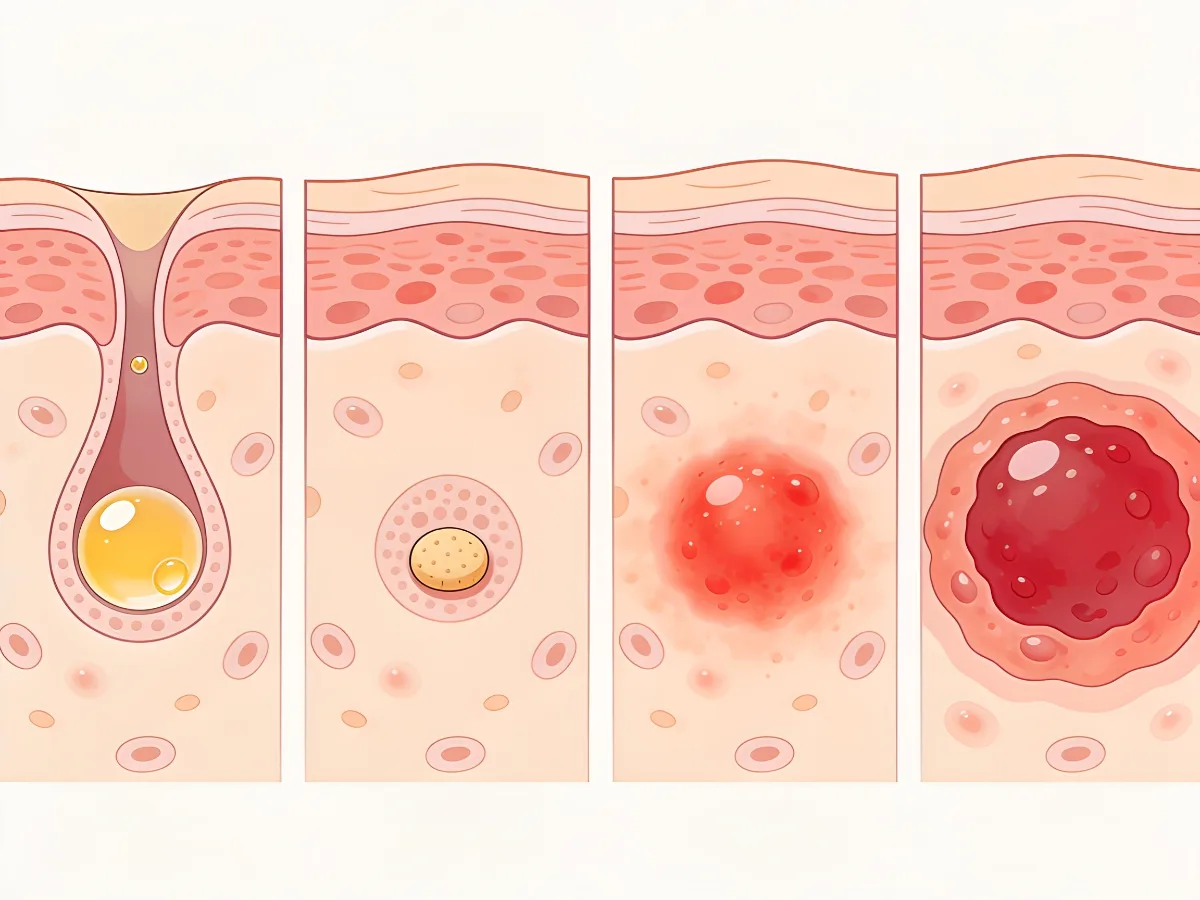
Back acne, often called bacne, is common because the upper back and chest have many oil glands, and Singapore's heat and humidity mean more sweat trapped under clothing. Not every bump on the back is acne, though, and the right back acne treatment depends on which one you have.
Itchy, uniform bumps are often fungal acne, which acne creams do not clear.
| Type | What it usually looks like | Usual approach |
|---|---|---|
| Acne (acne vulgaris) | Blackheads, whiteheads and red bumps of different sizes | Prescription creams or washes; tablets for moderate to severe |
| Fungal acne (Malassezia folliculitis) | Itchy, same-sized bumps on the upper back and chest | Antifungal wash, cream or tablets |
| Friction acne (acne mechanica) | Under bag straps, tight sportswear or protective gear | Less friction, breathable fabric, then treatment |
| Bacterial folliculitis | Small pustules centred on hairs, sometimes tender | Antibacterial wash or antibiotics |
| Steroid acne | Uniform bumps after steroid tablets or creams | Doctor reviews the medicine |
Sources: Reynolds RV, et al. Guidelines of care for the management of acne vulgaris. J Am Acad Dermatol. 2024;90(5):1006.e1-1006.e30; Prohic A, et al. Malassezia species in healthy skin and in dermatological conditions. Int J Dermatol. 2016;55(5):494-504.
How common back acne is, and why it is easy to miss
Back acne is common. In a study of 965 people with acne referred to dermatologists, 92% had acne on the face, 61% on the back and 45% on the chest (Tan et al., 2008). A 2022 review puts truncal involvement at about 48–52% of people with facial acne, with a slight male predominance (54% of men vs 43% of women) (Woo and Kim, 2022).
It is also easy to miss. In the 2008 study, patients and doctors agreed on whether back acne was present only 74% of the time, against 92% for the face. A 2024 Korean expert consensus estimates that one or two in four people with both facial and truncal acne do not mention the body spots unless asked (Ko et al., 2024).
So if you are being treated for facial acne, ask for your back and chest to be checked as well. The same consensus notes that truncal acne is more affected by sweat than facial acne, and that spots can persist under clothing.
How to stop back acne coming back: habits that help
Back acne returns less often when sweat, friction and heavy products are kept off the skin, alongside any treatment a doctor prescribes. DermNet and the American Academy of Dermatology list these habits.
- Wear loose, breathable tops, and change out of sweaty clothes soon after exercise.
- Pat sweat away with a clean towel rather than rubbing it.
- Avoid bags and straps that rub. DermNet suggests handheld or shoulder bags rather than backpacks.
- Choose non-comedogenic products, including sunscreen and hair products, so heavy residues do not sit on the skin.
- Cover the whole area. Apply washes and creams across all acne-prone skin, using a back applicator or another person's help for spots you cannot reach.
- Do not pop or squeeze. It pushes material deeper and can lead to scarring.
- Keep going long enough. The AAD advises allowing 6 to 8 weeks before judging a product.
If the bumps itch and look the same size, they may be fungal acne, which needs antifungal care rather than acne products.
Scars and marks
Back acne scar treatment in Singapore
Back acne scar treatment in Singapore starts with getting the breakouts under control, because new spots keep making new marks. Most marks on the back are flat and brown and fade slowly with sun protection and time. True scars are different: the chest, shoulders and upper back are among the areas most prone to raised hypertrophic scars and keloids, so any heat-based treatment there is planned cautiously and tested first. For pitted scars on the face, see acne scar treatment in Singapore.
| Type | What it looks like | Common options | Timescale |
|---|---|---|---|
| Dark marks (post-inflammatory hyperpigmentation) | Flat brown marks | Sun protection, fading creams, pigment laser | Months |
| Depressed scars | Shallow dips or boxcar-like pits | Fractional CO2 laser or RF microneedling | A course of sessions |
| Raised scars and keloids | Firm, raised, sometimes itchy | Scar injections and silicone, planned by a doctor | Ongoing follow-up |
Sources: Ogawa R. Keloid and hypertrophic scars are the result of chronic inflammation in the reticular dermis. Int J Mol Sci. 2017;18(3):606; Jacob CI, Dover JS, Kaminer MS. Acne scarring: a classification system and review of treatment options. J Am Acad Dermatol. 2001;45(1):109-117.
Why back acne marks and scars last longer than on the face
Back acne tends to leave more lasting marks than facial acne. A 2024 Korean expert panel agreed that dark marks after inflammation (post-inflammatory hyperpigmentation) are more likely, and last longer, on the trunk than on the face (66.7% agreement), and that raised hypertrophic scars and keloids are more likely after truncal acne (77.8% agreement). The panel named scars as the lesion least responsive to truncal acne treatment (Ko et al., 2024).
Two practical points follow:
- Treat active spots early: 91.7% of the panel agreed that early treatment increases the success rate, which is the main way to limit new marks.
- For marks and scars that remain, laser was the approach most favoured by the panel, both for dark marks (68.8%) and for truncal scars (78.1%).
SkinRev Lab has no dedicated back acne scar package: Dr Sin Yong, medical adviser, assesses marks and raised scars once breakouts settle, and medical pricing is given at consultation.
Common questions
Your questions,
answered
Which back acne treatment in Singapore is right for me?
It depends on what the spots actually are. True acne on the back responds to many of the same approaches as facial acne, adapted for a larger area. Yeast-related folliculitis needs treatment aimed at the yeast instead. Bacterial folliculitis and keratosis pilaris need something different again. Dr Sin Yong confirms the diagnosis at SkinRev Lab first, so you are not spending weeks on the wrong product.
How much does back acne treatment in Singapore cost?
Pricing for doctor-led body acne care is given at consultation at SkinRev Lab, because it depends on the diagnosis, the area involved and the plan. SkinRev does not currently list a dedicated body acne session, so there is no SkinRev price for this concern. You are welcome to book a consultation with Dr Sin Yong at SkinRev Lab in CityLink Mall.
Is my back acne actually fungal acne?
It might be. Clues include small bumps that all look about the same size, itching rather than soreness, flares after sweating or in hot weather, and little change despite weeks of acne products. Normal acne is usually a mix of blackheads, red spots and pustules of different sizes. The two can also occur together. A doctor can confirm which you have, sometimes with a simple skin test.
Why does my back acne get worse after exercise?
Sweat, heat and friction together are a common trigger. Tight synthetic clothing holds sweat against the skin, and straps or equipment rub the follicles, so inflammation builds along those lines. Showering soon after training, changing out of damp clothes quickly and choosing looser, breathable fabrics often helps. If breakouts still appear after every session, the pattern is worth showing to a doctor.
Can back acne leave scars or keloids?
Yes. The chest, shoulders and upper back are areas where some people form thick raised scars or keloids, even from small spots. Deep, inflamed lumps and picking raise the risk. Dark marks are also common on the back and usually fade slowly. If you already have raised scars from earlier breakouts, mention this early so that both the acne and the scar risk are planned for.
Can I try treating back acne myself first?
For mild breakouts, yes. Use a gentle body wash, shower after sweating, avoid heavy oils and body butters on the back, wash sports gear and bedsheets regularly and try not to scratch. Give these changes six to eight weeks. If there is little improvement, if the spots itch, or if you see deep lumps or new scars, back acne treatment in Singapore with a doctor is the sensible next step.
How do I get rid of back acne fast?
Shower soon after sweating, wear loose breathable clothing, use a benzoyl peroxide or salicylic acid body wash and avoid heavy body oils. If the bumps itch, try an antifungal wash. If nothing changes within six to eight weeks, or the spots are deep and painful, see a doctor for prescription treatment.
Is back acne hormonal?
Hormones play a part in all acne, and back acne often flares around puberty, the menstrual cycle or when testosterone or steroids are used. But sweat, friction and yeast are just as often the trigger, so the pattern of the bumps matters more than the label.
Do back acne scars go away?
Flat dark marks usually fade over months with sun protection. Pitted scars and raised scars do not go away on their own, but they can be improved with laser, RF microneedling or scar injections, planned carefully because the back scars easily.
Which doctor treats back acne in Singapore?
A GP can start treatment for mild back acne. A doctor at a skin clinic, such as Dr Sin Yong at SkinRev Lab, can confirm whether the bumps are acne or fungal, prescribe treatment and plan scar care. Severe or unusual cases are referred to a dermatologist.
Why do I get acne on my body but not my face?
The chest and back have many large oil glands and are exposed to sweat, friction from clothing and bags, and hair products that rinse down in the shower. These can trigger breakouts even when the face is clear. A yeast-related folliculitis can look similar and needs different treatment.