Medical Treatments · Skin & Lasers · Dr Sin Yong
R2T2 and R2 Glow Laser in Singapore
A low-downtime brightening course on a Fotona Nd:YAG platform, designed to even out tone and fade scattered sun-related pigment step by step.
By Dr Sin Yong · 8 October 2026
Doctor-led · City Hall
R2 Glow Laser with Dr Sin Yong
Assessment first
Dr Sin Yong examines the area and explains which options suit it.
Performed by Dr Sin Yong
Medical treatments at SkinRev Lab are carried out by Dr Sin Yong, medical adviser.
Priced at consultation
The fee is explained before any treatment, so the decision stays with the patient.
Results vary from person to person.
Medically reviewed by Dr Sin Yong, medical adviser · Last reviewed 16 November 2026
R2T2 laser is a shorthand for two separate laser protocols used together: R2 Glow, a brightening laser protocol for dull, uneven tone and sun spots, and T2 Frax Radiance, a pico laser. At SkinRev Lab, CityLink Mall (City Hall MRT), Dr Sin Yong, medical adviser, performs R2 Glow, priced at consultation.
In short
R2 Glow Laser is Dr Sin Yong's low-downtime brightening course on the Fotona StarWalker, a 1064 nm Nd:YAG platform. It evens out dull tone and fades scattered sun-related pigment step by step over several sessions. It is not a vascular yellow laser and not a scar treatment. It is performed by Dr Sin Yong at SkinRev Lab, CityLink Mall.
Key facts
- Platform: Fotona StarWalker (Nd:YAG)
- Suits: dull, uneven tone; scattered sun pigment
- Downtime: little
- Performed by: Dr Sin Yong, SkinRev Lab, CityLink Mall (City Hall)
Updated
R2T2 and R2 Glow laser: key facts
| Fact | Detail | Source |
|---|---|---|
| Sessions and interval | In melasma studies of low-fluence Q-switched Nd:YAG laser toning, treatment usually ran to about 10 sessions (range 5–15), usually at intervals of 1–2 weeks. A pilot study of Q-switched Nd:YAG laser for skin tone and texture used 7 full-face treatments at 2-week intervals. | Lee et al., Medicina 2022; Munavalli & Leight-Dunn, J Clin Med 2024 |
| Downtime | In that pilot study, redness and swelling persisted for one day in most participants. | Munavalli & Leight-Dunn, J Clin Med 2024 |
| What it treats | Sun spots (solar lentigines) can be treated with pigment-specific laser such as the Nd:YAG laser; they do not require treatment unless for cosmetic reasons, and strict sun protection is required to prevent recurrence. | DermNet, Solar lentigo, 2024 |
| Main risk, with a figure | Mottled hypopigmentation (pale patches) after low-fluence Q-switched Nd:YAG laser for melasma: one study found it in 21 of 177 patients (11.9%) within 10 sessions, and the review notes reports of approximately a 10% risk in East Asian patients with melasma. | Lee et al., Medicina 2022 |
| Melasma relapse | In one study, 8 of 21 patients (38%) relapsed one year after the last session; the review states that long-term follow-up data are lacking. | Lee et al., Medicina 2022 |
| Cost at SkinRev Lab | Priced at consultation. | SkinRev Lab |
| Who performs it at SkinRev Lab | Dr Sin Yong, medical adviser; about 30 minutes, sessions a few weeks apart. | SkinRev Lab |
Looking for the main guide? See intimate brightening in Singapore.
Related: SKINPINK intimate brightening.
At a glance
| Performed by | Dr Sin Yong, Global Key Opinion Leader for CLASSYS, DEKA, Fotona, Alma, HIRONIC, ilooda and Lutronic · MBBS (Singapore), MRCS (Edinburgh), MSc Practical Dermatology (Cardiff), Professional Diploma in Obstetrics and Gynaecology (RCPI) |
|---|---|
| Where | SkinRev Lab, #B1-28 CityLink Mall (City Hall MRT) |
| Before treatment | A consultation and examination by Dr Sin Yong |
| Device | StarWalker (Fotona) |
| Price | Priced at consultation |
| Book | WhatsApp +65 8266 9585 · daily, 11am to 8pm |
Your doctor
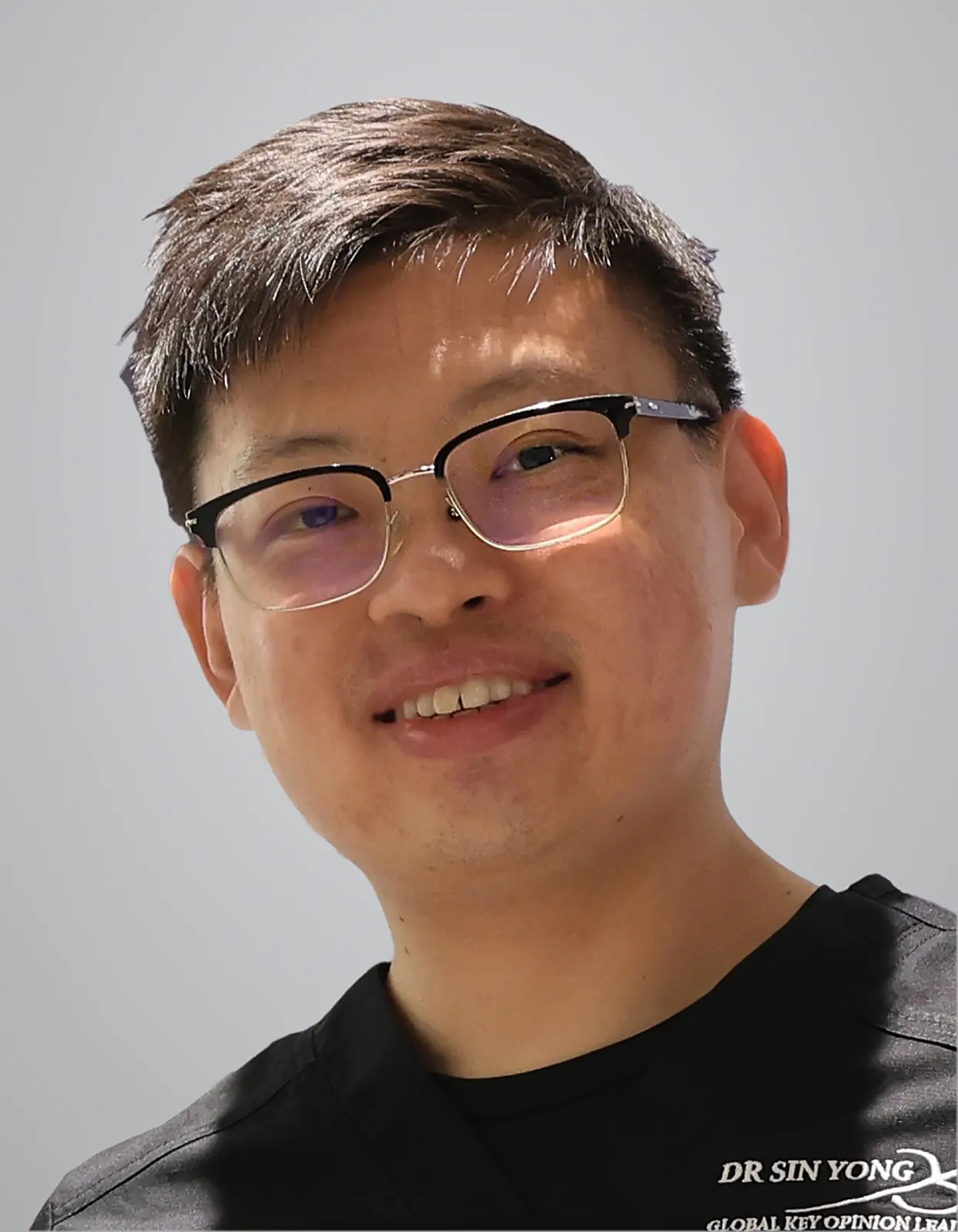
Dr Sin Yong
This treatment is performed by Dr Sin Yong, after a consultation. Dr Sin Yong is a Global Key Opinion Leader for seven device makers and has been invited to teach doctors in São Paulo, Bangkok, Seoul, Taipei, Dubai and Singapore.
Invited to present or train: DEKA Academy 2026, Florence 2026 · DEKA Centre of Excellence, Singapore 2026
MBBS (NUS) · MRCS (Edinburgh) · MSc Aesthetic Medicine, Distinction (London) · MSc Practical Dermatology (Cardiff) · Professional Diploma in Obstetrics and Gynaecology (RCPI) · Profile · KOL brands & devices
R2 Glow vs pico laser vs fractional CO2 for sun spots and melasma
R2 Glow uses 1064 nm light at low, even energy, with 532 nm for superficial spots. These studies in Asian skin compared the same laser family (Q-switched Nd:YAG) with pico or fractional CO2 lasers, or tested a pico laser on its own:
| Comparison | Patients | What the study found | Source |
|---|---|---|---|
| 1064 nm picosecond vs 1064 nm Q-switched Nd:YAG toning for melasma, 5 sessions, split face | 20 Korean patients | Both improved melasma scores; no significant difference in efficacy, satisfaction or pain | Hong et al., 2022 |
| 532 nm Q-switched Nd:YAG vs fractional CO2 for sun spots | 25 Thai patients | Greater pigment improvement with Nd:YAG at weeks 6 and 12; 80% rated their Nd:YAG result excellent vs 8% for CO2; CO2 healed faster with less pain | Vachiramon et al., 2016 |
| 532 nm picosecond laser for sun spots | 20 Asian patients | 93% of lesions were more than 75% cleared after one treatment | Negishi et al., 2018 |
In practice, the right laser depends on the type of pigment and how much downtime you accept, and the studies are small. At SkinRev Lab, Dr Sin Yong, medical adviser, examines the pigment first and explains whether R2 Glow or pico laser fits; R2 Glow is priced at consultation.
R2 Glow side effects and how often they happen
Most people have redness for a few hours after R2 Glow. One of the main side effects in Asian skin is temporary darkening, called post-inflammatory hyperpigmentation (PIH). The key facts above give the other main risk, mottled pale patches after repeated low-fluence toning sessions for melasma; this table adds how often PIH followed treatment of sun spots.
| Laser and use | How often PIH occurred | Source |
|---|---|---|
| 532 nm Q-switched Nd:YAG for sun spots | 20.3% of 516 Korean patients, five hospitals | Kang et al., 2017 |
| 532 nm picosecond laser for sun spots | Under 5% of lesions in 20 patients | Negishi et al., 2018 |
| 532 nm Q-switched Nd:YAG vs fractional CO2 for sun spots | No significant difference between the two lasers in 25 Thai patients | Vachiramon et al., 2016 |
In the Korean survey, PIH was more likely when the sun spots were reddish or the face had diffuse uneven pigment; age, sex, skin type and season were not clearly linked. This is why treatment is deferred during a tan and daily sunscreen is part of aftercare at SkinRev Lab, and why melasma is treated only with caution and a dedicated plan.
Quick answer
- A low-downtime brightening course on a Fotona Nd:YAG platform, designed to even out tone and fade scattered sun-related pigment step by step.
- Used for: Dull & Uneven Skin Tone, Sun Spots & Freckles.
- Performed by: Dr Sin Yong at SkinRev Lab, #B1-28 CityLink Mall (City Hall MRT).
- Book: WhatsApp SkinRev Lab on +65 8266 9585.
- Suitability, number of sessions and pricing are decided at consultation; individual results vary.
Watch · Dr Sin Yong explains
R2 Glow is Dr Sin Yong's brightening and toning protocol for dull, uneven skin. For people looking for an R2 Glow laser in Singapore, it is performed by Dr Sin Yong on the Fotona StarWalker platform, an Nd:YAG laser system that can deliver very short picosecond pulses as well as nanosecond (Q-switched) pulses at 1064 nm, with a 532 nm wavelength available for more superficial brown spots. What each Fotona laser system does is explained in our Fotona guide.
The idea is a series of gentle, non-ablative sessions rather than one strong treatment. The skin surface is not removed. Each session breaks up a little of the scattered pigment that makes skin look patchy or tired, and the body clears it between visits. Over a course, tone tends to look more even and brighter, and individual sun spots can fade. It is aimed at people who want improvement with minimal disruption to work and social life. The "black doll" facial is explained in our guide to the carbon laser peel.


Full guides: Melasma treatment in Singapore · Pigmentation treatment in Singapore
How it works
The mechanism,
in plain English
Nd:YAG light at 1064 nm passes through the epidermis with relatively little absorption and reaches the upper dermis, while still being absorbed by melanin. When it is delivered in extremely short pulses, pigment granules are shattered largely by a pressure (photoacoustic) effect rather than by heat, which limits heat spread into neighbouring skin. The fragments are then removed over the following weeks by the skin's clean-up cells.
Where a defined sun spot sits close to the surface, the 532 nm wavelength, which brown pigment absorbs strongly, can be used on that spot. The protocol is built on low, even energy across the face, with cooling, rather than high energy on a few points. That balance matters in Asian skin: too much energy can provoke rebound darkening, while too little does nothing, so settings are adjusted session by session according to how the skin responds.
“A brighter tone comes from a steady course and daily sun protection, not from a single strong session.”
— Dr Sin Yong, SkinRev Lab
- Energy / device
- Fotona StarWalker Nd:YAG: 1064 nm picosecond and Q-switched pulses; 532 nm for superficial spots
- Target layer
- Melanin in the epidermis and upper dermis
- Typical session
- About 30 minutes
- Downtime
- Usually minimal: mild redness for a few hours; darker spots may flake over a few days
- Performed by
- Dr Sin Yong, SkinRev Lab
Is it right for you
Who it suits,
and who it does not
R2 Glow laser in Singapore suits people whose main concern is dull, patchy or uneven tone, scattered sun-related pigmentation, light freckling, or residual brown marks after acne, and who prefer a gradual approach with little visible downtime. Busy professionals who cannot take a week off for resurfacing often choose this kind of course. It also suits people with medium skin tones common in Singapore, where gentle settings are preferred to aggressive single treatments. Yellow laser is not offered at SkinRev Lab; for what it does and how R2 and T2 compare, read yellow laser in Singapore.
It is not designed for deep scars, significant skin laxity or large raised growths. A single prominent spot may clear faster with a targeted pigment laser. Melasma can be treated only with caution and a specific medical plan, because it relapses easily and can darken with heat. Treatment is deferred during a tan, in pregnancy, and while taking light-sensitising medicines. Any mole or spot that is changing, raised or irregular must be examined by a doctor before any laser is used near it.
Non-invasive alternative at SkinRev Lab
HydraFacial Syndeo — HydraFacial Syndeo at SkinRev cleanses, extracts and hydrates, which can make skin look fresher and more luminous straight away. It is a good maintenance step between laser sessions, but it works on the surface and does not break up pigment in the skin. Read more: HydraFacial Singapore
What to expect
Consultation, session
and aftercare
At consultation, Dr Sin Yong looks closely at your pigment to identify sun spots, freckles, post-acne marks or melasma, since they can sit side by side and respond differently. Dr Sin Yong checks your skin type, current skincare and sun exposure, and explains how R2 Glow compares with pico laser and laser toning for your skin. A course is usually planned at consultation, with sessions spaced a few weeks apart and maintenance discussed afterwards.
During the session you wear eye protection; the laser feels like light snapping with warmth, and cooling keeps it comfortable. Numbing cream is optional. Afterwards your skin may be pink for a few hours, and darker spots may turn slightly darker before flaking away over a few days. Use a gentle cleanser, moisturiser and broad-spectrum sunscreen every day, and pause strong exfoliants or retinoids briefly if advised.
Where this happens
Medical and non-invasive treatments — SkinRev Lab, CityLink Mall #B1-28, 1 Raffles Link, Singapore 039393. Underground from City Hall MRT and Esplanade MRT; a short walk from Raffles Place, Marina Bay, Suntec and Bugis. Open daily 11am–8pm. Medical treatments by Dr Sin Yong; facials and body treatments by trained therapists.
Dr Sin Yong performs medical treatments at SkinRev Lab, CityLink Mall (City Hall).
What the research says
The evidence,
with sources
Nd:YAG lasers with picosecond and Q-switched pulses have a broad research base for pigment. A systematic review of picosecond lasers in dermatology found level I to IV evidence for benign pigmented lesions and level II evidence for skin rejuvenation, concluding the technology is safe and effective across these uses. A 2025 systematic review of clinical studies on solar lentigines found that laser treatments, including Q-switched and picosecond lasers, appeared more effective than other methods such as creams or cryotherapy, with mostly mild, temporary side effects.
The main caution in Asian skin comes from studies of low-energy 1064 nm Q-switched Nd:YAG for melasma. A systematic review found it generally effective and safe, but reported that high cumulative energy can cause pale mottled patches and that aggressive use can trigger darker pigment, with recurrence common after stopping. These findings are the reason R2 Glow uses measured settings and spacing, and why results are described as gradual and variable.
References
- Wu DC, Goldman MP, Wat H, et al. A systematic review of picosecond laser in dermatology: evidence and recommendations. Lasers Surg Med. 2021;53(1):9-49.
- Mardani G, Nasiri MJ, Namazi N, et al. Treatment of solar lentigines: a systematic review of clinical trials. J Cosmet Dermatol. 2025;24(4):e70133.
- Lee YS, Lee YJ, Lee JM, et al. The low-fluence Q-switched Nd:YAG laser treatment for melasma: a systematic review. Medicina (Kaunas). 2022;58(7):936.
Common questions
Your questions,
answered
How much does R2 Glow laser in Singapore cost at SkinRev Lab?
Pricing is given at consultation at SkinRev Lab, because it depends on the area treated, the type of pigment and how long a course your skin is likely to need. It is worth asking how the plan fits with daily sun protection and skincare, since those determine how long the brightening lasts as much as the laser does.
How is R2 Glow different from pico laser and laser toning?
All three target pigment, so they overlap. R2 Glow runs on the Fotona StarWalker Nd:YAG platform as a brightening course; the pico laser here uses the T2 Frax Radiance protocol on a DEKA platform with a 785 nm picosecond wavelength, also used for tattoos; laser toning uses low-energy Q-switched 1064 nm pulses. Dr Sin Yong chooses based on your pigment type, its depth and your skin tone.
How many sessions will I need?
Brightening is gradual, so R2 Glow is planned as a course rather than a single visit. The number of sessions depends on how much pigment you have, how deep it sits and your sun exposure, and is set at consultation. Sessions are usually a few weeks apart. Many people then continue with occasional maintenance, especially if they spend time outdoors.
Is there any downtime?
Usually very little. Mild redness typically settles within a few hours and most people return to work the same day. Darker spots may look slightly darker before they flake off over a few days. Avoid strong sun, saunas and harsh exfoliants for a short period afterwards, and use sunscreen daily. Make-up can usually be applied once the skin has calmed.
Can R2 Glow treat melasma?
Mild melasma can sometimes be included, but only with caution and a dedicated melasma plan. Melasma is driven by hormones, UV and visible light, and heat, and it can darken if treated too aggressively. Dr Sin Yong first confirms whether your pigment is melasma, sun spots or a mix, then sets energy and intervals conservatively, alongside sunscreen and prescription creams where appropriate.
Is R2 Glow suitable for sensitive skin?
Often, yes, because it is non-ablative and uses gentle energy with cooling. However, active eczema, a rosacea flare, sunburn or a recent strong peel should settle first, and people who tend to darken after irritation need extra care. Tell the doctor about any reactions to past treatments and about the skincare you use, so the settings and aftercare can be adjusted.
What is R2 Glow laser?
R2 Glow is Dr Sin Yong's brightening and toning laser protocol, performed by Dr Sin Yong on the Fotona StarWalker Nd:YAG platform, which uses very short 1064 nm pulses to break up scattered pigment for the body to clear, evening out dull, uneven tone over a course of gentle sessions. It is non-ablative, so the skin surface is not removed, and downtime is usually minimal. A 532 nm wavelength can treat superficial brown spots. Pricing is given at consultation.
What is R2T2 laser?
"R2T2" is how some people refer to R2 Glow and T2 Frax Radiance together. They are two separate protocols on two platforms: R2 Glow on the Fotona StarWalker for tone, and T2 Frax Radiance on the DEKA TORO for pigment. Dr Sin Yong decides which suits your skin at consultation.
Related
Concerns it treats & related treatments
R2 Glow laser course, visit by visit
R2 Glow is planned as a course. This is how it usually runs; Dr Sin Yong sets the number of sessions and the gap for your skin.
| Stage | What happens | What you notice |
|---|---|---|
| Consultation | Dr Sin Yong checks the type of pigment, looks for melasma, which needs a dedicated plan, and asks about sun, tanning and skincare | A plan with the number of sessions and the gap between them |
| First session | About 30 minutes of low, even energy over the face | Mild redness for a few hours; darker spots may look darker before they flake |
| Later sessions, a few weeks apart | Settings adjusted to how your skin responded | Tone looks more even gradually; brown spots lighten over the course |
| If R2T2 is planned | R2 Glow and T2 Frax Radiance are separate protocols; the order and gap are set at consultation | Many people need only one of the two |
| After the course | A review of what has changed | Maintenance sessions may be suggested; daily sunscreen keeps the result |
Planning R2 Glow around events, sun and other treatments
| Situation | What we usually advise |
|---|---|
| An event coming up | Book R2 Glow at least a week before, so any redness or flaking has settled |
| A recent tan or a beach holiday ahead | Wait until the tan fades, and avoid strong sun for about a week after each session |
| R2T2 (R2 Glow with T2 Frax Radiance) | Allow extra time before an event, as the two are usually done on separate days |
| A HydraFacial or other facial | Usually on a different day; Dr Sin Yong advises the gap |
| Filler or wrinkle-relaxing injections | Tell Dr Sin Yong; laser is often done first or on a separate day |
| Strong actives, such as vitamin A creams or acids | Pause them for a few days on either side of each session |
| Pregnancy or breastfeeding | Usually postponed |
More on spacing treatments: timing a HydraFacial with injectables and laser.
References
- Lee YS, Lee YJ, Lee JM, Han TY, Lee JH, Choi JE (2022). The low-fluence Q-switched Nd:YAG laser treatment for melasma: a systematic review. Medicina 58(7):936. doi:10.3390/medicina58070936 Source
- Munavalli GS, Leight-Dunn HM (2024). Pilot study to demonstrate improvement in skin tone and texture by treatment with a 1064 nm Q-switched neodymium-doped yttrium aluminum garnet laser. Journal of Clinical Medicine 13(5):1380. doi:10.3390/jcm13051380 Source
- Fitzpatrick A, Chan J (2024; peer reviewed 2025). Solar lentigo. DermNet. Source
- Hong JK, Shin SH, Park SJ, Seo SJ, Park KY (2022). A prospective, split-face study comparing 1,064-nm picosecond Nd:YAG laser toning with 1,064-nm Q-switched Nd:YAG laser toning in the treatment of melasma. J Dermatolog Treat 33(5):2547-2553. doi:10.1080/09546634.2022.2033674. PMID 35067157. Source
- Vachiramon V, Panmanee W, Techapichetvanich T, Chanprapaph K (2016). Comparison of Q-switched Nd: YAG laser and fractional carbon dioxide laser for the treatment of solar lentigines in Asians. Lasers Surg Med 48(4):354-9. doi:10.1002/lsm.22472. PMID 27096729. Source
- Negishi K, Akita H, Matsunaga Y (2018). Prospective study of removing solar lentigines in Asians using a novel dual-wavelength and dual-pulse width picosecond laser. Lasers Surg Med 50(8):851-858. doi:10.1002/lsm.22820. PMID 29608215. Source
- Kang HJ, Na JI, Lee JH, Roh MR, Ko JY, Chang SE (2017). Postinflammatory hyperpigmentation associated with treatment of solar lentigines using a Q-Switched 532-nm Nd: YAG laser: a multicenter survey. J Dermatolog Treat 28(5):447-451. doi:10.1080/09546634.2016.1254330. PMID 27786580. Source