Guide · Telogen effluvium
Telogen effluvium why hair sheds months after a trigger, and how it recovers
Telogen effluvium is the sudden, all-over shedding that follows a fever, childbirth, a crash diet or a hard few months. Here is what triggers it, how a doctor confirms it, which blood tests help, how long recovery takes, and when it is hiding pattern hair loss.
Quick answer
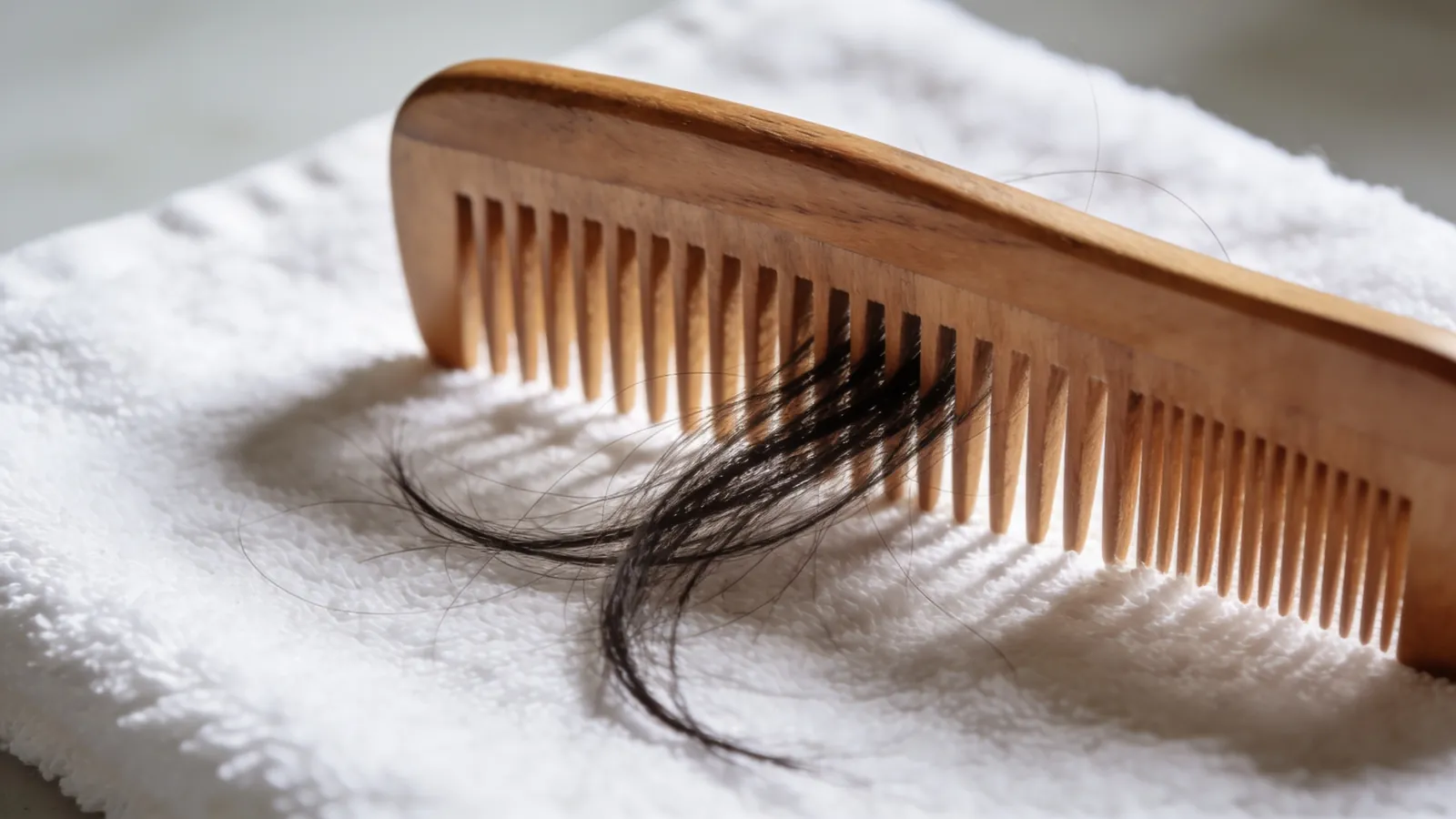
- Telogen effluvium is sudden, diffuse hair shedding that starts about two to three months after a shock to the body, such as a high fever, childbirth, surgery, a crash diet, major stress, a thyroid problem or a new medicine. Many more hairs than usual switch into the resting (telogen) phase at once, then fall out together.
- It thins hair all over rather than causing bald patches, and it does not scar, so the follicles keep working. Once the trigger has passed, shedding usually eases within about six to nine months and density gradually returns; one review reports remission in about 95% of acute cases.
- A doctor confirms it with your history, a gentle pull test, a magnified scalp examination and, where needed, blood tests such as a full blood count, ferritin and thyroid function. Shedding that lasts beyond six months, or a parting that keeps widening, can mean pattern hair loss has been unmasked.
- SkinRev Lab does not diagnose or treat hair loss. Dr Sin Yong assesses shedding at IN Eternity Clinic, Pacific Plaza, and may add H2LT low-level laser or other treatment where suitable, priced at consultation; needle-free PDRN scalp care at SkinRev (S$348 before GST) looks after scalp condition only.
The basics
What is telogen effluvium?
Telogen effluvium (TE) is one of the most common causes of sudden, diffuse hair shedding. At any one time about 90% of scalp hairs are in the growing (anagen) phase, which lasts years, and about 10% are in the resting (telogen) phase, which lasts a few months before the hair falls out and a new one starts. A shock to the body can push a much larger share of follicles into the resting phase at the same time.
Because resting hairs stay in place for around three months, the shedding starts weeks to months after the event that caused it, typically two to three months later. By then the fever, the birth or the stressful period may be over, which is why many people do not connect the two.
Telogen effluvium does not scar: the follicles are not destroyed, and new hairs are already forming behind the ones that fall. It thins hair all over, sometimes most noticeably at the temples, but on its own it does not cause bald patches or complete baldness.
Triggers
What triggers telogen effluvium, and why the delay
Doctors often work backwards: what happened about two to three months before the shedding began? In about a third of cases no clear cause is found, but the common triggers are well recognised.
In Singapore, dengue is a trigger worth knowing about. In a 2026 study of 1,302 people with dengue at one hospital in southern China, about 1.2% developed hair loss, almost all of them women; it usually appeared during recovery, and telogen effluvium was the commonest type.
Shedding after childbirth is widely described, but how often it truly happens is debated; one review of the published data found little hard evidence on its frequency. Never stop a prescribed medicine because of shedding without speaking to your doctor first, as there is often an alternative.
| Trigger | Examples | When shedding usually starts |
|---|---|---|
| High fever or illness | Dengue, influenza and other feverish infections; a stay in hospital | Often during recovery, from a few weeks to about three months after the fever |
| Childbirth | Shedding after delivery, often called postpartum hair loss | About two to four months after delivery |
| Surgery or injury | Major operations, accidents, significant blood loss | About two to three months later |
| Crash dieting or rapid weight loss | Very low-calorie or low-protein diets, disordered eating | About two to four months after intake drops |
| Major emotional stress | Bereavement, burnout, a difficult few months | About two to three months later; the link is harder to prove |
| Thyroid disorders | An overactive or underactive thyroid | Gradual; usually settles once thyroid levels are corrected |
| Low iron or other shortfalls | Iron; less often zinc, vitamin D, vitamin B12 or folate | Gradual; how strongly iron is linked is still debated |
| Medicines | Starting, stopping or changing the dose of some medicines, including stopping the contraceptive pill | Often around 12 weeks after the change |
Telling it apart
Telogen effluvium vs pattern hair loss vs alopecia areata
Three conditions account for most of the hair loss people bring to a doctor, and they behave differently. A few features usually point the way, although more than one can be present at the same time.
A burning, sore or scaly scalp, shiny patches without visible follicle openings, or redness around the hairs suggest an inflammatory or scarring condition instead. These need a doctor promptly, because scarring hair loss cannot be reversed.
| Telogen effluvium | Pattern hair loss | Alopecia areata | |
|---|---|---|---|
| How it starts | Suddenly; people often know the month it began | Gradually, over months to years | Often suddenly |
| What you notice | Handfuls in the shower drain or brush; a thinner ponytail | Wider parting, see-through crown or receding temples | Smooth, round bald patches |
| Where | All over the scalp, sometimes most obvious at the temples | Crown and parting in women; temples and crown in men | Patches on the scalp, beard or eyebrows |
| Shed hairs | Full-length hairs with a small white bulb at the root | Fewer shed hairs; many short, fine hairs on the scalp | Short broken hairs at the edge of a patch |
| Usual course | Settles over months once the trigger has passed | Progressive without treatment | Patches can regrow on their own, or spread |
| First step | Doctor to find and correct the trigger | Doctor for medical treatment | Doctor first |
Diagnosis
The pull test and other checks a doctor uses
Diagnosis starts with the story: when the shedding began, what happened two to four months earlier, diet and weight changes, periods and pregnancy, new medicines, and any family history of thinning. Many people with telogen effluvium can name the week it started.
In the hair pull test, the doctor gently grasps a small bundle of hairs close to the scalp and slides the fingers along to the ends, repeating this in a few areas. If more hairs than expected come away easily, and they are resting hairs with a small white bulb at the root, shedding is active. The test is less reliable if you washed your hair that day, so you may be asked not to shampoo for a day or more beforehand.
Some doctors use a modified wash test: after five days without shampooing, you wash your hair over a basin lined with gauze and count what comes out. More than about 100 hairs, with fewer than 10% short, fine hairs, points to telogen effluvium; a higher share of short, fine hairs suggests pattern hair loss as well. A magnified scalp examination (trichoscopy) helps tell the two apart, and a scalp biopsy is usually kept for shedding that has lasted more than six months or remains unclear.
Blood tests
Blood tests a doctor may order for hair shedding
There is no single fixed panel. Tests are chosen from your history to find a trigger that is still active, such as a thyroid problem or low iron, because correcting it is often what allows the shedding to settle.
Evidence linking low iron to hair shedding is mixed, and a major review found too little evidence to test everyone with hair loss, although many hair clinics check iron because deficiency is common in women and worth treating. Take supplements only for a confirmed shortfall: too much vitamin A or selenium can itself cause hair loss, and excess iron is harmful.
- Full blood count: anaemia, and clues to recent infection or blood loss.
- Iron studies, including ferritin: iron stores. Ferritin can read normal or high during infection or inflammation, so it is interpreted with other results.
- Thyroid function: both an overactive and an underactive thyroid can cause shedding.
- Vitamin B12 and folate, and in some people vitamin D and zinc, especially after a restricted diet.
- Hormone tests if shedding comes with irregular periods, acne or new facial hair, which can point to polycystic ovary syndrome.
- Other tests, such as for autoimmune disease, only when your symptoms suggest them.
Recovery
Telogen effluvium recovery timeline
One review reports that acute telogen effluvium resolves in about 95% of cases. Recovery can be incomplete if the trigger continues, if a deficiency is not corrected, or if pattern hair loss was developing underneath. Photos of your parting and hairline taken in the same light each month are a more reliable guide than counting hairs in the drain.
| When | What usually happens |
|---|---|
| The trigger | Fever, birth, surgery, a crash diet or another shock; no shedding yet |
| About 2 to 3 months later | Shedding starts suddenly; hair comes out in handfuls when washing or brushing |
| The following few months | Shedding peaks, then starts to slow once the trigger has passed |
| Within about 6 to 9 months | Shedding tapers off in most cases; short new hairs appear, often along the hairline and temples |
| 6 to 12 months and beyond | Density gradually returns as new hairs lengthen, at about a centimetre a month; long hair takes longer to look full |
| Shedding for more than 6 months | Called chronic telogen effluvium; see a doctor to look for an ongoing trigger or pattern hair loss |
When it lingers
When telogen effluvium unmasks pattern hair loss
Telogen effluvium and pattern hair loss (androgenetic alopecia) often overlap. A heavy shed can unmask a genetic tendency to pattern thinning that had been developing quietly: when the hair grows back, the crown, parting or temples look thinner than before, because some follicles had already begun to shrink.
Signs that it is more than telogen effluvium include a parting that keeps widening after the shedding slows, a crown that stays see-through, receding temples in men, and many short, fine hairs on a magnified scalp check. Pattern hair loss is progressive, so it is worth checking early, while fine hairs remain.
Chronic telogen effluvium is a separate pattern: shedding for more than six months, often in middle-aged women, that comes and goes over years without causing baldness. In a small study of five women with chronic telogen effluvium, the four followed for at least seven years kept a fluctuating shed with no visible loss of density and no follicle shrinkage on biopsy, while the fifth developed female pattern hair loss within 18 months. A doctor's review helps tell these apart.
At home
Scalp care and daily habits while hair recovers
No shampoo, serum or supplement stops telogen effluvium once it has started; the hairs that fall were already resting. Care at home is about protecting the hair that is growing back and not adding new problems.
At SkinRev Lab, needle-free PDRN scalp care (the Korea Professional (Scalp) tier, 90 minutes, S$348 before GST) is for the condition and comfort of the scalp skin, such as an oily, dry or mildly irritated scalp. It does not treat telogen effluvium or regrow hair, and our Aesthetic Specialists will point you to a doctor first if shedding is active.
- Keep washing as often as you need to. Washing does not cause the loss; it releases hairs that were already going to fall, which is why more come out after a gap between washes.
- Handle hair gently: a wide-toothed comb, low heat, and loose styles rather than tight buns, ponytails or extensions that pull on the roots.
- Eat regular meals with enough protein, and avoid crash diets while you recover.
- Treat dandruff or an itchy, flaky scalp; inflammatory scalp conditions such as seborrhoeic dermatitis can add to shedding. A scalp that stays red, scaly or sore needs a doctor.
- Skip high-dose supplements unless a blood test shows a shortfall.
- Thinner partings burn more easily in Singapore's strong sun; a hat or a scalp sunscreen helps.
- Take the worry seriously. Shedding is distressing; tell your doctor if it is affecting your sleep or mood.
See a doctor
When to see a doctor about hair shedding
A GP can start the blood tests. For hair loss that does not fit a simple pattern, or for patches and scalp inflammation, a dermatologist or a doctor with an interest in hair is the right next step.
- Shedding that is still heavy after three months, or has gone on for more than six.
- Round bald patches, or shiny, scarred or inflamed patches.
- A red, scaly, burning or painful scalp.
- Shedding with tiredness, weight change, palpitations, irregular periods, acne or new facial hair.
- Hair loss that began after starting or changing a medicine; do not stop it on your own.
- Shedding after dengue or another illness that has not settled within a few months.
- Shedding after childbirth that has not settled within six to twelve months, or a parting that keeps widening.
- Very low food intake, or a large recent weight loss.
In our network
Doctor-led options at IN Eternity Clinic
At IN Eternity Clinic, 9 Scotts Road, #12-01 Pacific Plaza, beside Orchard MRT, Dr Sin Yong assesses shedding with a history, a magnified scalp examination, baseline photographs and blood tests where indicated. For telogen effluvium with a single clear trigger, confirming the cause, correcting what the tests find and allowing time is often the whole plan.
Where shedding has dragged on, or after childbirth once the cause has been checked, he may suggest H2LT, an in-clinic low-level red laser protocol in visits of about 15 to 20 minutes, aimed at follicles that are still present. If pattern hair loss has been unmasked, the plan may include prescription treatment and, for selected people with pattern thinning, Regenera Activa, which places micrografts from three small 2.5 mm scalp samples into thinning areas in one visit. Regenera Activa is for pattern thinning, not for telogen effluvium on its own.
Medical treatment is priced at consultation by the clinic; WhatsApp +65 8815 3008. SkinRev Lab, at CityLink Mall #B1-28 by City Hall MRT, does not diagnose hair loss, prescribe or inject, and passes hair loss enquiries to the clinic.
Sources
References & sources
- Chang FLC, Oakley A (ed). Telogen effluvium (hair shedding). DermNet NZ; updated November 2019.
- Asghar F, Shamim N, Farooque U, Sheikh H, Aqeel R. Telogen effluvium: a review of the literature. Cureus. 2020;12(5):e8320.
- Rebora A. Telogen effluvium: a comprehensive review. Clin Cosmet Investig Dermatol. 2019;12:583-590.
- Sinclair R. Chronic telogen effluvium: a study of 5 patients over 7 years. J Am Acad Dermatol. 2005;52(2 Suppl 1):S12-S16.
- Trost LB, Bergfeld WF, Calogeras E. The diagnosis and treatment of iron deficiency and its potential relationship to hair loss. J Am Acad Dermatol. 2006;54(5):824-844.
- Gai Z, Shaojuan H, Manmin L, Shufang L. Low platelet count and hematocrit as risk factors for alopecia in dengue fever: a retrospective analysis. Am J Trop Med Hyg. 2026;114(1):170-173.
- Mirallas O, Grimalt R. The postpartum telogen effluvium fallacy. Skin Appendage Disord. 2016;1(4):198-201.
Common questions
Your questions,
answered
Is telogen effluvium permanent?
Usually not. The follicles are not damaged, so hair grows back once the trigger has passed, and shedding usually eases within about six to nine months. If it lasts longer than six months, or your hair does not return to its old density, a doctor should check for an ongoing trigger or pattern hair loss.
How long does telogen effluvium last?
Acute telogen effluvium lasts less than six months by definition, and shedding usually tapers off within six to nine months of starting. Getting back full length and density takes longer, because new hair grows about a centimetre a month.
Will my hair grow back after telogen effluvium?
In most people, yes. One review reports remission in about 95% of acute cases, and short new hairs often appear first along the hairline and temples. Recovery can be incomplete if the trigger continues or pattern hair loss is present underneath.
Can stress cause hair loss?
It can trigger telogen effluvium, typically two to three months after a stressful period. Stress is harder to prove as the cause than fever or childbirth, and hair loss is stressful in itself, so other triggers such as illness, diet changes or thyroid problems should be checked too.
Telogen effluvium or androgenetic alopecia: how can I tell?
Telogen effluvium starts suddenly, with diffuse shedding of full-length hairs. Pattern hair loss creeps in, with a widening parting, a thinner crown or receding temples and many fine hairs. The two often overlap, and a magnified scalp examination by a doctor is the reliable way to tell.
Can dengue cause hair loss?
Yes. Hair shedding after dengue is usually telogen effluvium and tends to appear during recovery, from a few weeks to a few months after the fever. In one hospital study about 1 in 100 people with dengue developed hair loss. It usually settles; see a doctor if it continues or you still feel unwell.
What blood tests should I do for hair shedding?
A doctor chooses them from your history. Common ones are a full blood count, ferritin and iron studies, thyroid function, vitamin B12 and folate, and sometimes vitamin D, zinc or hormone tests. There is no single panel that suits everyone.
Should I take biotin or hair supplements for telogen effluvium?
Only if a blood test shows a deficiency. Reviews do not support routine biotin, and too much vitamin A or selenium can itself cause hair loss. Correcting a real shortfall, such as low iron, is worthwhile.
How much does hair loss treatment cost in Singapore?
At IN Eternity Clinic, assessment, blood tests and treatment such as H2LT are priced at consultation by the clinic, because the plan depends on the cause. At SkinRev Lab, needle-free PDRN scalp care is S$348 per 90-minute session before GST; it supports scalp condition but does not treat shedding.