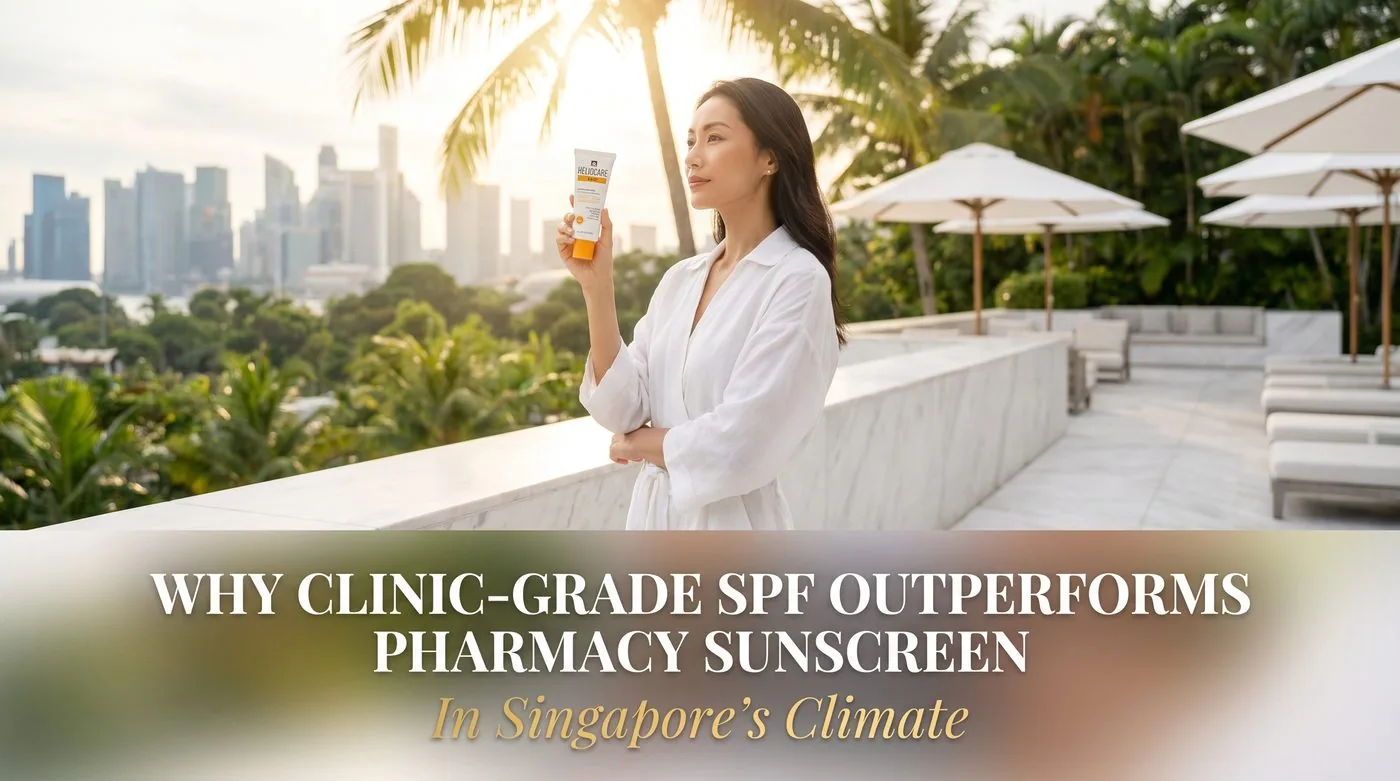
In Singapore's year-round UV, daily sunscreen is a key anti-ageing habit, and choosing sunscreen in Singapore comes down to a few label checks. What matters most is a broad-spectrum filter in a texture you will actually reapply, because sunscreen only works when it is reapplied.
Sun protection is non-negotiable in Singapore's year-round UV environment. But not all sunscreens are equal — understanding how professional-grade and pharmacy formulations differ helps you choose well. What a facial for sun damaged skin can and cannot do is set out in our sun damage guide.
How strong UV is in Singapore
UV in Singapore is high all year, so sunscreen is a daily habit rather than a holiday one. NEA reports that it is common for the UV index to reach Very High (8 to 10) and Extreme (11 and above) between 11am and 3pm on days with little cloud.
Most of what reaches you is UVA. NEA notes that about 94% of the UV radiation reaching the ground is UVA and about 6% is UVB. UVB is the main cause of sunburn, while UVA reaches deeper into the skin and contributes to ageing and pigmentation, so protection against both matters.
Thick cloud and rain can lower the reading, but conditions change quickly and readings vary across the island. Checking NEA's live UV index is more reliable than judging by the sky.
UV index in Singapore: what each level means
SPF, PA and broad spectrum: reading the label
Look for three things on the label: an SPF of at least 30, a PA rating, and the words broad spectrum. NEA's advisory, sourced from the Ministry of Health, recommends at least SPF 30. Higher SPF numbers add only a little extra filtering, but they give a margin for the fact that most people apply less than the tested amount.
| Label | What it measures | What to look for |
|---|---|---|
| SPF | Protection against UVB, the main cause of sunburn | SPF 30 filters about 97% of UVB and SPF 50 about 98%; no sunscreen blocks 100% |
| PA+ to PA+++ (and higher) | Protection grade against UVA, common on Asian and European products | More plus signs mean more UVA protection; choose a high grade for pigment-prone skin |
| Broad spectrum | Covers both UVA and UVB | Essential in Singapore, where most UV reaching the ground is UVA |
| Water resistant | Stays effective for a tested time while swimming or sweating | Reapply after 40 minutes for water-resistant and 80 minutes for very water-resistant formulas |
Mineral vs chemical sunscreen
Both types work; the better one is the one that suits your skin and that you will wear every day. Mineral, also called physical, sunscreens use zinc oxide, titanium dioxide or both. Chemical sunscreens use organic filters, such as avobenzone, that absorb UV. Many modern products combine the two.
A NUHS dermatology article advises people with sensitive skin to choose physical sunscreens, because chemical filters have been known to cause allergic reactions. The trade-off is texture: older mineral formulas can leave a white cast, although tinted and newer mineral products reduce this.
In Singapore, sunscreens may only contain UV filters that have been assessed as safe and effective, according to the Ministry of Health. So the choice between mineral and chemical is mainly about comfort, sensitivity and finish rather than safety.
Tinted sunscreen, iron oxides and melasma
If you have melasma or pigment that darkens easily, a tinted sunscreen containing iron oxides is worth considering. Standard sunscreens filter UV, but visible light also drives pigmentation, especially in medium and darker skin tones.
In a double-blind randomised trial of 68 people with melasma, all using a prescription lightening cream cream, those given an SPF 50+ sunscreen with iron oxide improved more over eight weeks than those using a UV-only SPF 50+ sunscreen. A 2026 review of visible-light protection found that tinted sunscreens with iron oxides and pigmentary titanium dioxide gave the most effective and cosmetically acceptable visible-light protection.
Tinted sunscreen supports a melasma plan; it does not replace one. Melasma needs a doctor's diagnosis and long-term care.
Melasma and pigmentation · Melasma treatment in Singapore: types and options
How much sunscreen to use, and how often
Most people use too little. The American Academy of Dermatology notes that people often apply only 20 to 50% of the amount needed to reach the SPF on the label. For the face and neck, NUHS suggests about one teaspoon; for the whole body, the AAD suggests about 30 ml, roughly a shot glass.
Apply about 15 minutes before going out, reapply every two hours outdoors, and reapply straight after swimming or heavy sweating. A typical Singapore day might look like this:
- Morning: a full teaspoon on face, neck and ears after moisturiser, before makeup.
- Commute and lunch outdoors: carry an umbrella or seek shade between 11am and 3pm.
- Office by a window: ordinary glass filters out most UVB but lets much of the UVA through, so morning sunscreen still matters.
- After exercise, swimming or a long walk in the heat: reapply rather than wait for the two-hour mark.
- Makeup with SPF: helpful as a top-up, but you would need far more foundation than usual to reach the SPF on the label.
Sunscreen in heat, humidity and sweat
In Singapore, the sunscreen you will actually reapply beats the one with the most impressive label. Heat and humidity make heavy creams feel greasy, and sweat and wiping remove product from the skin, which is why reapplication matters more here than in cooler climates.
For sport or outdoor work, choose a water-resistant or very water-resistant formula and reapply after 40 or 80 minutes respectively. No sunscreen is waterproof or sweatproof. For oily or acne-prone skin, gel, fluid and oil-free textures are usually easier to wear; look for non-comedogenic on the label. For dry or dehydrated skin, a lotion or cream texture can double as a light moisturiser.
Facials for oily and acne-prone skin
What clinic-grade or professional-grade sunscreen really means
Clinic-grade, professional-grade and medical-grade are marketing terms, not regulated categories. In Singapore, sunscreens are regulated as cosmetic products by HSA under the Health Products Act. They do not need pre-market approval, because they are not intended to prevent, treat or cure disease; instead, the dealer must notify HSA before selling them, and they may only contain permitted UV filters.
HSA checks the market after products go on sale. It samples and tests sunscreens for their declared UV filters, and in October 2025 the Ministry of Health said HSA would check SPF test reports from suppliers of notified sunscreens. Suppliers of non-compliant products or misleading claims face fines of up to S$50,000, up to two years' imprisonment, or both.
In practice, professional-grade usually means a product sold mainly through clinics, aesthetic centres or pharmacists, sometimes with extras such as antioxidants, visible-light protection or textures designed for skin after treatment. Those features can be useful, but they are not guaranteed by the term. Judge any sunscreen by its SPF, PA rating, broad-spectrum label, water resistance and how it feels on your skin.
Choosing a sunscreen for your skin
Match the formula to your skin and your day rather than looking for a single winner. A pharmacy sunscreen that meets the label checks and that you apply generously protects better than an expensive one used sparingly.
| Your skin or situation | What to look for |
|---|---|
| Oily or acne-prone | Gel or fluid, oil-free, labelled non-comedogenic |
| Dry or dehydrated | Lotion or cream texture with hydrating ingredients |
| Sensitive or reactive | Mineral filters, fragrance-free; patch-test first |
| Melasma or pigment-prone | Tinted with iron oxides, SPF 50 and a high PA grade |
| Sport, swimming or outdoor work | Very water-resistant, reapplied after 80 minutes |
| After a facial or laser treatment | Gentle, broad-spectrum, as advised by whoever treated you |
SkinRev shop · Sun spots and freckles
Choosing sunscreen in Singapore: a shelf checklist
Sunscreen aisles in Singapore are crowded with Japanese, Korean, European and local labels. Instead of chasing a brand, read the label for the things that matter in our climate.
| On the label | Look for | Why it matters in Singapore |
|---|---|---|
| SPF | 30 or higher for daily use; 50 for outdoor days | The UV index is often very high or extreme around midday |
| PA rating | PA+++ or PA++++ | UVA, which drives pigment and ageing, is present all year |
| Broad spectrum | The words broad spectrum, or a UVA logo | Covers both UVB and UVA |
| Tint or iron oxides | A tinted formula if you have melasma | Iron oxides also screen visible light |
| Water resistance | Water resistant (40 or 80 minutes) for sport and outdoor work | Sweat and humidity wear sunscreen off |
| Texture | Gel or fluid for oily skin; lotion or cream for dry skin | A texture you like is one you will reapply |
For pigment that sunscreen alone does not shift, see pigmentation treatment in Singapore.
Sunscreen after laser, peels and facials
Treated skin darkens more easily, so sun care after a treatment matters more than usual. The advice SkinRev Lab gives after common treatments:
- After pico laser: use sunscreen and shade strictly between sessions, and plan sessions away from beach trips.
- After CO2 laser: stay mostly indoors for the first days, start sunscreen when the doctor advises, and avoid deliberate sun for at least the first month.
- After a chemical peel or HydraFacial: use sunscreen every day; freshly exfoliated skin burns and darkens more easily.
- With melasma: a tinted SPF 50+ daily, reapplied, alongside the plan from melasma treatment in Singapore.
Sources
- National Environment Agency (Singapore). UV Radiation and UV Index; Advisory on sun protection measures (source: Ministry of Health).
- NUHS+ (National University Health System). 5 things you need to know about sun protection. 2022.
- American Academy of Dermatology. How to apply sunscreen.
- American Academy of Dermatology. Sunscreen FAQs.
- Ministry of Health Singapore. Verifying efficacy of protection levels in sunscreen products. Reply to parliamentary question, 15 October 2025.
- Castanedo-Cazares JP, Hernandez-Blanco D, Carlos-Ortega B, et al. Near-visible light and UV photoprotection in the treatment of melasma: a double-blind randomized trial. Photodermatol Photoimmunol Photomed. 2014;30(1):35-42.
- Visser WI, Amien A, Moola H, Naidoo K. Visible light protection strategies for diverse populations. Dermatol Ther (Heidelb). 2026;16(2):833-854.
Frequently Asked Questions
There are formulations for oily, dry, sensitive and acne-prone skin; your therapist can suggest one that suits your skin at your assessment.
Apply generously every morning and reapply about every two hours outdoors, and after sweating or swimming — Singapore's heat and humidity make reapplication especially important.
There is no single answer, because skin types differ. For daily use, choose a broad-spectrum sunscreen of at least SPF 30 with a good PA rating, in a texture light enough to reapply in the heat. Oily skin often suits gels or fluids; sensitive skin often suits mineral filters; pigment-prone skin benefits from a tinted formula with iron oxides.
Usually, yes. Thick cloud and rain can lower the UV index, but readings change quickly and vary across Singapore, so check NEA's live UV index rather than the sky. Indoors, ordinary window glass filters most UVB but lets much of the UVA through, so if you sit near a window or drive a lot, morning sunscreen is still worth it.
NEA's advisory, sourced from the Ministry of Health, recommends at least SPF 30. SPF 30 filters about 97% of UVB and SPF 50 about 98%. The bigger difference comes from how much you apply and how often you reapply, since most people use far less than the tested amount. Many people choose SPF 50 for long days outdoors.
Often, yes. Mineral sunscreens use zinc oxide or titanium dioxide, and a NUHS dermatology article advises people with sensitive skin to choose them, because chemical filters have been known to cause allergic reactions. If any sunscreen stings, itches or causes a rash, stop using it and see a doctor, who can check for a contact allergy.
Not automatically. Clinic-grade is a marketing term, not a regulated category. In Singapore, all sunscreens are regulated as cosmetics by HSA and must use permitted UV filters. A professional brand may offer useful extras, such as visible-light protection or a texture designed for treated skin, but SPF, PA rating, broad-spectrum cover and generous use matter most.
Some heavier or oily formulas can contribute to clogged pores in acne-prone skin. Gel or fluid textures labelled oil-free and non-comedogenic are usually easier to wear. Cleanse properly at night to remove sunscreen and sweat. If breakouts persist after switching products, a facial for congestion or a doctor's acne assessment may help more than another product change.
Singapore's strong UV accelerates pigmentation, melasma and ageing. Professional-grade sunscreen helps protect the results of treatments like pigmentation and skin-rejuvenation protocols.
Yes. Daily broad-spectrum protection is essential to prevent and manage pigmentation and melasma, common Singapore skin concerns.
The right sunscreen is one you will wear every day: SPF 30 or higher, PA+++ or PA++++, broad spectrum, in a texture that suits your skin, and tinted with iron oxides if you have melasma. Brand matters less than applying enough and reapplying.
There is no single answer, and we do not rank brands. In Singapore, sunscreens are regulated as cosmetics by HSA and may only use permitted UV filters, so compare labels instead: SPF, PA rating, broad-spectrum cover, water resistance and texture.
In everyday use the words mean the same thing. Sunblock used to describe mineral products (zinc oxide or titanium dioxide) that sit on the skin, and sunscreen chemical filters that absorb UV; many products now combine both. Choose by SPF, PA and texture, not by the name.
Trust the label rather than the brand: a stated SPF and PA rating, broad-spectrum cover and water resistance if you sweat. In Singapore, the dealer must notify HSA before selling a sunscreen, and it may only contain permitted UV filters.
More skin guides
Melasma treatment in Singapore →Acne scar treatment in Singapore →Enlarged pores treatment in Singapore →Eye bag and dark circle treatment →Glass skin facials in Singapore →Facials for acne-prone skin in Singapore →Sensitive skin treatment in Singapore →LDM facial: what it is and who it suits →PDRN and Rejuran explained →Oral sunblock in Singapore →