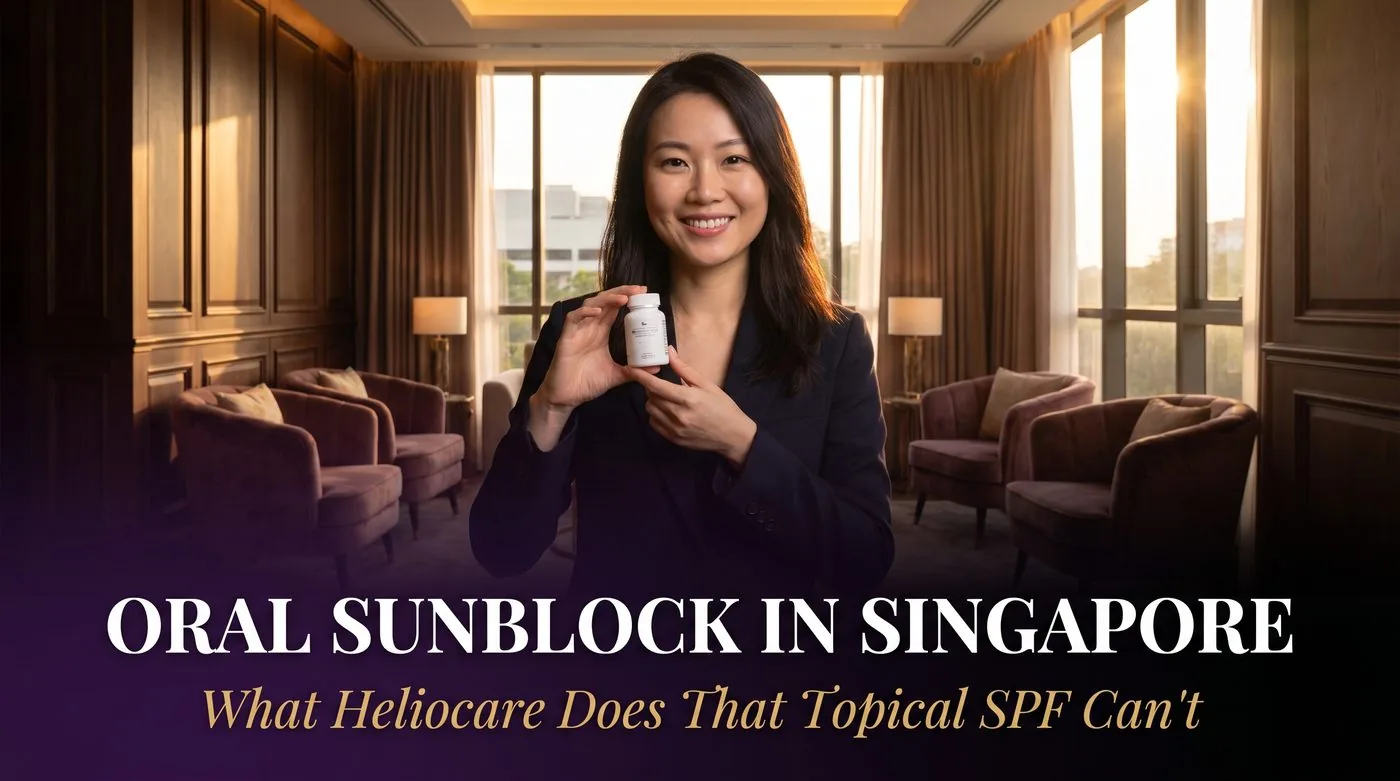
Oral sunblock does not replace sunscreen. It adds a second layer of antioxidant defence that works from within, which matters in Singapore where UV exposure is year-round and topical sunscreen is rarely reapplied often enough.
Internal sun protection through oral supplementation is a concept supported by published research. Heliocare oral capsules are one widely studied example — here is what they do and how they work.
Looking for the main guide? See UV index in Singapore.
What oral sunblock actually is
Oral sunblock is a daily supplement, not a sunscreen. Most products sold under the name, including Heliocare, are built on an extract of Polypodium leucotomos, a tropical fern. Cantabria Labs, which makes Heliocare, calls its standardised extract Fernblock.
The extract is studied as an antioxidant. The idea is that it helps the skin cope with the oxidative stress and inflammation that sunlight triggers, so a given amount of sun does a little less damage. It does not form a film on the skin, does not reflect or absorb UV the way a sunscreen does, and has no SPF or PA rating.
That is why the honest name is oral photoprotection rather than sunblock. It is an extra layer on top of sunscreen, shade and clothing, never a replacement for them.
Heliocare products in the SkinRev shop
What the studies show about Polypodium leucotomos
The research is real but small. Most trials involve tens of people rather than thousands, several are open-label or industry-linked, and many measure skin under a UV lamp rather than real life. The table summarises the studies most often quoted.
A 2025 systematic review found 21 qualifying articles, including 11 randomised controlled trials, across photoaging, sun allergy, actinic keratoses, melasma, vitiligo and eczema. The authors concluded that the extract has photoprotective and immune-modulating effects and an encouraging safety profile, and that it should be seen as an add-on to standard care.
| Study | Who took part | What was found | Limits |
|---|---|---|---|
| Middelkamp-Hup et al., 2004 | 9 healthy adults exposed to artificial UV | Less redness, fewer sunburn cells and less UV-related DNA damage in biopsies after taking the extract | Very small; lamp exposure, not daily life |
| Tanew et al., 2012 | 35 people with polymorphic light eruption (sun allergy) | After two weeks, 30% no longer reacted to repeated UVA provocation, and more exposures were needed to trigger a rash in the rest | Open study with no placebo group |
| Goh et al., 2018 (National Skin Centre, Singapore) | 40 Asian adults with melasma, all on a prescription lightening cream and SPF 50+ sunscreen | The extract group had lower melasma scores than placebo at 8 and 12 weeks | Pilot study; both groups improved, and it was an add-on to cream and sunscreen |
| Winkelmann et al., 2015 (safety review) | 19 human studies, 1,016 people | Side effects in 16 people (2%), mainly mild stomach upset and itch | Pooled from small trials |
What oral sunblock does not do
It does not stop you burning. None of the studies replaced sunscreen with a capsule, and the melasma trials gave every participant SPF 50+ sunscreen as well. In 2018 the US Food and Drug Administration warned consumers that pills sold as supplements cannot protect against sunburn or skin cancer and should not be used in place of sunscreen, and it sent warning letters to companies marketing such products.
In Singapore, HSA does not evaluate or approve health supplements before they are sold. Dealers are responsible for safety and quality, and supplement advertising must not claim to treat or prevent disease. So read any oral sunblock label as support for your skin, not as a medical treatment.
- It will not fade existing sun spots or melasma on its own.
- It will not make a long beach day, a hike or a swim safe without sunscreen, shade and reapplication.
- It is not a reason to skip a doctor's assessment of a changing or unusual spot.
Sun spots and freckles: causes and options
Who uses oral sun protection
Oral photoprotection is mostly used as a top-up by people for whom a little extra protection matters. Results vary, and it is worth discussing with a doctor if you have a skin condition.
- Melasma: as an add-on to a doctor's plan of prescription cream, daily tinted sunscreen and sometimes laser. The Singapore pilot study tested it exactly this way.
- Sun-sensitive skin: people with polymorphic light eruption, who break out in an itchy rash after sun, were the subject of the Tanew study. A doctor should confirm the diagnosis first.
- Pigment-prone skin during treatment: people having pigment treatment often want extra protection, because sun exposure can undo progress.
- Long outdoor days: outdoor workers, golfers, runners and travellers who know they will not reapply sunscreen as often as they should.
Melasma and pigmentation: which room it belongs in
Safety notes before you start
Polypodium leucotomos extract is generally well tolerated. In the 2015 safety review, side effects were mild to moderate and uncommon, mainly stomach upset and itching, at daily doses from 120 mg to 1,080 mg across the studies.
Check with your doctor first if you are pregnant, breastfeeding, have allergies, take regular medication or have a condition that makes you sensitive to light. Follow the dose on the pack you buy, because products and strengths differ.
Buy from an authorised seller rather than an unknown online listing. HSA advises that if you think a product is making you unwell, you should see a doctor and bring the product with you.
Where it fits with topical SPF in Singapore's UV
In Singapore, sunscreen does the heavy lifting and an oral product, if you use one, sits behind it. NEA reports that it is common for the UV index here to reach Very High and Extreme levels between 11am and 3pm on days with little cloud, and its advisory, sourced from the Ministry of Health, recommends sunscreen of at least SPF 30, shade or an umbrella, UVA/UVB-blocking sunglasses and a broad-brimmed hat.
A sensible order of priority looks like this. Most people who use an oral product take it in the morning, before they head out.
| Layer | What it does | Notes for Singapore |
|---|---|---|
| Shade, umbrella, hat, sunglasses | Blocks light before it reaches the skin | Most useful between 11am and 3pm |
| Broad-spectrum sunscreen, SPF 30 or more | Absorbs or reflects UVB and UVA on the skin | Apply generously and reapply about every two hours outdoors and after sweating |
| Tinted sunscreen with iron oxides | Adds protection against visible light | Worth asking about if you have melasma; see our sunscreen guide |
| Oral Polypodium leucotomos | Antioxidant support from within | Optional add-on; never on its own |
UV index in Singapore: what each level means · Sunscreen in Singapore: SPF, PA and how much to use
Does SkinRev Lab sell Heliocare oral sunblock?
Yes. The SkinRev shop lists Heliocare 360° Oral Capsules and Heliocare PureWhite Radiance Max 240, both built on Fernblock, alongside two Heliocare 360° topical sunscreens: the Gel Oil-Free SPF 50 and the Water Gel SPF 50+. Current prices are on the shop page.
Orders are made by WhatsApp on +65 8266 9585. The team confirms stock before you come in, and you pay and collect at SkinRev Lab, #B1-28 CityLink Mall, 1 Raffles Link, between City Hall and Esplanade MRT, open daily 11am to 8pm.
If your pigment looks like melasma, Dr Sin Yong assesses it at SkinRev Lab, CityLink Mall (City Hall), where options such as laser toning are priced at consultation.
SkinRev shop · Laser toning at SkinRev Lab
Sources
- Middelkamp-Hup MA, Pathak MA, Parrado C, et al. Oral Polypodium leucotomos extract decreases ultraviolet-induced damage of human skin. J Am Acad Dermatol. 2004;51(6):910-918.
- Tanew A, Radakovic S, Gonzalez S, et al. Oral administration of a hydrophilic extract of Polypodium leucotomos for the prevention of polymorphic light eruption. J Am Acad Dermatol. 2012;66(1):58-62.
- Goh CL, Chuah SY, Tien S, et al. Double-blind, placebo-controlled trial to evaluate the effectiveness of Polypodium leucotomos extract in the treatment of melasma in Asian skin: a pilot study. J Clin Aesthet Dermatol. 2018;11(3):14-19.
- Winkelmann RR, Del Rosso J, Rigel DS. Polypodium leucotomos extract: a status report on clinical efficacy and safety. J Drugs Dermatol. 2015;14(3):254-261.
- Zundell MP, Katz A, Shah M, et al. The utility of oral Polypodium leucotomos extract for dermatologic diseases: a systematic review. J Drugs Dermatol. 2025;24(4):346-351.
- Health Sciences Authority (Singapore). How health supplements are regulated by HSA.
- National Environment Agency (Singapore). UV Radiation and UV Index; Advisory on sun protection measures (source: Ministry of Health).
- Mount Sinai Health System newsroom (2018). FDA warns to steer clear of sunscreen pills.
Oral sunblock ingredients: what you will see on the label
Oral sunblocks sold in Singapore are built on a few ingredient types. The evidence behind each is not the same.
| Ingredient type | What it is | Human evidence |
|---|---|---|
| Fern extract (Polypodium leucotomos) | A plant extract with antioxidant action | The most studied. Small trials, modest effects. |
| Tomato or carotenoid extracts | Plant pigments taken daily for weeks | A few small studies, mainly on redness and skin tone. |
| Antioxidant vitamin blends | Mixes of vitamins and plant extracts | Little direct evidence for sun protection. |
- The active ingredient and amount per capsule should be stated clearly.
- Any pill that claims an SPF, or to replace sunscreen, is a warning sign.
- Ask a doctor or pharmacist first if you are pregnant, breastfeeding or on regular medicines.
Does oral sunblock work, and can it replace sunscreen in Singapore?
Oral sunblock does not replace sunscreen. It is a daily supplement, such as Heliocare oral capsules, built on a fern extract (Polypodium leucotomos), that adds antioxidant defence from within. The research on it is small, so treat it as an add-on only. In Singapore's year-round UV, topical SPF stays the main protection. Check with a doctor first if pregnant or on regular medicines. SkinRev Lab sells it.
- Type: daily oral supplement, not a sunscreen
- Main ingredient studied: Polypodium leucotomos fern extract
- Where: sold by SkinRev Lab, CityLink Mall, near City Hall MRT; current prices on the shop page
- Check with a doctor first: pregnancy, breastfeeding, allergies, regular medicines or a light-sensitive condition; follow the pack directions
Related: sunscreen in Singapore.
Oral sunblock vs topical sunscreen, side by side
People often ask which one to choose. The honest answer is that they do different jobs. This table shows how they compare.
| Oral sunblock | Topical sunscreen | |
|---|---|---|
| How it works | Antioxidant support from inside the body | Filters or reflects UV on the skin surface |
| SPF rating | None | Yes, plus UVA rating on many products |
| Covers missed spots | Yes, whole body, but only partly | Only where applied |
| Affected by sweat and water | No | Yes, needs reapplying |
| Strength of evidence | Smaller studies, modest effects | Large body of evidence for sunburn and sun damage |
| Role | An add-on for some people | The main daily protection |
If you only do one thing, use a broad-spectrum sunscreen every morning and reapply when outdoors.
Sun protection around laser, peels and pigmentation treatment
Skin is more sensitive to the sun after many clinic treatments. In Asian skin, sun exposure in this window can trigger dark patches that take months to fade. Sun care is part of the treatment plan, not an extra.
- Before treatment: avoid tanning for at least two weeks. Tanned skin is more likely to react.
- First two weeks after: use a gentle broad-spectrum sunscreen, a hat and shade. Reapply when outdoors.
- Where oral sunblock may fit: some doctors suggest it as an add-on during a pigmentation or laser course. Ask first; it is not needed by everyone.
- Signs to report: new darkening, blistering or a rash after sun exposure should be checked by the clinic.
Dr Sin Yong will tell you what sun care your treatment needs. For pigmentation plans, see sun spots and freckles.
Sunblock supplement
Oral sunblock in Singapore explained: what Polypodium leucotomos (Heliocare) is, what studies show, why it never replaces sunscreen, safety and who uses it.
Frequently Asked Questions
Oral sun-protection supplements suit most adults, but ask your doctor first if you are pregnant, breastfeeding, have allergies or take regular medication.
Follow the directions on the pack. It is taken as part of a daily routine alongside topical sunscreen, never instead of it.
It has measurable effects in small studies. In a 2004 trial, people taking Polypodium leucotomos extract showed less redness and less UV damage in skin biopsies after lamp exposure, and a Singapore pilot found it helped melasma when added to cream and sunscreen. But the studies are small, and it gives far less protection than sunscreen. Think of it as a supporting layer, not a shield.
No. Oral products have no SPF and will not stop you burning. Every melasma trial of the extract also gave participants SPF 50+ sunscreen, and the US FDA has warned that pills cannot replace sunscreen. In Singapore, use a broad-spectrum sunscreen of at least SPF 30 every day, reapply outdoors, and add an oral product only if you want extra support.
For most healthy adults, Polypodium leucotomos extract appears well tolerated. A review of 19 human studies found side effects in about 2% of participants, mainly mild stomach upset and itching. Follow the dose on your pack, and ask a doctor first if you are pregnant, breastfeeding, have allergies, take regular medication or have a light-sensitive condition.
SkinRev Lab lists Heliocare 360° Oral Capsules and Heliocare PureWhite Radiance Max 240 in its shop. Order by WhatsApp on +65 8266 9585; the team confirms stock, and you pay and collect at #B1-28 CityLink Mall, open daily 11am to 8pm. Whoever you buy from, choose an authorised seller so you know the product is genuine.
It may help as an add-on. In a 2018 pilot at Singapore's National Skin Centre, 40 Asian adults on a prescription lightening cream cream and SPF 50+ sunscreen were given the extract or a placebo, and the extract group had lower melasma scores at 8 and 12 weeks. It is not a treatment on its own. Melasma needs a doctor's diagnosis and a long-term plan.
It has been studied for polymorphic light eruption, an itchy sun rash. In an open study of 35 patients, nearly a third no longer reacted to UVA provocation after two weeks of the extract. The study had no placebo group, so the evidence is limited. A doctor should confirm the diagnosis, because other conditions can look similar and need different treatment.
Oral sun protection complements topical sunscreen for added defence against UV-driven pigmentation and melasma — useful in Singapore's strong sun.
Yes. Layering oral and topical protection adds an extra layer of defence, supporting pigmentation and anti-ageing care.
Most oral sunblock products are daily supplements built on an extract of Polypodium leucotomos, a tropical fern studied as an antioxidant. The idea is to help skin cope with the oxidative stress and inflammation that sunlight triggers. It does not form a film on the skin or absorb UV, and has no SPF or PA rating, so it is an extra layer on top of sunscreen, never a replacement for it.
No: in Singapore, HSA does not evaluate or approve health supplements, such as oral sun-protection products, before they are sold. Dealers are responsible for safety and quality, and supplement advertising must not claim to treat or prevent disease. Read any oral sunblock label as support for your skin rather than a medical treatment, and buy from an authorised seller rather than an unknown online listing.
Most people who use an oral sun-protection supplement take it in the morning before they head out, at the dose on the pack, since products and strengths differ. It sits behind sunscreen, not in place of it: apply a broad-spectrum SPF 30 or higher generously and reapply about every two hours outdoors and after sweating. Shade, a hat and sunglasses matter most between 11am and 3pm.
More skin guides
Melasma treatment in Singapore →Acne scar treatment in Singapore →Enlarged pores treatment in Singapore →Eye bag and dark circle treatment →Glass skin facials in Singapore →Facials for acne-prone skin in Singapore →Sensitive skin treatment in Singapore →LDM facial: what it is and who it suits →PDRN and Rejuran explained →Skin boosters vs facials →