Guide · Fractional laser
Fractional laser in Singapore: ablative vs non-ablative, downtime, and PIH in Asian skin
Fractional lasers treat the skin in a grid of microscopic columns so it heals faster. Here is how ablative CO2 differs from non-ablative thulium and erbium-glass lasers, what each day of downtime looks like, how many sessions to expect, and how to keep the risk of darkening low.
By Dr Sin Yong · 30 October 2026
Medically reviewed by Dr Sin Yong, medical adviser · Last reviewed 17 November 2026
Fractional laser in Singapore is a doctor-performed treatment that splits its beam into thousands of microscopic columns, leaving untouched skin between them to heal faster, for acne scars, pores and texture. At SkinRev Lab, CityLink Mall (City Hall MRT), Dr Sin Yong, medical adviser, performs fractional CO2 (S3 Resurfacing) and the non-ablative FSX and Luminescence lasers, each priced at consultation.
In short
A fractional laser treats the skin in thousands of tiny columns and leaves untouched skin between them, so it heals faster than full resurfacing. In Singapore, ablative fractional CO2 suits deeper acne scars, while non-ablative fractional lasers suit texture, pores and shallow scars with less downtime. Settings are kept careful in Asian skin to limit darkening.
For a non-ablative option, see FSX laser Singapore, which combines 1540 nm erbium-glass and 1927 nm thulium energy beneath an intact surface.
Fractional laser is one option for a textured tattoo removal scar; our scar removal guide explains when it fits.
Secret DUO pairs a 1540 nm non-ablative fractional laser with RF microneedling; our guide covers how the two compare.
For how CO2 compares with erbium and non-ablative options, see our guide to CO2 laser in Singapore and laser resurfacing.
Some platforms combine an erbium and an Nd:YAG wavelength in one machine; what a Fotona laser does in each mode is explained in our separate guide.
For what trials found when fractional CO2 was compared with RF microneedling and other fractional lasers, see our CO2 laser Singapore resurfacing guide.
To see how fractional lasers sit alongside pico, Q-switched and CO2 lasers, read laser types explained.
Key facts
- Ablative fractional: S3 Resurfacing, DEKA Tetra Pro CO2
- Non-ablative fractional: FSX Laser; Luminescence Laser for scars
- Downtime: a few days (CO2) to a day or two (non-ablative)
- Performed by: Dr Sin Yong, SkinRev Lab, CityLink Mall
Quick answer
- A fractional laser treats the skin in a grid of microscopic columns and leaves untouched skin in between, so it heals faster than when the whole surface is treated. In Singapore, fractional laser is a doctor-performed treatment for acne scars, uneven texture, enlarged pores, fine lines and stretch marks.
- Ablative fractional lasers such as CO2 remove tiny columns of tissue and do more per session, with about five to seven days of swelling and fine crusts. Non-ablative lasers such as thulium and erbium-glass heat the skin beneath an intact surface, so redness usually settles within hours to a few days, but change builds more gradually over a course.
- The main risk in Asian skin is post-inflammatory hyperpigmentation (PIH). It rises with energy, density and bulk heating, and in one meta-analysis fractional CO2 carried about four times the PIH risk of RF microneedling; careful settings, cooling, no treatment while tanned and strict sun protection keep it down.
- At SkinRev Lab, CityLink Mall (City Hall), Dr Sin Yong performs S3 Resurfacing on the DEKA Tetra Pro fractional CO2 laser and the non-ablative FSX Laser, priced at consultation. SkinRev Lab's SKINTIGHT microplasma treatment on the Alma PrimeX (S$588 per zone before GST) is a lighter-downtime option for surface texture.
In short
Fractional laser in Singapore treats the skin in microscopic columns for acne scars, texture and pores. Ablative CO2 does more per session with five to seven days of crusting; non-ablative lasers need more sessions with little downtime. At SkinRev Lab, Dr Sin Yong performs S3 Resurfacing and FSX Laser, priced at consultation. Related guide: acne scar laser treatment. Every laser we use is compared in our guide to laser treatment in Singapore.
Fractional laser: key facts
| Fact | Detail | Source |
|---|---|---|
| What it is and how it works | A laser beam divided into thousands of microscopic treatment zones: tiny but deep columns in the skin, with untouched tissue around each, which speeds healing. It works at both the epidermal and dermal layers. | DermNet, 2015 |
| Types | Non-ablative: heats the skin without removing it (the original device emits a non-ablative 1550-nm wavelength). Ablative: erbium:YAG for superficial treatments and CO2 for deeper treatments, removing the outer layer. | DermNet, 2015; Mayo Clinic, 2024 |
| Number of sessions and interval | Non-ablative: 2 to 4 treatments scheduled over weeks or months; for the original 1550-nm device, four to five treatments about one month apart, with improvement visible over three to four months. | Mayo Clinic, 2024; DermNet, 2015 |
| Downtime | Non-ablative: swelling should resolve in 2–3 days, skin looks pinkish for 3–5 days, and most people return to work the same or next day. Ablative: new skin covers the area in 7 to 10 days; full recovery takes at least a month. | DermNet, 2015; Mayo Clinic, 2024 |
| What it treats | Facial lines and wrinkles, sun damage, pigmentation linked to photoageing, and surgical and acne scarring; caution with melasma, as the treatment itself can lead to post-inflammatory pigmentation. | DermNet, 2015 |
| Main risks | Pigment change. In 37 Chinese patients (119 sessions), generalised post-inflammatory hyperpigmentation was 7.1% with high-energy, low-density settings vs 12.4% with low-energy, high-density settings (not statistically significant). People with brown or Black skin have a higher risk of long-term skin colour changes. | Chan et al., 2007; Mayo Clinic, 2024 |
| Cost at SkinRev Lab | S3 Resurfacing (fractional CO2), FSX Laser and Luminescence Laser are each priced at consultation. | SkinRev Lab |
| Who performs it at SkinRev Lab | Dr Sin Yong, medical adviser, at CityLink Mall (City Hall MRT). | SkinRev Lab |
The basics
What is a fractional laser?
Older laser resurfacing treated the whole skin surface at once, which meant weeks of healing. Fractional photothermolysis, described in 2004, splits the beam into thousands of microscopic treatment zones. In that first study each zone was about 0.1 mm wide and 0.3 mm deep, the surface healed within a day, and wrinkle scores around the eyes improved by 18% three months after treatment. Related guide: CO2 laser in Singapore. What shapes the fee is covered in our guide to CO2 laser price in Singapore.
The untouched skin between the columns acts as a reservoir for repair, so healing is quicker than with full-surface resurfacing. Each controlled micro-injury prompts new collagen, which is why fractional lasers are used for acne scars, texture, enlarged pores, fine lines and stretch marks. Remodelling continues for months after each session. Pigment or texture? The two lasers are compared in our guide, pico laser vs CO2 laser.
Two settings shape both the result and the recovery: energy, which sets how deep each column goes, and density, which sets how much of the surface is treated. Both also change the risk of darkening in Asian skin. The 577 nm option, and what SkinRev Lab uses instead, is explained in our guide to the yellow laser.
Fractional laser Singapore: the options at SkinRev Lab
Fractional laser at SkinRev Lab in Singapore means one of three doctor-performed protocols, chosen by Dr Sin Yong after he examines the skin; a fourth, non-laser fractional option is performed by our Aesthetic Therapists.
| Treatment | Type | Performed by | Price |
|---|---|---|---|
| S3 Resurfacing | Ablative fractional CO2, on the DEKA Tetra Pro | Dr Sin Yong | At consultation |
| FSX Laser | Non-ablative fractional laser | Dr Sin Yong | At consultation |
| Luminescence Laser | Non-ablative laser, used in scar plans | Dr Sin Yong | At consultation |
| SKINTIGHT® microplasma | Fractional microplasma radiofrequency, not a laser | Aesthetic Therapists | S$588 per zone before GST |
The choice is made in this order:
- Diagnosis. Scars, pores, pigment and redness can look alike and need different plans.
- Ablative or non-ablative. This is weighed against how much downtime you can take; the daily downtime table below compares them.
- Settings for your skin type. These are set to limit the risk of darkening (PIH) afterwards.
To arrange a consultation, WhatsApp SkinRev Lab on +65 8266 9585.
Two families
Ablative vs non-ablative fractional laser
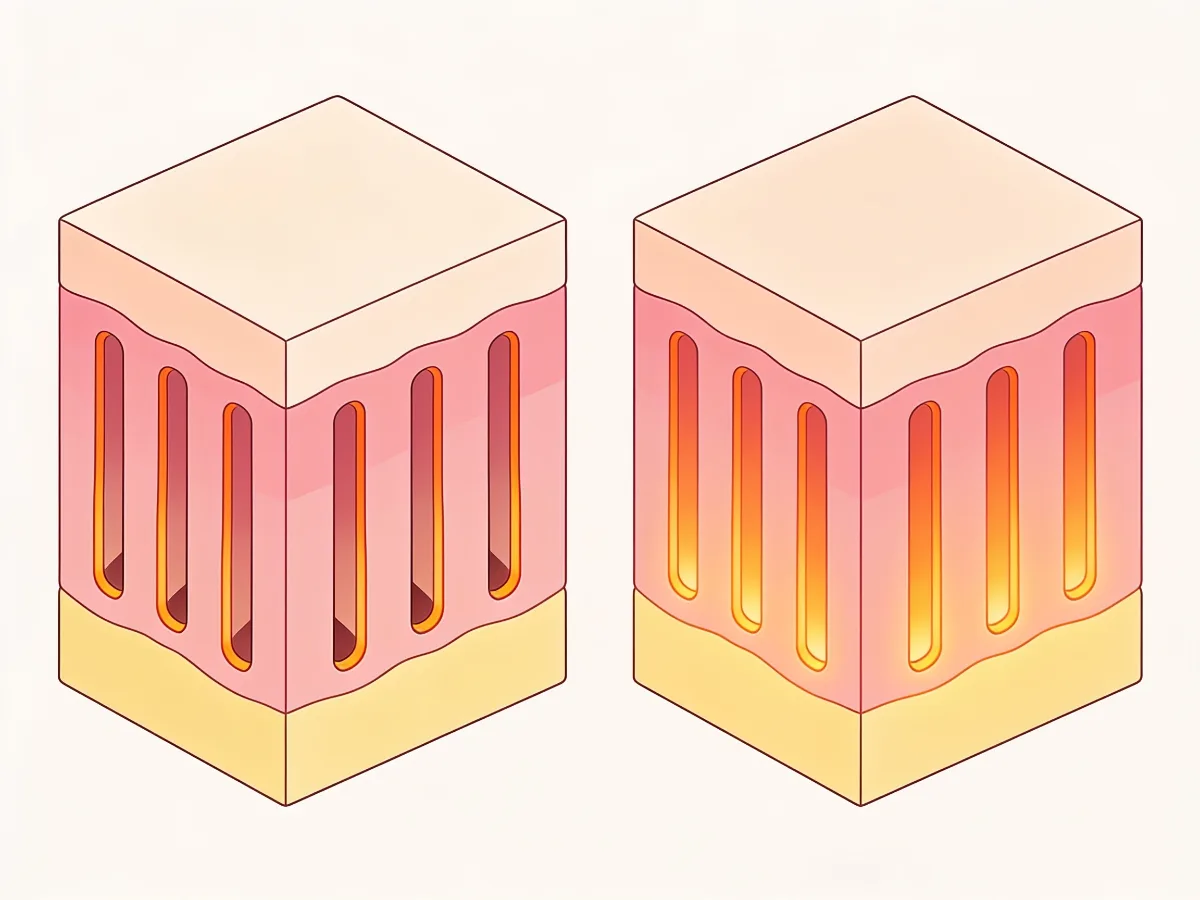
Fractional lasers fall into two families. The choice is mostly a trade between how much change you want per session and how much downtime and pigment risk you can accept. Half or full legs are covered in our guide to leg laser hair removal.
The gap may be narrower than often assumed. A 2026 meta-analysis of four small randomised trials (98 people) comparing non-ablative erbium-glass with CO2 for acne scars found similar improvement, satisfaction and PIH rates, with less pain and shorter-lasting crusting and redness after erbium-glass. Because the trials were small, ablative lasers remain a main tool for deeper scars.
| Ablative fractional (CO2) | Non-ablative fractional (thulium, erbium-glass) | |
|---|---|---|
| What it does | Vaporises microscopic columns of skin, with a rim of heated tissue | Heats columns in the dermis; the surface stays intact |
| Wavelengths | 10,600 nm | Around 1,550 nm (erbium-glass) and 1,927 nm (thulium) |
| Mainly used for | Depressed acne and surgical scars, marked texture | Fine lines, pores, mild scarring, stretch marks, sun-related tone |
| Downtime | About 5 to 7 days of swelling and fine crusts; pinkness for weeks | Redness for hours to a few days; light scabs or flaking after stronger passes |
| Sessions | Fewer, spaced several weeks apart | A course, spaced weeks apart |
| PIH risk in Asian skin | Higher; needs careful settings and aftercare | Lower but present; falls with lower energy and density |
| In our network | S3 Resurfacing (DEKA Tetra Pro), SkinRev Lab | FSX Laser (thulium and erbium-glass), SkinRev Lab |
Which fractional laser for wrinkles, pigment, scars or stretch marks: what studies found
Fractional lasers treat texture, wrinkles, pigment and some scars, but each laser type suits some concerns better than others. These studies compared or tested them:
| Concern | Laser studied | What the study found | Source |
|---|---|---|---|
| Wrinkles and nasolabial folds | Fractional CO2 vs non-ablative 1550 nm and 1927 nm, 730 patients | Fractional CO2 gave the greatest improvement (p < 0.001) | Cohen et al., 2017 |
| Pigmentation | Same three lasers | 1927 nm gave the greatest improvement (p < 0.001) | Cohen et al., 2017 |
| Burn scars | Fractional CO2, 3 or more sessions at 4 to 8 week intervals, 69 patients | Starting before 6 months after injury gave improvement comparable to starting later | Slavinsky et al., 2024 |
| Stretch marks | Review of 68 articles | Fractional lasers give modest improvement, with few randomised trials; a 1,540 nm non-ablative laser was suggested as a reasonable first choice | Ross et al., 2017 |
None of these is a randomised trial comparing the lasers across all four concerns, so they show which laser type suited each concern in those patients rather than a fixed rule. At SkinRev Lab, Dr Sin Yong, medical adviser, performs S3 Resurfacing (fractional CO2) and the non-ablative FSX Laser and Luminescence Laser, each priced at consultation; which one fits depends on the main concern and on how much downtime you can take.
What is a ProFractional laser?
A ProFractional laser is a branded fractionated erbium laser handpiece: an ablative fractional treatment that, as its maker describes it, removes narrow channels of tissue while leaving the surrounding skin intact. The maker lists scar revision and resurfacing among its uses, and it runs as a handpiece on a larger laser platform rather than as a stand-alone machine.
In the terms used on this page, ProFractional belongs to the ablative fractional family, alongside fractional CO2, although the laser type is different. Fractional machines exist in both erbium:YAG and CO2 forms. As with any ablative fractional laser, the points to ask about are depth, downtime and how the settings are adjusted for your skin type.
SkinRev Lab does not offer ProFractional. The ablative fractional treatment Dr Sin Yong performs here is S3 Resurfacing, a fractional CO2 protocol on the DEKA Tetra Pro, which is a separate treatment and is priced at consultation. If you have been advised to have an erbium fractional laser specifically, raise that at the consultation so the plan can be discussed.
Ablative
Fractional CO2: S3 Resurfacing on the DEKA Tetra Pro
Fractional CO2 light at 10,600 nm is absorbed strongly by water in the skin, so each microbeam removes a narrow column of tissue and leaves a thin rim of heated tissue around it. That is why it can change the structure of a scar more than a non-ablative laser, and why recovery takes about a week.
At SkinRev Lab, Dr Sin Yong uses the DEKA Tetra Pro with his S3 protocol. Instead of one even pass, deeper single shots are placed into individual scar pits, then a fractional pass treats the surrounding skin so the scar blends in, with depth and density set separately. Numbing cream goes on for 45 to 60 minutes first, and it is often combined with subcision or TCA CROSS within his 4D Scar Reconstruction protocol.
It suits depressed acne scars, flat or depressed surgical and injury scars, and textured stretch marks, in people who can protect the area from sun for several weeks. It is not used over active acne, infection, cold sores or a fading tan, and raised or keloid scars need a different plan.
Non-ablative
Non-ablative options: FSX Laser and Luminescence Laser
Non-ablative fractional lasers use mid-infrared light, mainly erbium-glass at around 1,550 nm and thulium at 1,927 nm, absorbed by water in the skin. Erbium-glass reaches deeper into the dermis for scarring and fine lines; thulium works nearer the surface on sun-related tone and texture. The surface stays in place and acts as a natural dressing.
Dr Sin Yong's FSX Laser at SkinRev Lab is a non-ablative, multi-pass protocol combining thulium and erbium-glass energy, adjusted zone by zone, for fine lines, enlarged pores, rough texture and stretch marks. A session takes about 30 minutes after around 45 minutes of numbing cream; redness usually settles within hours, with light scabs for several days after stronger passes.
For scars, his Luminescence Laser is a separate non-ablative protocol calibrated for skin types III to VI, with mild redness for a few hours and sometimes dryness or slight swelling for one to three days. Research on erbium-glass and thulium systems supports this class of laser, but FSX and Luminescence are clinic protocols, so the studies support the mechanism rather than the protocols themselves.
Downtime
Fractional laser downtime, compared
These are typical patterns, not promises; the settings, the area and your skin all change recovery. Plan fractional CO2 before a quiet week, keep out of direct sun, and use only the aftercare you are given until the skin has closed.
| Treatment | Day 0 to 1 | Days 2 to 7 | After the first week |
|---|---|---|---|
| Non-ablative (FSX type) | Redness and warmth for a few hours | Usually back to normal; light scabs or flaking after stronger passes | Collagen builds over the following one to two months |
| Luminescence (non-ablative, scars) | Mild redness for a few hours | Sometimes dryness or slight swelling for one to three days | Gradual scar remodelling over months |
| Fractional CO2 (S3 Resurfacing) | Hot, tight, sunburn-like feeling; swelling begins | Swelling peaks in the first three days; fine brown crusts flake by about day 5 to 7 | Pinkness fades over two to four weeks; make-up once the skin has closed |
| SKINTIGHT microplasma, tightening setting | Mild redness for a few hours | Usually nothing visible | Firmness and texture change over the following weeks |
| SKINTIGHT microplasma, scar setting | Redness | Pinpoint scabbing for a few days | Texture changes over the following weeks |
Sessions and results
How many sessions, and what the evidence shows
Non-ablative treatments are usually given as a course spaced several weeks apart, because each session does less and collagen needs time to remodel. Fractional CO2 often needs fewer sessions, also spaced weeks apart. Change builds over one to several months after each session, so judge progress with photographs taken in the same light rather than in the mirror the next week.
For acne scars, a 2026 meta-analysis of eight randomised trials (249 patients) found fractional CO2 gave more scar improvement and higher satisfaction than RF microneedling, but with more pain, about 1.7 more days of redness and a PIH risk about four times higher. A 2022 international consensus of 24 dermatologists and plastic surgeons lists ablative and non-ablative fractional lasers among the devices they most often choose for acne scars, often combined with other methods.
No laser turns a scar back into untouched skin. Most people see scars soften and blend rather than disappear, and individual results vary.
Asian skin
Keeping PIH risk down in Asian skin
Melanin competes with the laser's target, and heat stimulates pigment cells, so post-inflammatory hyperpigmentation (PIH) is the main risk of fractional laser in Asian skin. It usually fades over months, but it can mask the improvement in the meantime.
In a study of 37 Chinese patients treated with a 1,540 nm fractional laser, generalised PIH followed 7.1% of high-energy, low-density sessions and 12.4% of low-energy, high-density sessions. The difference was not statistically significant, but the authors concluded density may matter more, and localised darkening around the mouth occurred in people treated without air cooling. A 2026 review of 15 studies of erbium-glass and thulium lasers in skin of colour also found less PIH at lower energy and density.
- Do not have fractional laser while tanned or sunburnt; treatment is usually postponed.
- Pause exfoliating acids, scrubs and retinoids for about a week beforehand, or as advised.
- Tell the doctor about past dark marks after spots, bites or treatments, and about cold sores.
- Expect conservative settings at first, with cooling during treatment.
- Use only the recommended aftercare at first, do not pick crusts, and use sunscreen daily once the skin has closed.
- Report new darkening early, so the plan can be adjusted.
Fractional laser side effects and how often they happen
Side effects after fractional laser are uncommon and mostly short-lived. In a review of 730 patients treated with three fractional lasers, 31 (4.2%) had an adverse event or complication, and skin type was not significantly linked to the complication rate (Cohen et al., 2017):
| Side effect | Cases (of 730) |
|---|---|
| Acne flare-up | 13 |
| Dermatitis | 9 |
| Cold sore (herpes simplex) outbreak | 5 |
| Prolonged redness | 4 |
| Abrasion, bacterial infection, drug reaction, hyperpigmentation, swelling, thread veins | 1 each |
By laser, the rates were 6.4% for fractional CO2, 3.3% for 1550 nm and 4.0% for 1927 nm, a difference that was not statistically significant. Most patients in that review had skin types II and III, so for Asian skin the PIH figures above remain the main guide. Acne flare-ups and cold sore outbreaks were among the most frequent, which is why mentioning acne-prone skin and past cold sores before treatment matters.
A lighter option
SKINTIGHT microplasma at SkinRev Lab: lighter downtime
SKINTIGHT at SkinRev Lab is not a laser. It uses the microplasma mode of the Alma PrimeX: radiofrequency energy at 40.68 MHz is released through fine pins that discharge close to the skin, forming plasma that creates micro-channels in the surface while conducting heat into the upper dermis. Like a fractional laser, it treats a pattern of tiny zones and leaves untouched skin between them.
A session takes about 30 minutes, with numbing cream available. On tightening, texture and glow settings, most people have mild redness for a few hours; scar settings are deliberately stronger and leave pinpoint scabbing for a few days. SKINTIGHT is S$588 per zone before GST, for the face, the neck and double chin, the upper and lower eyes, or a 15 × 15 cm body area, usually as a short course planned at your assessment.
Its action is shallower than a dermal laser, so it suits surface texture, pores, mild laxity and early scarring better than deep acne scars, which still need a doctor-performed laser or a combined scar plan. Evidence for microplasma is more limited: in a 2010 pilot study of 16 people, a fractional microplasma radiofrequency device improved acne scars and wrinkles over two to four sessions with short downtime. Our team is trained on the Alma PrimeX by Dr Sin Yong.
Who should wait
Who should wait, or choose another option
- Active acne, infection, cold sores or open wounds in the area.
- A recent tan or sunburn, or a beach holiday planned soon after treatment.
- Pregnancy.
- A tendency to keloids or thick raised scars, especially before ablative treatment.
- Recent oral acne medicine (a prescription retinoid); timing is discussed individually with the doctor.
- Medicines or conditions that make you sensitive to light or slow healing.
- Melasma: heat-based treatments can flare it, so a doctor plans the pigment first.
- Skin that darkens easily after any injury: a non-ablative laser or RF microneedling may be a more cautious start than CO2.
In Singapore
Fractional laser in Singapore: who performs it
In Singapore, the high-power lasers used for fractional treatment may be used on people only by doctors in a medical setting. A fractional laser is therefore a doctor's procedure, and it starts with a diagnosis, because scars, pores, pigment and redness can look alike and need different plans.
At SkinRev Lab, CityLink Mall (City Hall), Dr Sin Yong performs S3 Resurfacing, FSX Laser and Luminescence Laser, three of his signature protocols, and decides which suits your skin after examining it. Each is priced at consultation; WhatsApp SkinRev Lab on +65 8266 9585. Medical laser treatments are performed by Dr Sin Yong at SkinRev Lab, CityLink Mall (City Hall), and priced at consultation.
- Is the laser ablative or non-ablative, and why that one for my skin?
- How many sessions, how far apart, and how much downtime each time?
- How will you set it for my skin type to limit PIH?
- Who performs the treatment, and who reviews me afterwards?
Common questions
Your questions,
answered
What is fractional laser used for?
Mainly acne scars, uneven texture, enlarged pores, fine lines, stretch marks and some surgical scars. It works by prompting new collagen in a grid of tiny treated zones. It is not the first choice for melasma, active acne or visible thread veins.
How long is the downtime after fractional laser?
It depends on the type. Non-ablative fractional laser usually means redness for hours to a few days. Fractional CO2 means about five to seven days of swelling and fine crusts, with pinkness fading over two to four weeks.
Fractional CO2 or non-ablative laser for acne scars?
Deeper scars usually get more change per session from CO2, at the cost of about a week's downtime and a higher PIH risk. Non-ablative lasers suit milder scarring and people who cannot take time off. Small trials suggest the gap may be narrower than assumed, and many plans combine lasers with subcision or TCA CROSS.
How many fractional laser sessions will I need?
It varies with the concern and the laser. Non-ablative treatments are usually a course of several sessions spaced weeks apart; CO2 often needs fewer. A doctor sets the plan after examining your skin, and results build over months.
Is fractional laser suitable for Asian skin?
It can be used, but PIH is the main risk. Lower energy and density, cooling, avoiding treatment while tanned and strict sun protection reduce it. Fractional CO2 carries a higher risk than non-ablative lasers or RF microneedling.
Does fractional laser hurt?
Numbing cream is applied for about 45 to 60 minutes first. Non-ablative passes feel like warm, prickling pulses; CO2 feels hotter and is followed by a sunburn-like sensation for a day or two.
Fractional laser vs RF microneedling: what is the difference?
Fractional laser uses light, ablative or not; RF microneedling uses fine needles to deliver radiofrequency heat into the dermis. In a meta-analysis of acne scar trials, CO2 improved scars more, while RF microneedling had less pain, shorter redness and lower PIH risk.
Is SKINTIGHT a fractional laser?
No. SKINTIGHT at SkinRev Lab uses Alma PrimeX microplasma, a radiofrequency-based technology, to make a fractional pattern of tiny surface channels. Downtime is lighter than with an ablative laser, but it works more superficially. It is S$588 per zone before GST.
How much does fractional laser cost in Singapore?
It depends on the laser, the area and the number of sessions. At SkinRev Lab, S3 Resurfacing and FSX Laser are priced at consultation after Dr Sin Yong has assessed your skin. Compare the whole course, including downtime, rather than one session.
Is Fraxel the same as fractional laser?
Fraxel is one brand of fractional laser, known mainly for non-ablative erbium-glass and thulium settings. Fractional laser is the wider category, which also includes ablative CO2 lasers such as the DEKA Tetra Pro used by Dr Sin Yong at SkinRev Lab. What matters is the wavelength, depth and density chosen for your skin, not the brand; it is priced at consultation.
How soon can I see results after fractional laser?
Skin looks smoother once it has healed, but collagen keeps remodelling for three to six months, so the full result is judged months after the last session.
Can I have fractional laser if I have melasma?
With caution. Heat can worsen melasma, so the melasma is usually controlled first and settings are gentle. The doctor decides after examining the skin.
Questions people ask
What is a ProFractional laser?
ProFractional is the brand name of a fractionated erbium laser handpiece. Its maker describes it as an ablative treatment that removes narrow channels of tissue while leaving the surrounding skin intact, used for scars and resurfacing. It sits in the same ablative fractional family as fractional CO2, although the laser type is different.
Is ProFractional laser available at SkinRev Lab?
No. SkinRev Lab does not offer ProFractional laser. The ablative fractional laser performed here is S3 Resurfacing, a fractional CO2 treatment on the DEKA Tetra Pro, alongside the non-ablative FSX and Luminescence lasers. All three are performed by Dr Sin Yong after he examines the skin, and each is priced at consultation.
Where can I have fractional laser in Singapore near City Hall MRT?
Fractional laser is available at SkinRev Lab, #B1-28 CityLink Mall, 1 Raffles Link, by City Hall MRT. Dr Sin Yong performs S3 Resurfacing, FSX Laser and Luminescence Laser there and decides which suits your skin after examining it. To arrange a consultation, WhatsApp SkinRev Lab on +65 8266 9585.
How long does swelling last after fractional laser?
Usually two to three days. DermNet notes that swelling after fractional laser is usually minimal and should resolve in 2–3 days, though it can last up to a week, and the skin looks pinkish for 3–5 days. Ice packs at 10-minute intervals in the first 24 hours help. Ablative fractional CO2 takes longer to heal.
Can fractional laser treat pigmentation?
For some types, yes. DermNet lists pigmentation linked to photoageing among the conditions fractional laser treats, but advises caution with melasma, because the treatment itself can lead to post-inflammatory pigmentation. At SkinRev Lab, Dr Sin Yong, medical adviser, assesses the type of pigment first, and the plan follows that assessment.
Can fractional laser treat stretch marks?
It can give modest improvement. A 2017 review of 68 articles on stretch marks found few randomised trials, but fractional lasers offered modest gains, and the authors considered a 1,540 nm non-ablative laser a reasonable first choice. Results vary, so ask at consultation whether your marks are suitable.
How soon after an injury can a scar be treated with fractional CO2 laser?
Possibly as early as 3 to 6 months after injury, for some scars. In a study of 69 people with burn scars treated with fractional CO2 at 4 to 8 week intervals, starting before 6 months after the injury gave improvement comparable to starting later. Dr Sin Yong reviews the scar before planning any treatment.
How common are side effects after fractional laser?
Uncommon. In a review of 730 patients, 4.2% had an adverse event or complication, most often acne flare-ups, dermatitis, cold sore outbreaks or prolonged redness. Rates were 6.4% for fractional CO2, 3.3% for 1550 nm and 4.0% for 1927 nm, a difference that was not statistically significant.
Does fractional laser actually work?
Yes, for texture, wrinkles and some pigment and scars, though it improves them rather than erasing them. In a review of 730 patients, fractional CO2 gave the greatest improvement in wrinkles and nasolabial folds and the 1927 nm laser in pigmentation (Cohen et al., 2017). Results build over months, often over several sessions.
How long does a fractional laser last?
Deeper resurfacing gives relatively long-lasting results, but the skin keeps ageing and wrinkles eventually reappear, some sooner than others depending on where they are (The Aesthetic Society, 2021). Lighter, superficial treatments may need repeating periodically to maintain results.
More questions, answered
What should I avoid before fractional laser?
Tanning and strong exfoliating or prescription creams for the time your doctor advises.
References
- Ngan V; updated by Oakley A (2007, updated 2015). Fractional laser treatment. DermNet. Source
- Chan HHL, Manstein D, Yu CS, Shek S, Kono T, Wei WI (2007). The prevalence and risk factors of post-inflammatory hyperpigmentation after fractional resurfacing in Asians. Lasers in Surgery and Medicine 39(5):381–385. doi:10.1002/lsm.20512. Source
- Mayo Clinic Staff (2024). Laser resurfacing: About. Mayo Clinic. Source
- Manstein D, Herron GS, Sink RK, Tanner H, Anderson RR. Fractional photothermolysis: a new concept for cutaneous remodeling using microscopic patterns of thermal injury. Lasers Surg Med. 2004;34(5):426-438. Source
- Chan HH, Manstein D, Yu CS, Shek S, Kono T, Wei WI. The prevalence and risk factors of post-inflammatory hyperpigmentation after fractional resurfacing in Asians. Lasers Surg Med. 2007;39(5):381-385. Source
- Salameh F, Shumaker PR, Goodman GJ, et al. Energy-based devices for the treatment of acne scars: 2022 international consensus recommendations. Lasers Surg Med. 2022;54(1):10-26. Source
- Xue D, Yu Y, Li X, et al. Efficacy and safety of Er:Glass versus CO2 lasers in the treatment of atrophic acne scars: a systematic review and meta-analysis. Aesthetic Plast Surg. 2026;50(7):2731-2740. Source
- Argobi Y, Tobeigei F, Alasiri FI. Fractional CO2 laser versus micro needling radiofrequency for post acne scarring: a meta-analysis of RCTs. J Cosmet Dermatol. 2026;25(3):e70765. Source
- Goldman MP, Wu DC, Khetarpal S, Jacobson A, Wang JV, Geronemus RG. Dual 1550-nm erbium glass fiber and 1927-nm thulium fiber non-ablative fractional laser system treatment in patients with skin of color: a review of clinical studies and unmet needs. Lasers Surg Med. 2026;58(3):169-179. Source
- Halachmi S, Orenstein A, Meneghel T, Lapidoth M. A novel fractional micro-plasma radio-frequency technology for the treatment of facial scars and rhytids: a pilot study. J Cosmet Laser Ther. 2010;12(5):208-212. Source
- Sciton. ProFractional (product page: fractionated erbium laser handpiece for the JOULE platform). Opened 12 November 2026. Source
- Cohen SR, Goodacre A, Lim S, Johnston J, Henssler C, Jeffers B, Saad A, Leong T (2017). Clinical Outcomes and Complications Associated with Fractional Lasers: A Review of 730 Patients. Aesthetic Plast Surg 41(1):171-178. doi:10.1007/s00266-016-0767-x. PMID 28032173. Source
- Slavinsky V, Wong JH, Carney BC, Lee DT, Allely R, Shupp JW, Tejiram S, Travis TE (2024). Addressing Burn Hypertrophic Scar Symptoms Earlier: Laser Scar Revision May Begin as Early as 3-6 Months After Injury. Lasers Surg Med. doi:10.1002/lsm.23822. PMID 38973144. Source
- Ross NA, Ho D, Fisher J, Mamalis A, Heilman E, Saedi N, Jagdeo J (2017). Striae Distensae: Preventative and Therapeutic Modalities to Improve Aesthetic Appearance. Dermatol Surg 43(5):635-648. doi:10.1097/DSS.0000000000001079. PMID 28375972. Source
- The Aesthetic Society (2021). Laser Skin Resurfacing - Results. theaestheticsociety.org, published 25 October 2021. Source