Guide · Hypertrophic scars
Hypertrophic scar treatment how raised scars differ from keloids, and what helps them flatten
A hypertrophic scar is the raised, red, itchy scar that stays inside the line of the original wound. Here is how it differs from a keloid, what silicone, pressure, steroid injections and lasers can and cannot do, and why timing matters.
Quick answer
- A hypertrophic scar is a raised, firm, often red or itchy scar that stays within the edges of the original wound. Hypertrophic scar treatment usually starts with silicone gel or sheets, adds steroid injections (triamcinolone) for thick or itchy scars, and uses lasers for redness and texture; pressure garments are used mainly for burn scars.
- Unlike a keloid, which spreads into normal skin and rarely shrinks by itself, a hypertrophic scar usually appears within weeks of an injury, grows for about three to six months, and then often levels off and fades slowly. Treatment can speed this up and ease itch and tightness.
- The evidence is only moderate. A meta-analysis of 34 trials supported silicone, triamcinolone (better combined with silicone or 5-fluorouracil), pulsed dye laser and fractional CO2 laser, but Cochrane reviews rate much of the laser and pressure evidence as low or very low certainty.
- Steroid injections and lasers are medical treatments. Dr Sin Yong assesses raised scars at IN Eternity Clinic, Pacific Plaza, and plans treatment priced at consultation; SkinRev Lab does not treat scars, prescribe or inject.
The basics
What is a hypertrophic scar?
A hypertrophic scar is a scar that has healed with too much collagen. It sits above the surrounding skin, feels firm or rubbery, and is often pink, red or darker than the skin around it. Many itch, feel tight or are tender, especially in the first months. Its defining feature is that it stays within the line of the original cut, burn or spot.
These scars form when healing does not switch off on time. Inflammation in the deeper layer of the dermis carries on, small blood vessels multiply, and fibroblasts keep laying down collagen. A 2022 review by Ogawa describes hypertrophic scars appearing several weeks after an injury, growing for three to six months and then, if risk factors are minor, levelling off and slowly regressing.
Being raised does not automatically make a scar a keloid. That distinction shapes the whole plan, so it is the first thing a doctor checks.
Side by side
Hypertrophic scar vs keloid
The two are closely related, and some scars have features of both. Doctors separate them mainly by behaviour: whether the scar stays inside the wound or spreads, and whether it settles with time. These are the classic patterns.
If a scar keeps spreading into normal skin, it is treated as a keloid. Keloids need a longer, more intensive plan, and cutting one out on its own is avoided because it often returns.
| Hypertrophic scar | Keloid | |
|---|---|---|
| Borders | Stays within the original wound | Spreads beyond the wound into normal skin |
| When it appears | Within weeks of the injury | Weeks to months later, sometimes after a minor injury |
| Course | Grows for about three to six months, then often flattens and fades | Tends to keep growing; rarely shrinks by itself |
| Common sites | Surgical scars across joints, chest and shoulders; burns | Earlobes, chest, shoulders, upper back, jawline |
| After surgical removal | Often improves if tension is reduced | High risk of returning, sometimes larger, without added treatment |
| Usual treatment | Silicone, steroid injection, laser; pressure for burns | A combined plan: injections, silicone, pressure, laser, sometimes surgery with added therapy |
Risk factors
Why some scars become raised
Some of these factors can be changed; others can only be planned around. If you know you form thick scars, say so before any surgery, piercing or procedure.
- Tension and movement: scars across the chest, shoulders and joints are pulled with every breath or movement.
- Slow or complicated healing: infection, wound breakdown or a wound that takes weeks to close.
- Burns and deep injuries that reach the deeper dermis; superficial grazes rarely form raised scars.
- Deep, inflamed acne, especially on the chest, shoulders and back.
- A personal or family history of thick scars or keloids.
- Hormones and blood pressure: Ogawa's review notes these scars can worsen in pregnancy and with high blood pressure.
- Stretching the scar, including vigorous massage in people prone to thick scars.
Silicone
Silicone gel and sheets: the usual first step
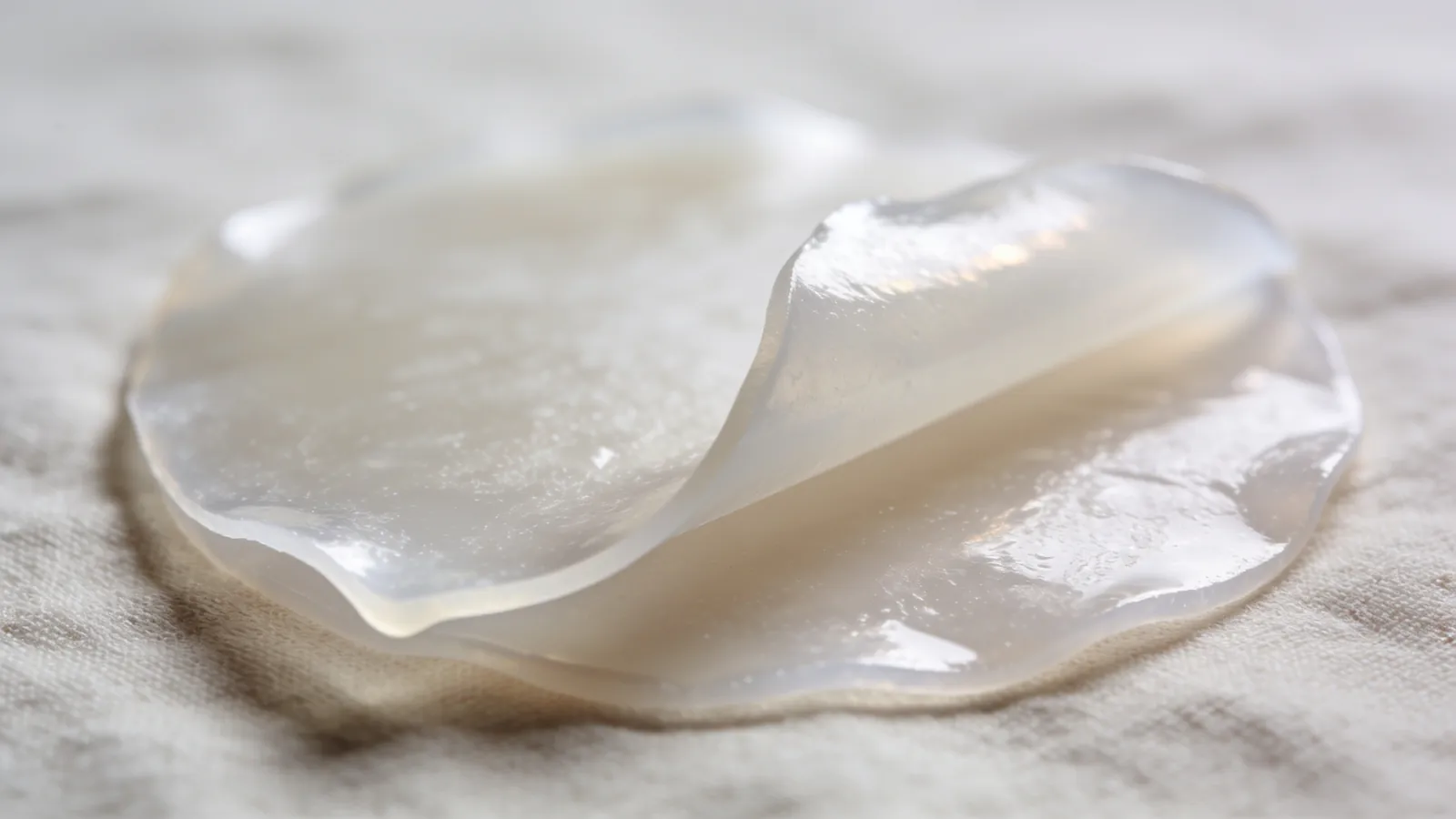
Silicone gel sheets and silicone gels are the most widely used first step. They are thought to work partly by limiting tension on the scar and keeping the outer skin hydrated. A Cochrane review of 20 trials with 873 people found that sheeting lowered the chance of a raised scar in people prone to them, and improved the thickness and colour of existing raised scars, but the trials were of poor quality. In a 2022 meta-analysis of 34 randomised trials, silicone improved scar scores by about five points on a standard scar scale, compared with about 3.6 points for laser.
Silicone works slowly and only while it is used. Start once the wound has fully closed, with no scab or stitches left, and use it every day for months rather than weeks. Ogawa's review notes that continuous use helps scars mature, and that silicone and other gel sheets seem to work about equally well.
In Singapore's heat, sheets can lift with sweat or cause a rash underneath. Wash or replace them as directed, let the skin breathe for a short time each day, and consider a silicone gel on visible or sweaty areas. Protect the scar from the sun, which can darken it.
Pressure and taping
Pressure garments, taping and massage
Pressure has long been used for large burn scars, with garments worn most of the day for many months. Ogawa's review cites a meta-analysis of 12 trials in which pressure of 15 to 25 mmHg reduced burn scar thickness, redness and hardness. A 2024 Cochrane review of 15 studies, however, judged the evidence for pressure garments after burns very uncertain and suggested that patient preference can guide the choice. In Singapore's heat, wearing them consistently is hard.
For surgical wounds, tape that stops the new scar from stretching is a simple preventive step; Ogawa's review cites a randomised trial in which paper tape after caesarean section greatly reduced raised scars. Ask your surgeon or doctor how long to tape.
Massage is often suggested, but the evidence is weak, and Ogawa cautions that stretching an active scar may worsen it in people prone to thick scars. Gentle moisturising is fine; vigorous rubbing of a red, active scar is better avoided.
Injections
Steroid injections (triamcinolone) for raised scars
For a thick, firm or itchy scar, a doctor may inject a corticosteroid, usually triamcinolone, directly into the scar. Reviews summarised by Ogawa report 50% to 100% regression of hypertrophic scars and keloids with injected steroids. Injections are usually given over several visits, weeks apart, and the scar softens and flattens gradually. In the 2022 meta-analysis, triamcinolone combined with silicone or with 5-fluorouracil worked better than triamcinolone alone.
Side effects include pain at the injection, skin thinning or a dent, paler skin, small visible blood vessels and, with larger doses, changes to periods. That is why the strength and amount are chosen carefully and why injections are spaced. Scar doses are higher than the weak dilutions used for an acne cyst, so the two should not be confused.
Triamcinolone and 5-fluorouracil are prescription-only medicines in Singapore and are injected by a doctor. SkinRev Lab does not prescribe or inject.
Lasers
Lasers for hypertrophic scars: what each one does
Vascular lasers, mainly the pulsed dye laser at 585 to 595 nm, target the extra blood vessels in an active scar, which reduces redness and itch and can soften it; Nd:YAG lasers at 532 or 1064 nm are reported to have similar effects. A 2011 systematic review found the most evidence for pulsed dye laser, with the 595 nm version the more promising.
Fractional lasers make microscopic columns of controlled injury to remodel scar tissue. The 2022 meta-analysis supported fractional CO2 laser, but Ogawa's review notes randomised trials showing no benefit, and a 2022 Cochrane review of 15 trials found the evidence for lasers overall too weak to support or refute them. In Asian skin, heat-based lasers also carry a risk of PIH. Lasers are therefore one part of a combined plan, not the whole plan.
| Laser | Main target | Evidence for hypertrophic scars | In our network |
|---|---|---|---|
| Pulsed dye laser (585–595 nm) | Blood vessels: redness and itch | Most studied; low-certainty evidence of improvement | Not among the lasers listed at IN Eternity Clinic |
| Nd:YAG laser (532 or 1064 nm) | Blood vessels and dermal heating | Reported to reduce redness; smaller studies | Not listed for scars at IN Eternity Clinic |
| Non-ablative laser | Dermal collagen under an intact surface | Limited; gentle, gradual change | Luminescence Laser, priced at consultation |
| Fractional CO2 laser | Texture and thickness of settled scars | Mixed: supported in one meta-analysis, no clear benefit in others | Tetra Pro S3, for settled scars, priced at consultation |
Timing
When to start: a timeline for raised scars
Scars keep remodelling for about 12 to 18 months, so the approach changes with the scar's age. This is a general pattern; a doctor adapts it to your scar.
| Scar age | What is happening | Usual approach |
|---|---|---|
| Wound not yet closed | Healing | Wound care; prevent infection; follow the surgeon's advice |
| Closed, up to 3 months | Collagen laid down quickly; the scar may start to thicken | Silicone gel or sheets, taping where advised, sun protection; watch for thickening, itch or redness |
| 1 to 6 months, raised or itchy | Active hypertrophic phase | See a doctor: steroid injection, vascular or non-ablative laser, continued silicone; pressure for large burn scars |
| 6 to 18 months | The scar levels off and starts to fade | Continue what is working; laser for redness and texture |
| Over 12 to 18 months, settled | Mature scar | Fractional laser for texture; surgical revision if tight across a joint or very wide |
In Singapore
Hypertrophic scar treatment in Singapore
See a doctor if a scar is still raised, red or itchy a few months after healing, or if it is spreading beyond the wound, painful, tight across a joint or affecting your confidence. A GP can start simple care and refer you; a dermatologist or plastic surgeon manages large scars and contractures. Seek prompt review if a scar suddenly grows, bleeds or breaks down, or if a lump appears without any injury.
In our network, Dr Sin Yong assesses raised scars at IN Eternity Clinic, 9 Scotts Road, #12-01 Pacific Plaza, beside Orchard MRT. He first confirms whether a scar is hypertrophic, a keloid or something else, then plans a combination such as silicone, pressure, an injection into the scar, the Luminescence Laser or, for settled scars, fractional CO2. Treatment is priced at consultation by the clinic; WhatsApp +65 8815 3008.
SkinRev Lab, at CityLink Mall #B1-28 by City Hall MRT, is a non-invasive centre. It does not treat scars, prescribe medicines or give injections, and it passes scar enquiries to the clinic.
Sources
References & sources
- Ogawa R. The most current algorithms for the treatment and prevention of hypertrophic scars and keloids: a 2020 update of the algorithms published 10 years ago. Plast Reconstr Surg. 2022;149(1):79e-94e.
- Choi C, Mukovozov I, Jazdarehee A, et al. Management of hypertrophic scars in adults: a systematic review and meta-analysis. Australas J Dermatol. 2022;63(2):172-189.
- O'Brien L, Jones DJ. Silicone gel sheeting for preventing and treating hypertrophic and keloid scars. Cochrane Database Syst Rev. 2013;(9):CD003826.
- Harris IM, Lee KC, Deeks JJ, Moore DJ, Moiemen NS, Dretzke J. Pressure-garment therapy for preventing hypertrophic scarring after burn injury. Cochrane Database Syst Rev. 2024;1(1):CD013530.
- Vrijman C, van Drooge AM, Limpens J, et al. Laser and intense pulsed light therapy for the treatment of hypertrophic scars: a systematic review. Br J Dermatol. 2011;165(5):934-942.
- Leszczynski R, da Silva CA, Pinto ACPN, Kuczynski U, da Silva EM. Laser therapy for treating hypertrophic and keloid scars. Cochrane Database Syst Rev. 2022;9(9):CD011642.
Common questions
Your questions,
answered
What is the difference between a hypertrophic scar and a keloid?
A hypertrophic scar stays within the edges of the original wound and often flattens over a year or two. A keloid spreads into the surrounding normal skin, tends to keep growing and rarely shrinks on its own. Some scars show features of both, so a doctor confirms which it is.
Do hypertrophic scars go away on their own?
Many improve slowly. They usually grow for three to six months, then level off and fade over the following year or two, although they rarely return to completely normal skin. Treatment can speed this up and ease itch and tightness.
How do you flatten a hypertrophic scar?
Daily silicone gel or sheets for several months is the usual first step. For thick or itchy scars, a doctor may add steroid injections (triamcinolone) into the scar, and lasers can reduce redness and improve texture. Combinations usually work better than any single method.
Does silicone gel work on old scars?
Silicone is used most often on newer scars that are still changing. Trials also showed improvement in the thickness and colour of established raised scars, but the studies were of poor quality, and older, mature scars tend to change less.
Are steroid injections for hypertrophic scars safe?
They are widely used and effective, but side effects include pain, a dent from skin thinning, paler skin and small visible blood vessels. A doctor chooses the strength and spacing carefully and stops once the scar is flat or the skin starts to thin.
Which laser is used for hypertrophic scars?
Pulsed dye laser is the most studied, mainly for redness and itch. Nd:YAG, non-ablative and fractional lasers are also used. The evidence is mixed and often low certainty, so lasers are usually one part of a combined plan.
Can a hypertrophic scar turn into a keloid?
They are closely related, and some scars show features of both. A scar that keeps spreading beyond its original edges is treated as a keloid. If a raised scar is still growing after about six months, have it reviewed.
Can a hypertrophic scar be removed with surgery?
Surgery is not usually the first step, because many hypertrophic scars improve without it. It is considered when a scar contracts across a joint, is very wide or has not improved with other treatment, and it is combined with measures that reduce tension. It replaces one scar with another, ideally finer, one.
How much does hypertrophic scar treatment cost in Singapore?
It depends on the size and number of scars and the combination used. At IN Eternity Clinic, Dr Sin Yong assesses the scar first and treatment is priced at consultation. Silicone gels and sheets are sold in pharmacies; ask a pharmacist or doctor which suits your scar.