Treatment · Back acne scars
Back acne scar treatment in Singapore: marks, dented scars and raised scars need different plans
What acne leaves on the back is usually a mix: flat brown or red marks, dented scars, and on the shoulders and chest, raised scars. Each is treated differently, and raised scars are never resurfaced.
Medically reviewed by Dr Sin Yong, medical adviser · Last reviewed 20 November 2026
Main guide: Acne scar treatment in Singapore
Quick answer: Back acne
- Flat brown or red marks are not scars. They fade with time and sun protection, and laser can speed this up.
- Dented scars are treated with RF microneedling, fractional CO2 laser or subcision, typically three to six sessions, six to eight weeks apart.
- Raised scars are flattened with injections and silicone. They are not resurfaced, because that can make them worse.
- The upper back, shoulders and chest carry a higher risk of keloids. Active back acne is treated first.
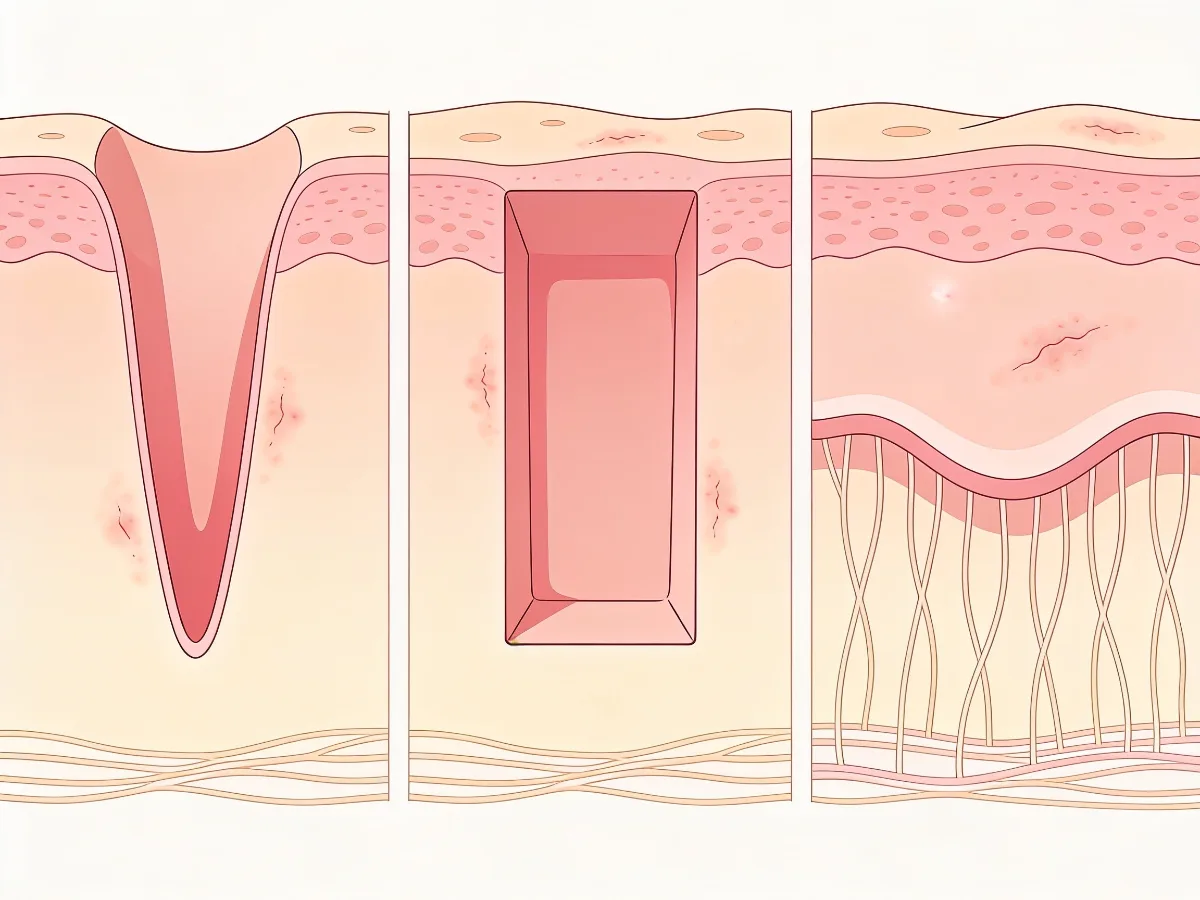
Mark, dent or raised scar?
| What you see | What it is | Does it fade by itself? |
|---|---|---|
| A flat brown mark | Pigment left after inflammation | Usually, over months, faster with sun protection |
| A flat red or purple mark | Small blood vessels left after inflammation | Usually, over months |
| A dent with sloping edges | A rolling scar, held down by fibrous bands | No |
| A dent with sharp edges | A boxcar scar | No |
| A firm raised scar within the area of the old spot | A hypertrophic scar | Sometimes, slowly |
| A raised scar that grows beyond the old spot | A keloid | No |
Most backs have more than one type, so the first step is to map them. The back is also harder to treat than the face. The skin is thicker, it heals more slowly, it is under constant movement and friction, and the upper back, shoulders and front of the chest are among the areas most prone to raised scars.
If you still get spots on the back, those are treated first. See back and body acne. Some "back acne" is a yeast-related folliculitis, which needs different treatment altogether.
Treatments for each type
| Type | Treatment | How it works |
|---|---|---|
| Flat brown marks | Pico laser or laser toning, with sun protection | Breaks up pigment so the body can clear it |
| Dented scars | RF microneedling | Releases heat at a set depth beneath the surface, to build collagen |
| Dented scars and rough texture | Fractional CO2 laser | Resurfaces scar edges and texture |
| Tethered, rolling scars | Subcision | Releases the fibrous bands that pull the scar down |
| Raised scars | Injections into the scar, and silicone, sometimes with laser | Flattens and softens the scar. See hypertrophic scars and keloids |
Raised scars are not resurfaced. Injuring a raised scar with a resurfacing laser or needling can make it grow, so they are flattened first and treated gently. Dented and raised scars on the same back are therefore treated in different ways at the same visit, or at different visits.
What a course involves
- Mapping and photographs. Dr Sin Yong marks out which areas have which type of scar.
- Comfort. A comfort cream is applied for 30 to 45 minutes. Subcision is done after the area has been made comfortable with a local injection.
- Treatment by zone. A large back is often divided into zones.
- Aftercare, and a review at about six to eight weeks.
A course for dented scars is typically three to six sessions, six to eight weeks apart. Raised scars need repeat injections a few weeks apart.
| Treatment | Usual downtime |
|---|---|
| RF microneedling | Redness and a sandpaper feel for a few days |
| Fractional CO2 laser | Small crusts that shed in about a week |
| Subcision | Bruising that fades over one to two weeks |
The surface usually looks normal by two to four weeks, while collagen goes on remodelling for months. For a week or so, avoid the gym, heavy sweating, tight straps and a backpack over the treated area, and keep it out of the sun.
Risks, and who should wait
Risks include darkening of the skin after treatment, redness that lasts, infection, and thickening of a scar, especially on the chest and shoulders. Results are an improvement and not removal. Dented scars become shallower and less visible, and the degree varies.
Keloid risk is higher on the upper back, shoulders and front of the chest, and in people who have had a keloid before or have one in the family. If that applies to you, tell Dr Sin Yong. Extra care is taken, and a small test area may be treated first.
Treatment is postponed while back acne is active, with a skin infection, during pregnancy, and while taking certain prescription acne medicines, where the timing is decided case by case.
Fractional CO2 laser can be used on Asian skin on the back, at conservative settings and with strict sun protection, because darkening after treatment is the main risk. For how scars are graded and what treatment costs, see acne scar grading and acne scar treatment cost.
Back acne scar treatment price and booking at SkinRev Lab
SkinRev Lab is at #B1-28 CityLink Mall, 1 Raffles Link, linked underground to City Hall MRT and Esplanade MRT, and is open daily from 11am to 8pm.
Back acne scar treatment is a medical treatment. It is carried out by Dr Sin Yong and always starts with a consultation, where the area is examined, your medical history is taken and the plan is explained before anything is agreed. It is priced at consultation, because the cost depends on what is found at that examination. The area, the types of scar, the methods used and the number of sessions decide the quote.
To arrange a consultation, message us on WhatsApp at 8266 9585 with your concern and the days that suit you. Prices for our non-medical treatments are on the price list.
Main guide
Acne scar treatment
acne scar treatment at SkinRev LabRelated questions: How is back and body acne treated?How are hypertrophic scars treated?Is it an acne mark or a scar?
Common questions
Your questions,
answered
Do back acne scars fade away?
Flat brown and red marks usually fade over months, faster with sun protection. Dented scars and keloids do not fade by themselves and need treatment.
Can back acne scars be removed completely?
Treatment improves them and does not erase them. Dented scars become shallower and less visible, and raised scars can be flattened. The degree of improvement varies.
How many sessions are needed for back acne scars?
A course for dented scars is typically three to six sessions, six to eight weeks apart. Raised scars need repeat injections a few weeks apart.
Why do raised scars form on the chest and shoulders?
The skin there is under constant tension and movement, and these areas are among the most prone to hypertrophic scars and keloids, particularly with a personal or family history.
Can scars be treated while I still get spots?
Active back acne is treated first. New spots would leave new marks, and treating scars over inflamed skin raises the risk of darkening.
Are back acne scars harder to treat than facial scars?
Usually, yes. Back skin is thicker, heals more slowly, is under more friction, and is more prone to raised scars, so courses tend to be longer.
When can I go back to the gym?
Avoid the gym, heavy sweating, tight straps and a backpack over the treated area for about a week, or as advised after your session.
Medical journal references
Peer-reviewed background reading for this page. These papers report research in groups of people and do not predict an individual result.
- Del Rosso JQ, Stein-Gold L, Lynde C, et al. Truncal Acne: A Neglected Entity. J Drugs Dermatol. 2019;18(12):205-1208. PubMed
- Woo YR, Kim HS. Truncal Acne: An Overview. J Clin Med. 2022;11(13). PubMed
- Jennings T, Duffy R, McLarney M, et al. Acne scarring-pathophysiology, diagnosis, prevention and education: Part I. J Am Acad Dermatol. 2024;90(6):1123-1134. PubMed
- Mustoe TA, Cooter RD, Gold MH, et al. International clinical recommendations on scar management. Plast Reconstr Surg. 2002;110(2):560-71. PubMed