Guide · Overfilled jawline
Overfilled jawline and chin: when filler makes the lower face too wide, heavy or square
When jawline or chin filler leaves the lower face looking wider, heavier or more square than before, the cause may be too much filler, filler in the wrong place, or something filler does not treat, such as strong jaw muscles or sagging. Telling them apart comes first.
Medically reviewed by Dr Sin Yong, medical adviser · Last reviewed 17 November 2026
Quick answer
- An overfilled jawline or chin usually shows as a lower face that looks wider, heavier or more square than before, a chin that looks long or pointed, or firm ridges and lumps along the jaw.
- Width in the lower face is not always filler: strong chewing muscles, fat under the chin, sagging jowls and bone shape can look similar, and each needs a different approach.
- If the filler is hyaluronic acid, an enzyme (hyaluronidase) can reduce it in stages; calcium hydroxylapatite, polycaprolactone and poly-L-lactic acid are not broken down by it.
- Adding more filler to sharpen or balance a heavy jaw usually adds weight; stopping top-ups until the area has been assessed is the first step.
- Seek same-day care for spreading redness, heat, rising pain, pus or fever; for pale, white, dusky or mottled skin, severe pain, or any change in vision, get help immediately, and for vision change call 995 or go to A&E.
- At SkinRev Lab, Dr Sin Yong examines the lower face from the front, in profile and while clenching, scans it with ultrasound where useful and explains the options; correction is priced at consultation.
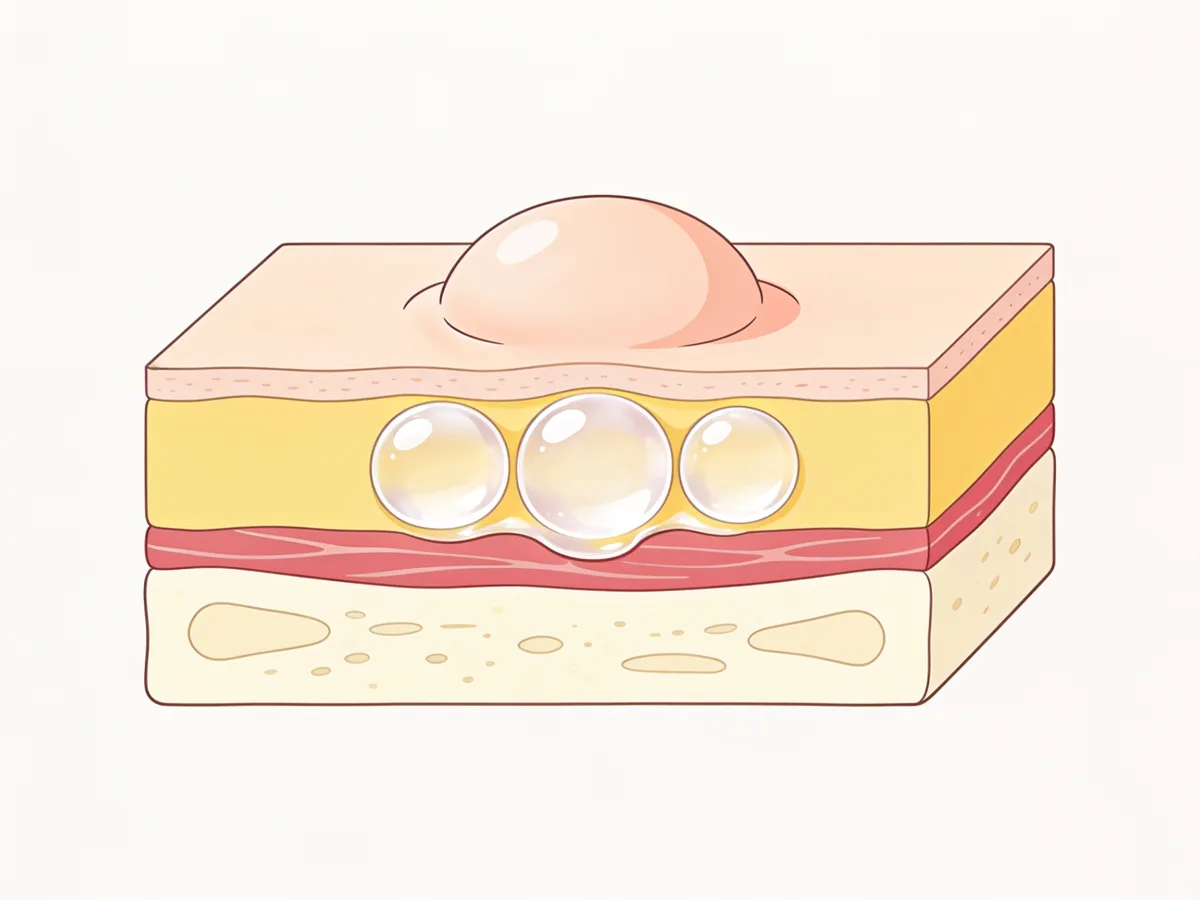
What does an overfilled jawline or chin look like?
An overfilled jawline or chin is a lower face carrying more filler than its proportions can hold, so it looks wider, heavier or more square rather than more defined. A review of facial overfilling lists a “witch's” chin and a “pillow face” profile among its typical appearances (Zhou and colleagues, 2026).
Signs people describe:
- Too wide or square: jaw angles that flare outwards, so the face looks broader from the front.
- Heavy: a lower face that looks bulky in photos, or a jawline that looks thick rather than sharp.
- A long or pointed chin: a chin that juts forward or downwards, especially in profile.
- Ridges or lumps along the jaw: firm lines or bumps you can feel or see when you turn your head or chew.
- Fullness that has spread: towards the jowls, under the chin or onto the upper neck.
- A harder look than you wanted: a face that looks older or more angular than intended.
This page focuses on the overfilled, wide or heavy look. For lumps, migration and urgent problems after chin filler in detail, see chin filler complications; for how chin filler is planned, see chin filler at SkinRev Lab.
Filler, muscle, fat or sagging? What makes a lower face look wide
A wide or heavy lower face can come from filler, chewing muscles, fat, sagging skin or bone shape, and the right next step depends on which. More than one is often present.
| What you see | Possible cause | Clues | Usual route |
|---|---|---|---|
| Width at the jaw angle that bulges when you clench | Large chewing (masseter) muscles | Firmer on clenching; often present before any filler | Jaw slimming injections rather than dissolving |
| Width, ridges or squareness that appeared after jaw filler | Filler: too much, or placed too wide | Present at rest and does not change on clenching; visible in photos since treatment | Assessment and scan; reducing it if it is hyaluronic acid |
| Soft fullness under the chin | Fat | Pinchable; changes with weight | Fat reduction rather than filler changes |
| Heaviness along the jaw that looks like jowls | Loose skin and fat pads, sometimes with filler | Worse when looking down; more noticeable with age | Assessment for laxity; lifting may suit better than volume |
| Firm fullness months after a collagen stimulator | Product plus new collagen | Built gradually over months | A different plan; the enzyme does not dissolve it |
Filler used to sharpen a jaw that is softening because of sagging can make the lower face look bigger and heavier, because the underlying issue was loose skin rather than missing volume. For muscle-related width, see wide jaw; for fat under the chin, see double chin; and for sagging, see sagging face and jowls.
Why the lower face ends up overfilled
The lower face usually ends up overfilled through volume added over several sessions, or through filler used for a problem that volume does not fix. A review of facial overfilling describes the cumulative effect of earlier fillers, made worse by touch-ups given before previous filler has broken down, and notes that imaging studies have found filler remaining for up to 27 months (Zhou and colleagues, 2026).
- Firm gels that last: chin and jaw fillers are firm gels placed deep on the bone, where they tend to persist, so top-ups can add to filler that is still there.
- Chasing a sharp V-shape: over-projecting the chin or building out the jaw angles to look sharper can instead make the face look heavier.
- Volume used for sagging: filler along a softening jawline can hide early jowls for a while, then add weight as the skin continues to loosen.
- Mixed products: hyaluronic acid layered with calcium hydroxylapatite, polycaprolactone or poly-L-lactic acid in the same area, which makes correction more complex.
- Width that was muscle: filler cannot slim a jaw made wide by chewing muscles, and adding it there widens it further.
- Perception drift: seeing your face daily makes gradual change hard to judge, and the same review describes a perception bias that keeps requests for more filler going (Zhou and colleagues, 2026).
Most filler problems are related to volume and technique, and serious ones are rare and mostly avoidable with careful planning and technique (Funt and Pavicic, 2013). For the wider face, see signs of too much filler, and for a realistic V-shape, see V-shape face.
Lumps and ridges along the jaw
Some lumpiness along the jaw is common in the first two weeks; ridges or lumps that persist need assessment. In a manufacturer-funded trial of jawline filler, with 157 adults randomised to treatment, lumps or bumps were recorded by about 8 in 10 after the first treatment, and most injection-site reactions were mild or moderate and settled within about two weeks (Burgess and colleagues, 2025).
- Early firmness or bumps: usually swelling and settling filler; review at about two weeks before anything else is done.
- A ridge along the jawline or at the angle that persists: often filler concentrated in one spot, placed too close to the surface or spread beyond the planned line.
- A bump that shows only when you chew or purse your lips: may be filler near the surface or within a muscle.
- A lump that is red, warm, tender or growing: possible inflammation or infection, including from a nearby dental problem; prompt review, and no massage.
- A lump that appears months later, sometimes after illness or dental work: may be a delayed reaction.
Do not massage, press or add filler over a jaw lump until it has been assessed. For lump types across the face, see filler lumps and nodules; for filler that has moved, see filler migration.
What can be assessed first
Before anything is dissolved, the useful questions are what is in the lower face, where it sits, which product is where and how much of the width is filler at all. At SkinRev Lab, Dr Sin Yong, medical adviser, works through these at an assessment.
- History: every chin, jaw, jowl and lower-cheek treatment, the product names, dates, any collagen stimulators and any earlier dissolving.
- Examination: the lower face from the front, in profile and at three-quarter view, at rest, smiling, clenching and looking down, to separate filler from muscle, fat and loose skin.
- Ultrasound where useful: a high-frequency scan can show where filler sits, at what depth and how far it has spread, and sometimes whether several layers are present. It can suggest the type of material but cannot confirm it with certainty.
- Dental and medical background: recent dental work or infection, allergies including bee or wasp sting allergy, and current medicines.
- Your goal: a narrower jaw, a softer chin, a reset, or reassurance that nothing needs doing.
Doing nothing can be the right advice, and correction is priced at consultation. For how scanning guides the enzyme, see ultrasound-guided filler dissolving, and you can see how mapping works in the ultrasound filler mapping video. For how SkinRev Lab approaches filler problems in general, see filler correction at SkinRev Lab.
Reducing hyaluronic acid filler in the jaw and chin
If the filler is hyaluronic acid, an enzyme (hyaluronidase) can reduce it, and a guideline states that overcorrection or misplacement of hyaluronic acid filler can be treated with it (King and colleagues, 2018). Firm jaw and chin gels, older filler and several layers often need more than one round; the review of facial overfilling notes that multiple injections are often required, and that filler which has been in place longer, or is more cross-linked, is harder to dissolve (Zhou and colleagues, 2026).
- Reduce where it is too much: for example, narrowing flared jaw angles while keeping chin projection you still like.
- Stage it: smaller treatments with reviews in between lower the risk of removing more than you wanted.
- Reassess the face underneath: once excess filler has gone, some people find that loose skin or jowls were the real concern, which lifting may suit better than more volume.
When to wait rather than dissolve now: in the first two weeks after filler unless there are urgent signs; with an active dental infection or abscess, or broken skin in the area; during pregnancy; and with a known enzyme allergy until a different plan has been agreed.
Refilling, if wanted, is not planned before the area has settled and been reviewed. For how dissolving works, see dissolving filler; for the choice between dissolving and lifting, see overfilled face: dissolve or facelift.
What if the jaw or chin filler is not hyaluronic acid?
Calcium hydroxylapatite, polycaprolactone and poly-L-lactic acid are also used along the jaw, and an enzyme (hyaluronidase) does not break any of them down. The plan then depends on the material, how long ago it was placed and whether there is a lump or general fullness.
- Calcium hydroxylapatite (as in Radiesse): there is no reversal agent; options include waiting, a doctor dispersing a lump, or a surgical opinion for a defined lump. See Radiesse gone wrong.
- Polycaprolactone (as in Ellansé): absorbed slowly and designed to last; see Ellansé gone wrong.
- Poly-L-lactic acid (as in Sculptra): works by building collagen, so fullness can increase over months; see Sculptra gone wrong.
- Non-absorbable fillers such as silicone or PMMA: the body does not break these down; removal, where needed, is a surgeon's decision.
- Mixed layers: any hyaluronic acid part can still be dissolved, which sometimes reduces the bulk enough.
For selected over-full areas such as the jowls and lower cheeks, including filler that cannot be dissolved, Dr Sin Yong may consider Time Freeze Laser LCLR, used for a microliposuction-like effect, after examination. This is Dr Sin Yong's clinical approach; no published trial has tested it for filler, and results vary. For other options, see non-dissolvable filler removal.
When surgery is the right answer
Surgery is the right answer for some jawline and chin problems, and a surgeon who advises it may well be correct. It is most often considered when the material cannot be dissolved, a problem has not responded to other treatment, or the concern is one filler cannot address.
- Non-absorbable filler such as silicone or PMMA causing lumps, swelling or distortion.
- A well-defined lump or granuloma that persists after medical treatment, including some calcium hydroxylapatite lumps.
- An abscess that needs draining.
- Heavy jowls with folded or excess skin, which are better discussed in terms of surgical options than more volume or energy devices.
- A chin set far back or a bite problem, where an orthodontic or surgical opinion fits better than filler.
The review of facial overfilling notes that for fillers the body does not break down, surgical excision may be necessary (Zhou and colleagues, 2026). Where the filler is hyaluronic acid, dissolving is usually tried first because it is far less invasive. A review before surgery can check which material is where, whether any of it is hyaluronic acid and whether an inflamed lump needs medical treatment first. SkinRev Lab does not perform surgery and refers where surgery is the right step. If you have already been told you need surgery, see filler removal surgery.
What to bring for a second opinion
A second opinion is more useful with records, although an assessment can go ahead without them. Bring what you can:
- The product name for each chin, jaw and lower-face treatment, including any collagen stimulators, and the clinic's record if it names the product.
- The dates of each treatment, the amount if it was recorded, and any earlier dissolving and how the area responded.
- Photos from before any lower-face filler and since the problem began, from the front, in profile and at three-quarter view, in daylight.
- Any scan reports or letters from other doctors, including a surgeon's or dentist's opinion if you have had one.
- Your dental history, allergies including bee or wasp sting allergy, current medicines and any recent illness.
- Your goal, in your own words: narrower, softer, back to your own face, or simply knowing what is there.
It is also worth contacting the provider who treated you, as they hold your records. See filler second opinion for what the assessment involves.
Warning signs: when jaw or chin filler is urgent
An overfilled look on its own is not an emergency, but some symptoms after jaw or chin filler are. Use the table as a general guide, and contact your provider or a doctor if you are unsure.
| What you notice | Usual timing | What it may mean | What to do |
|---|---|---|---|
| Swelling, firmness, tenderness, small bruises | First few days | Expected reaction | Avoid pressing the area; review if it does not settle |
| The jaw or chin looks wider or lumpier than planned | First two weeks | Often swelling or settling filler | Review at about two weeks; no top-up meanwhile |
| Width, ridges or a heavy look that persists | After two weeks | Overfill, filler placed too wide or filler that has moved | Doctor review before any more filler |
| Red, hot, increasingly painful swelling, pus or fever | Days to weeks; occasionally later | Possible infection | Same-day medical review |
| Pale, white, dusky or mottled skin on the chin, lower lip or upper neck, severe or rising pain, or gum or tooth pain | During or soon after injection | Possible blocked blood vessel | Contact the provider who treated you immediately, or go to an emergency department |
| Any change in vision | During or after injection | Emergency | Call 995 or go to A&E at once |
If you cannot reach the provider who treated you, any doctor can assess urgent symptoms.
Sources
References & sources
- Zhou C, Che Q, Zhao R, Wang H, Wa Q. Facial overfilled syndrome: a narrative clinical review. Clin Cosmet Investig Dermatol. 2026;19:600459. doi:10.2147/CCID.S600459.
- Burgess C, Dayan S, Bank D, Weinkle S, Sartor M, Chawla S, Keaney T. Hyaluronic acid filler VYC-25L for jawline restoration yields high satisfaction, improved jawline measurements, and sustained effectiveness across skin types, age, and gender for up to 12 months. Aesthet Surg J. 2025;45(1):98-107. doi:10.1093/asj/sjae172.
- King M, Convery C, Davies E. This month's guideline: the use of hyaluronidase in aesthetic practice (v2.4). J Clin Aesthet Dermatol. 2018;11(6):E61-E68.
- Funt D, Pavicic T. Dermal fillers in aesthetics: an overview of adverse events and treatment approaches. Clin Cosmet Investig Dermatol. 2013;6:295-316. doi:10.2147/CCID.S50546.
Main guide
Filler correction
filler correction at SkinRev LabRelated questions: What can go wrong with chin and jawline filler?How is chin filler planned?Is the width from jaw muscles rather than filler?
Overfilled chin: when the chin looks long, pointed or heavy
The chin is often filled to lengthen the face or sharpen a V-shape. Too much, or layers added over several sessions, can tip it from defined to heavy.
- In profile: the chin juts forward past the lower lip, or drops down so the face looks longer.
- From the front: the chin looks pointed, square or wider than before.
- When you talk or smile: the chin looks firm and fixed while the rest of the face moves.
- Below the jaw: fullness has spread under the chin or towards the jowls.
What helps depends on what is there. If it is hyaluronic acid, an enzyme (hyaluronidase) can often reduce the excess in stages, aiming to keep projection you still like. Fillers that are not hyaluronic acid do not respond to it, so the plan is different. If the chin sits far back or the bite is involved, an orthodontic or surgical opinion may fit better than more filler.
Dr Sin Yong examines the chin from the front and in profile, with ultrasound where useful, before any plan. Correction is priced at consultation.
Sources and medical review
Medically reviewed by Dr Sin Yong. Further reading from independent medical sources:
- Zhou C, Che Q, Zhao R, Wang H, Wa Q. Facial overfilled syndrome: a narrative clinical review. Clin Cosmet Investig Dermatol. 2026;19
- King M, Convery C, Davies E. This month's guideline: the use of hyaluronidase in aesthetic practice (v2.4). J Clin Aesthet Dermatol. 2018;11(6):E61-E68
- Funt D, Pavicic T. Dermal fillers in aesthetics: an overview of adverse events and treatment approaches. Clin Cosmet Investig Dermatol. 2013;6:295-316
Common questions
Your questions,
answered
Why does my jaw look wider after jawline filler?
Jawline filler can make the lower face look wider if too much is placed, if it sits too far out at the jaw angles, or if it was added over earlier filler that had not gone. Early on, swelling adds to it. If the width bulges when you clench, chewing muscles may be part of the cause.
Is it filler or my jaw muscles making my face look square?
Muscle width usually bulges or firms when you clench and is often visible in photos taken before any filler. Width from filler tends to look the same at rest and when clenching, and appeared after treatment. An examination, ideally with ultrasound, helps show which is which, and the two are treated differently.
Can overfilled jawline filler be dissolved?
If it is hyaluronic acid, yes. An enzyme (hyaluronidase) can reduce it, often in stages, because firm jaw gels and older or layered filler may need more than one round. Calcium hydroxylapatite, polycaprolactone and poly-L-lactic acid are not broken down by the enzyme and need a different plan.
Will an overfilled jawline go down on its own?
Early swelling settles over about two weeks. After that, firm hyaluronic acid gels placed on the bone tend to last, so an overfilled jaw may ease only slowly. Collagen-stimulating fillers can even look fuller over months as collagen builds. Photos taken in the same light every few weeks show whether it is changing.
Should I add chin filler to balance a wide jaw?
Usually not. Chin filler adds length and projection but does not reduce jaw width, so adding it to balance a heavy jaw often makes the whole lower face look larger. Stopping top-ups until the area has been assessed is the first step, and reducing the excess, or treating muscle width, may help more.
What if my jawline filler was Radiesse or Ellansé?
Radiesse (calcium hydroxylapatite) and Ellansé (polycaprolactone) are not dissolved by an enzyme (hyaluronidase). Options include waiting, treatment of an inflamed lump, a doctor dispersing a calcium hydroxylapatite lump and, for a persistent defined lump, a surgical opinion. Any hyaluronic acid filler in the same area can still be dissolved.
When is surgery needed for jawline or chin filler?
Surgery is mainly considered for non-absorbable filler such as silicone or PMMA causing problems, a defined lump or granuloma that persists after medical treatment, an abscess needing drainage, heavy jowls with excess skin, or a chin set far back. Hyaluronic acid filler is usually dissolved first. SkinRev Lab refers where surgery is right.
Can Dr Sin Yong assess jawline filler done elsewhere?
Yes. Dr Sin Yong can examine your lower face at SkinRev Lab, wherever you were treated, from the front, in profile and while clenching, scan it with ultrasound where useful and explain the options, including waiting. Bring product names, dates and photos. Correction is priced at consultation, and realistic expectations are explained first.
How much does it cost to correct an overfilled jawline or chin?
Dissolving with an enzyme (hyaluronidase) is priced at consultation at SkinRev Lab, after Dr Sin Yong has examined the area and, where useful, mapped the filler with ultrasound.
Medical journal references
Peer-reviewed background reading for this page. These papers report research in groups of people and do not predict an individual result.
- Lim T. Facial Overfilled Syndrome. Dermatol Clin. 2024;42(1):121-128. PubMed
- Peng CX, Xv W, Ao YJ. A Review: Causes, Consequences, and Management Strategies of Facial Overfilling. Clin Cosmet Investig Dermatol. 2025;18:1857-1864. PubMed
- Borzabadi-Farahani A, Mosahebi A, Zargaran D. A Scoping Review of Hyaluronidase Use in Managing the Complications of Aesthetic Interventions. Aesthetic Plast Surg. 2024;48(6):1193-1209. PubMed
- Urdiales-Gálvez F, Delgado NE, Figueiredo V, et al. Treatment of Soft Tissue Filler Complications: Expert Consensus Recommendations. Aesthetic Plast Surg. 2018;42(2):498-510. PubMed