Guide · Radiesse gone wrong
Radiesse gone wrong: lumps, overfilling and what can help
Most Radiesse treatments go smoothly. When they do not, the usual concerns are a lump, a face that looks too full or uneven, or a problem in an area where the product shows easily, such as the lips. Calcium hydroxylapatite cannot be dissolved like hyaluronic acid filler, so correction follows a stepped plan.
Medically reviewed by Dr Sin Yong, medical adviser · Last reviewed 17 November 2026
Advised surgery, or unsure what your options are?
Dr Sin Yong, our medical adviser, reviews filler lumps, nodules and overfilled areas, including filler placed elsewhere and fillers that cannot be dissolved. Surgery is sometimes the right answer; a review first helps you understand your options and their limits before you decide.
- Bring the product name and treatment dates if you have them, or the clinic's records.
- Take clear daylight photos from the front and both sides, and bring any scan reports.
- Do not wait for an appointment if you have pale, dusky or mottled skin or severe or rising pain (contact the provider who treated you at once or go to A&E), spreading redness with fever (see a doctor the same day), or any change in vision (call 995 or go to A&E at once).
WhatsApp us for a second opinion · Told you need surgery to remove filler? · What to bring to a filler second opinion
Quick answer
- Radiesse is calcium hydroxylapatite (CaHA): tiny mineral particles in a gel of water, glycerin and sodium carboxymethylcellulose.
- The problems people ask about most are lumps, an overfilled or heavy look, unevenness, and lumps in thin or mobile areas such as the lips.
- A 2024 clinical review, written partly by employees of the manufacturer, states that there is no reversal agent for CaHA and that the particles can persist for up to about two years.
- An enzyme (hyaluronidase), which is used to dissolve filler, does not break down CaHA; it may help only where hyaluronic acid has been mixed with it or is also present.
- Go to an emergency department now for skin turning pale, dusky or mottled, severe or escalating pain, any change in vision, or spreading redness with fever.
- At SkinRev Lab, Dr Sin Yong, medical adviser, assesses problems after Radiesse done elsewhere with a history, an examination and ultrasound where useful; correction is priced at consultation.
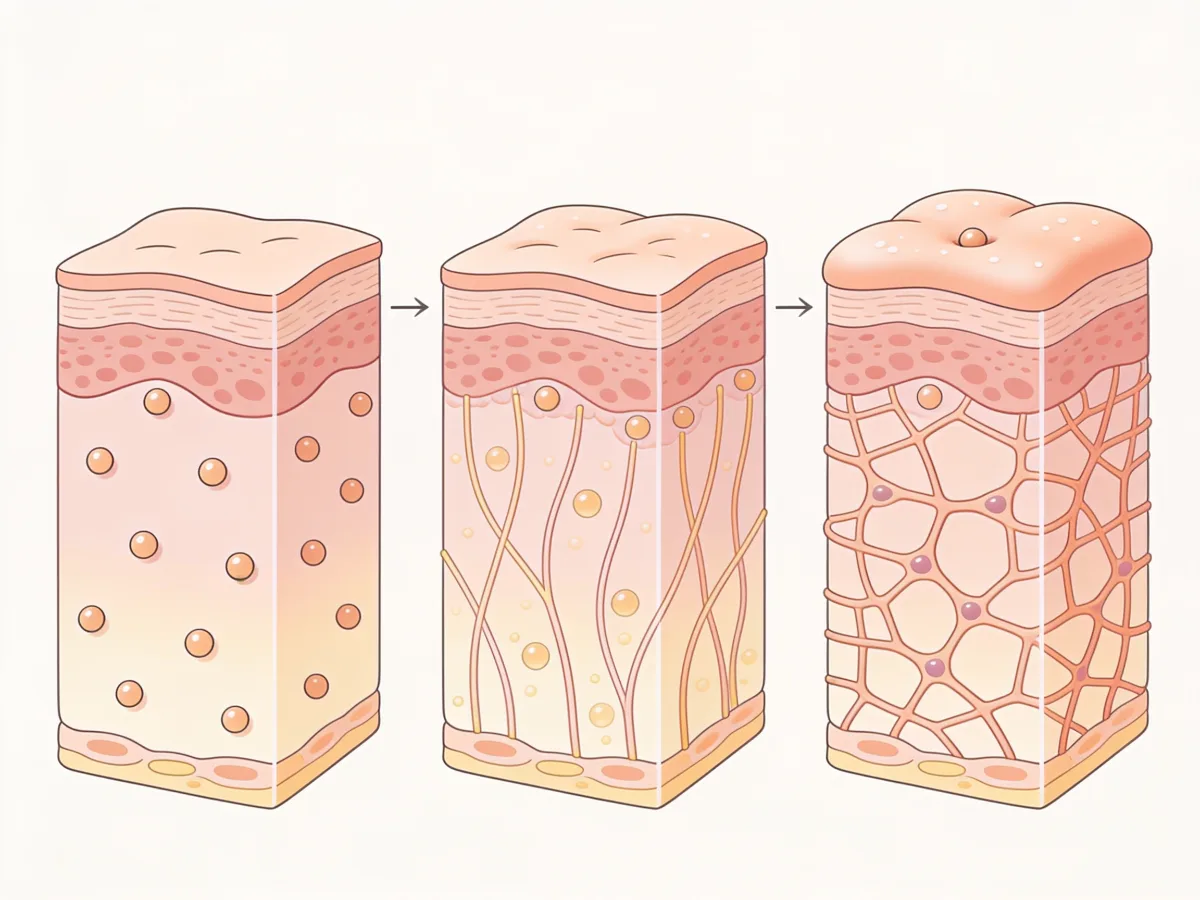
What is Radiesse, and what can go wrong?
Radiesse is an injectable filler made of calcium hydroxylapatite (CaHA), and most treatments with it go smoothly; when something goes wrong, it is usually a lump, too much fullness or unevenness. The maker describes it as synthetic calcium hydroxylapatite suspended in a gel carrier of sterile water, glycerin and sodium carboxymethylcellulose (Merz, Radiesse instructions for use).
The gel gives immediate volume and is absorbed over the following months, while the mineral particles stay longer and prompt the body to build collagen around them. A 2024 clinical review, written partly by employees of the manufacturer, states that CaHA can persist for up to about two years (McCarthy and colleagues, 2024).
The problems people ask about most:
- Lumps and nodules: firm spots, sometimes visible, often where product collected in one place.
- An overfilled or heavy look: cheeks, jawline or chin that look too full.
- Unevenness: one side fuller, or an irregular contour.
- Lumps in thin or mobile areas: especially the lips and around the mouth.
- Less often: product moving from where it was placed, infection or an inflamed lump later on.
- Rarely: a blocked blood vessel, which is an emergency with any filler.
This page explains problems after Radiesse and is not a recommendation for any product. SkinRev Lab assesses problems after CaHA treatment done elsewhere. For how the product works, see the Radiesse guide; for how SkinRev Lab approaches filler problems in general, see filler correction at SkinRev Lab.
How common are Radiesse lumps and other problems?
Lumps are the problem most often discussed after CaHA filler, but in the maker's main trial they were uncommon, and how often they occur depends heavily on the area and the technique. Across dermal fillers in general, most reactions are mild and short-lived, and most complications relate to the amount used and the technique (Funt and Pavicic, 2013).
- The maker's trial in the folds beside the nose: 117 people. In patient diaries, swelling, redness and bruising were common in the days after treatment, and a nodule was reported by one person (0.9%); doctors recorded no nodules on the Radiesse side (Merz, Radiesse instructions for use).
- Uneven contour: in the maker's 12-month study in people with facial fat loss linked to HIV treatment, doctors recorded contour irregularity in 19% (Merz, Radiesse instructions for use). That group differs from most aesthetic patients, but it shows that unevenness is a recognised effect.
- Reports since the product came to market: the maker lists nodules, granulomas, infection, product moving from where it was placed and blocked blood vessels among events reported voluntarily, and notes that their frequency cannot be reliably estimated.
- Lips: the maker states that use in the lips has not been established and notes published reports of nodules after lip injection.
Two points follow. First, a lump after Radiesse is a known effect, not in itself an emergency. Second, area and technique matter: lumps show more in thin, mobile areas and where product is placed close to the surface. Your doctor will advise how this applies to you.
Radiesse lumps: what kind of lump is it?
Most lumps after Radiesse are focal accumulations, meaning product gathered in one spot, and they are usually firm and not inflamed; a smaller group are inflamed, infected or immune-related and are managed differently. Doctors sort filler lumps by timing and by signs of inflammation (King and colleagues, 2016).
- At the time of injection or within hours: usually down to where the product was placed, or early swelling.
- Firm, cool, non-tender lumps: product collected in one spot, too close to the surface or near muscles that move a lot, such as around the mouth (McCarthy and colleagues, 2024).
- Lumps you can feel but not see: often left alone, as they may break down with the product over time.
- Red, warm, tender lumps between about day 3 and day 14: more likely to be infection and need same-day review (King and colleagues, 2016).
- Lumps that become inflamed weeks to years later: a delayed reaction or, rarely, a granuloma.
How a lump differs from fullness: a lump is a defined spot that can be pinched or rolled under a fingertip; overfilling is a broader fullness that changes the shape of the face. Both can be present at once.
In a Brazilian survey of 55 complications after collagen stimulators reported by ultrasound specialists, about a quarter involved CaHA alone or mixed with hyaluronic acid, almost nine in ten complications were nodules, and most appeared more than a month after treatment (Ianhez and colleagues, 2024). That series collected problem cases, so it does not show how often lumps happen.
For other lump types, see filler lumps and nodules, fibrotic filler lumps and filler granuloma.
Overfilled, heavy or uneven after Radiesse
An overfilled or uneven look after Radiesse usually comes from the amount placed, top-ups before the first result had settled, or layering over older filler in the same area. Because CaHA gives volume first and then stimulates collagen, the face can look different at two weeks and at several months.
How it can look:
- Cheeks that sit too far forward or too wide, most obvious when smiling.
- A heavy, square or long lower face after jawline or chin treatment.
- One side fuller than the other, or an irregular contour along the jawline.
- Firmness that makes the face feel stiff when moving.
What can look similar: swelling in the first days; older hyaluronic acid filler in the same area, which many people have had; and loose skin or heaviness in the lower face, which more volume does not correct.
What may help:
- Stopping further top-ups until the area has been assessed.
- Time, as the gel is absorbed over months and the particles break down over a longer period.
- Dissolving any hyaluronic acid filler found in the same area, which sometimes reduces the overall bulk.
- Where a collagen stimulator has over-responded and left an area too full, Dr Sin Yong may consider Time Freeze Laser LCLR, used for a microliposuction-like effect, after examination. This is Dr Sin Yong's clinical approach; no published trial has tested it for filler, and results vary.
For the whole-face pattern, see signs of too much filler and pillow face correction.
Can Radiesse be dissolved with an enzyme (hyaluronidase)?
No. An enzyme (hyaluronidase), the one used to dissolve filler, acts on hyaluronic acid only, and Radiesse is a mineral in a cellulose-based gel. A 2024 clinical review states directly that there is no reversal agent for CaHA (McCarthy and colleagues, 2024).
What this means for you:
- No quick reversal: there is no injection that removes Radiesse within days.
- Gradual natural breakdown: the same review reports that CaHA can persist for up to about two years, and notes that lumps generally do not outlast the material itself.
- A calcium-binding solution is not recommended: one has been suggested for dissolving CaHA, but the review does not recommend it, reporting that animal testing found no evidence that it broke the particles down, and noting a risk of tissue damage.
Where the enzyme can help: CaHA is sometimes mixed with hyaluronic acid before injection, and many people also have hyaluronic acid filler in the same area from other treatments. In the Brazilian survey above, the dissolving enzyme helped only where CaHA had been combined with hyaluronic acid (Ianhez and colleagues, 2024), which fits with it acting on the hyaluronic acid part alone.
Ultrasound can show where material sits and may suggest whether it is CaHA, hyaluronic acid or both, though not always with certainty, so that the enzyme is used only where it can work. That is why knowing exactly what was injected, and whether it was mixed, matters. See ultrasound-guided filler dissolving and dissolving filler.
What can be done for a Radiesse lump: a stepped approach
Radiesse lumps are managed in steps, starting with the least invasive option, and a 2024 clinical review sets these out in four levels (McCarthy and colleagues, 2024). Which step suits you depends on whether the lump is visible, inflamed or bothering you, and your doctor will advise.
- No intervention: a lump that can be felt but not seen may be left to break down naturally, taking your preference into account.
- Dispersion: a doctor injects sterile water or salt water into the lump to dilute and spread the product, often with massage. The review describes this as the first active step, and it can be repeated.
- Medical or laser treatment: for lumps that persist, options described include medicines injected into the lump and fractional laser.
- Removal: draining the material through a needle or small cut, or surgical excision, reserved as a last resort.
Before any of these: a red, warm, tender or growing lump is treated as possible infection or inflammation first. Infection is treated or ruled out before anything is injected into the lump (King and colleagues, 2016).
What does not help: squeezing, pressing or massaging hard at home, and having anything injected into the lump by someone who does not know what the product is.
At SkinRev Lab, surgical removal is by referral. For the wider group of fillers that cannot be dissolved, see non-dissolvable filler removal.
Lips, under-eyes and filler that moves
Radiesse problems show most readily in thin or mobile areas, such as the lips and under the eyes, and occasionally the product moves from where it was placed. The maker states that use in the lips and around the eyes has not been established (Merz, Radiesse instructions for use).
- Lips and around the mouth: the lips move constantly and have little tissue over the product, so lumps form and show more easily. The maker notes published reports of nodules after lip injection, and the 2024 review notes that lumps may arise where product sits near the ring of muscle around the mouth (McCarthy and colleagues, 2024).
- Under the eyes: the skin is thin, so a firm, pale or lumpy ridge can be visible. Under-eye problems are often mixed with older hyaluronic acid filler; see tear trough filler problems.
- Movement: the maker lists product displacement and migration among events reported since the product came to market. Fullness that appears away from the treated area should be examined, ideally with ultrasound. See filler migration.
- Diluted CaHA: CaHA is sometimes diluted and spread more thinly for skin quality rather than volume. That changes how it behaves, so tell your doctor which form you had if you know.
What may help: the stepped approach above, applied cautiously in these delicate areas. Firm massage of a lip lump at home is not advised. Lip problems from other fillers are covered in lip filler migration.
Infection, inflamed lumps and blocked blood vessels
Infection, delayed inflamed lumps and blocked blood vessels are uncommon or rare after Radiesse, but each needs prompt medical attention, and a blocked vessel is an emergency.
- Infection: a red, hot, increasingly painful swelling, especially from about day 3 to day 14 after injection, needs same-day review (King and colleagues, 2016). See filler infection.
- Delayed inflamed lumps: lumps that turn red, tender or larger weeks or months later, sometimes after an illness or dental work, need assessment rather than waiting.
- Granulomas: rare immune reactions to the material, listed by the maker among reported events.
- Blocked blood vessel: the maker warns that product entering a blood vessel can block it, and lists skin damage, vision impairment and blindness among the possible serious consequences. Pale, white, dusky or mottled skin, or pain that keeps rising, during or after injection is an emergency, and any change in vision needs emergency care at once. See filler vascular occlusion.
Because CaHA cannot be dissolved, a suspected blocked vessel is managed as a medical emergency without delay. If you cannot reach the provider who treated you, any doctor or emergency department can assess urgent symptoms.
Swelling, redness and bruising in the first days are expected and are not in this group; see filler swelling and bruising after filler.
Warning signs after Radiesse: what is normal and when to get help
Swelling, redness, tenderness and bruising for several days are normal after Radiesse, whereas a change in skin colour, escalating pain, spreading redness with fever or any change in vision is not. Use the table as a general guide, and contact your provider or a doctor if you are unsure.
| What you notice | Usual timing | What it may mean | What to do |
|---|---|---|---|
| Swelling, redness, tenderness, bruising | First several days | Expected reaction | Follow your aftercare advice |
| Firmness or slight lumpiness | First two weeks | Swelling, or product settling | Review at about two weeks |
| A firm lump that stays and is not tender | Beyond two weeks | Product collected in one spot | Doctor review; no more product there meanwhile |
| Face looking too full, heavy or uneven | Once swelling settles | More product than the area suits | Doctor review; no top-up |
| A lump in the lip or around the mouth | Weeks to months | Product near a mobile muscle | Doctor review; do not massage hard |
| Red, hot, increasingly painful swelling | Often days 3 to 14 | Possible infection | Same-day medical review |
| A lump that turns red, tender or grows | Weeks to years | Delayed inflamed nodule | Prompt doctor review; do not massage |
| Spreading redness with fever | Any time | Possible spreading infection | Go to an emergency department now |
| Pale, dusky or mottled skin, or severe or escalating pain | During or soon after injection | Possible blocked blood vessel | Go to an emergency department now |
| Any change in vision | During or after injection | Emergency | Call 995 or go to A&E at once |
Do not wait for a routine appointment with any of the last three signs, and do not try to treat them yourself.
How Dr Sin Yong assesses and corrects problems after Radiesse
At SkinRev Lab, Dr Sin Yong, medical adviser, assesses problems after Radiesse done elsewhere by taking a full treatment history, examining the face at rest and while moving, and scanning the area with ultrasound where useful. Because CaHA cannot be dissolved, the first aim is to work out what the lump or fullness is, and whether hyaluronic acid is also present, before deciding whether to wait, treat or refer.
What helps the assessment:
- The product name, dates, areas and amounts, and whether it was diluted or mixed with hyaluronic acid.
- Every other filler you have had in the same areas, including treatments from years ago or overseas.
- Photos from before treatment and since the problem began.
- Any recent illness, dental work, allergy or autoimmune condition, and your current medicines.
What correction may involve, where appropriate:
- Observation and review where the change is mild or still early.
- Medical treatment first for an inflamed or infected lump.
- Dissolving any hyaluronic acid filler found in the same area, in small, staged amounts.
- Time Freeze Laser LCLR in selected areas of over-fullness, with the caveats above.
- Referral for a surgical opinion for a persistent, well-defined lump.
Before any more treatment: ask what is already in the area, whether the product can be dissolved if you dislike the result, and how much is planned. A doctor who suggests a smaller amount, a different approach or no treatment is often protecting your result.
Doing nothing can be the right advice, and correction cannot shorten every problem. Correction is priced at consultation. You can see how mapping works in the ultrasound filler mapping video.
Sources
References & sources
- Merz North America. Radiesse injectable implant: instructions for use. IN00053-12, April 2023.
- McCarthy AD, van Loghem J, Martinez KA, Aguilera SB, Funt D. A structured approach for treating calcium hydroxylapatite focal accumulations. Aesthet Surg J. 2024;44(8):869-879. doi:10.1093/asj/sjae031.
- Ianhez M, de Goés e Silva Freire G, Sigrist RMS, et al. Complications of collagen biostimulators in Brazil: description of products, treatments, and evolution of 55 cases. J Cosmet Dermatol. 2024;23(9):2829-2835. doi:10.1111/jocd.16343.
- King M, Bassett S, Davies E, King S. Management of delayed onset nodules. J Clin Aesthet Dermatol. 2016;9(11):E1-E5.
- Funt D, Pavicic T. Dermal fillers in aesthetics: an overview of adverse events and treatment approaches. Clin Cosmet Investig Dermatol. 2013;6:295-316. doi:10.2147/CCID.S50546.
Main guide
Filler correction
filler correction at SkinRev LabRelated questions: How does Radiesse work, and where do lumps appear?What can be done about fillers that cannot be dissolved?What kind of lump is it after filler?
Common questions
Your questions,
answered
Can Radiesse be dissolved?
No. Radiesse is calcium hydroxylapatite, and a 2024 clinical review states that there is no reversal agent for it. An enzyme (hyaluronidase), which is used to dissolve filler, acts on hyaluronic acid only, so it may help only where hyaluronic acid was mixed in or is also present. Lumps are managed step by step instead.
How long do Radiesse lumps last?
Often no longer than the product itself. A 2024 review reports that CaHA can persist for up to about two years and that lumps generally do not outlast the material. A lump that can be felt but not seen may be left alone; a visible or bothersome lump can be treated sooner after assessment.
What can be done for a Radiesse lump?
A stepped approach is used: no intervention for small lumps that cannot be seen, dispersion with sterile water or salt water injected by a doctor, then medical or laser treatment for persistent lumps, and removal only as a last resort. An inflamed lump is treated as possible infection first.
Why is there a lump in my lip after Radiesse?
The lips move constantly and have little tissue over any filler, so product can collect and show as a lump. The maker states that use in the lips has not been established and notes published reports of lip nodules. A doctor should assess it; firm massage at home is not advised.
Can Radiesse make my face look overfilled?
It can, if more product is placed than the area suits, or after repeated top-ups. Because it cannot be dissolved, the response is to stop top-ups, allow time, dissolve any hyaluronic acid filler also present and, in selected cases, consider other treatment after assessment.
When is a problem after Radiesse urgent?
Seek same-day care for a red, hot, increasingly painful swelling. Go to an emergency department now if skin turns pale, dusky or mottled, pain is severe or keeps escalating, or there is spreading redness with fever. For any change in vision, call 995 or go to A&E at once.
Can Dr Sin Yong assess a problem after Radiesse?
Yes. Dr Sin Yong assesses problems after CaHA treatment done elsewhere at SkinRev Lab, with a history, an examination and ultrasound where useful, and explains the options, including waiting. Bring the product name, dates and areas if you have them. Correction is priced at consultation.
Medical journal references
Peer-reviewed background reading for this page. These papers report research in groups of people and do not predict an individual result.
- McCarthy AD, van Loghem J, Martinez KA, et al. A Structured Approach for Treating Calcium Hydroxylapatite Focal Accumulations. Aesthet Surg J. 2024;44(8):869-879. PubMed
- Wang H, Wu D, Lo C, et al. Foreign Body Granulomas Reaction Related to Collagen Stimulatory Cosmetic Fillers: A Systematic Review. J Cosmet Dermatol. 2025;24(10):e70459. PubMed
- Amiri M, Meçani R, Niehot CD, et al. Skin regeneration-related mechanisms of Calcium Hydroxylapatite (CaHA): a systematic review. Front Med (Lausanne). 2023;10:1195934. PubMed
- Baranska-Rybak W, Lajo-Plaza JV, Walker L, Alizadeh N. Late-Onset Reactions after Hyaluronic Acid Dermal Fillers: A Consensus Recommendation on Etiology, Prevention and Management. Dermatol Ther (Heidelb). 2024;14(7):1767-1785. PubMed