Guide · Juvelook gone wrong
Juvelook gone wrong: bumps, lumps and what can help
Most Juvelook treatments go smoothly, and small bumps on the day are expected. When something does go wrong, it is usually a lump that stays beyond the first weeks, unevenness or redness that lingers, and because the PDLLA particles in Juvelook cannot be dissolved, a lasting lump is assessed by type and managed step by step.
Medically reviewed by Dr Sin Yong, medical adviser · Last reviewed 17 November 2026
Advised surgery, or unsure what your options are?
Dr Sin Yong, our medical adviser, reviews filler lumps, nodules and overfilled areas, including filler placed elsewhere and fillers that cannot be dissolved. Surgery is sometimes the right answer; a review first helps you understand your options and their limits before you decide.
- Bring the product name and treatment dates if you have them, or the clinic's records.
- Take clear daylight photos from the front and both sides, and bring any scan reports.
- Do not wait for an appointment if you have pale, dusky or mottled skin or severe or rising pain (contact the provider who treated you at once or go to A&E), spreading redness with fever (see a doctor the same day), or any change in vision (call 995 or go to A&E at once).
WhatsApp us for a second opinion · Told you need surgery to remove filler? · What to bring to a filler second opinion
Quick answer
- Juvelook is a hybrid collagen stimulator made by VAIM in South Korea, combining poly-D,L-lactic acid (PDLLA) particles with non-cross-linked hyaluronic acid.
- Small bumps and needle marks on the day of treatment are common and usually settle within a few days; a firm lump that persists beyond about two weeks should be reviewed.
- Published data on Juvelook itself are limited; in a small study funded by the maker, temporary redness and pain at the injection site were the effects recorded.
- The PDLLA particles cannot be dissolved with an enzyme (hyaluronidase); the enzyme acts only on hyaluronic acid.
- Go to an emergency department now for skin turning pale, dusky or mottled, severe or escalating pain, any change in vision, or spreading redness with fever.
- At SkinRev Lab, Dr Sin Yong, medical adviser, assesses bumps, lumps and other problems after Juvelook with a history, an examination and ultrasound where useful; correction is priced at consultation.
What is Juvelook, and what can go wrong?
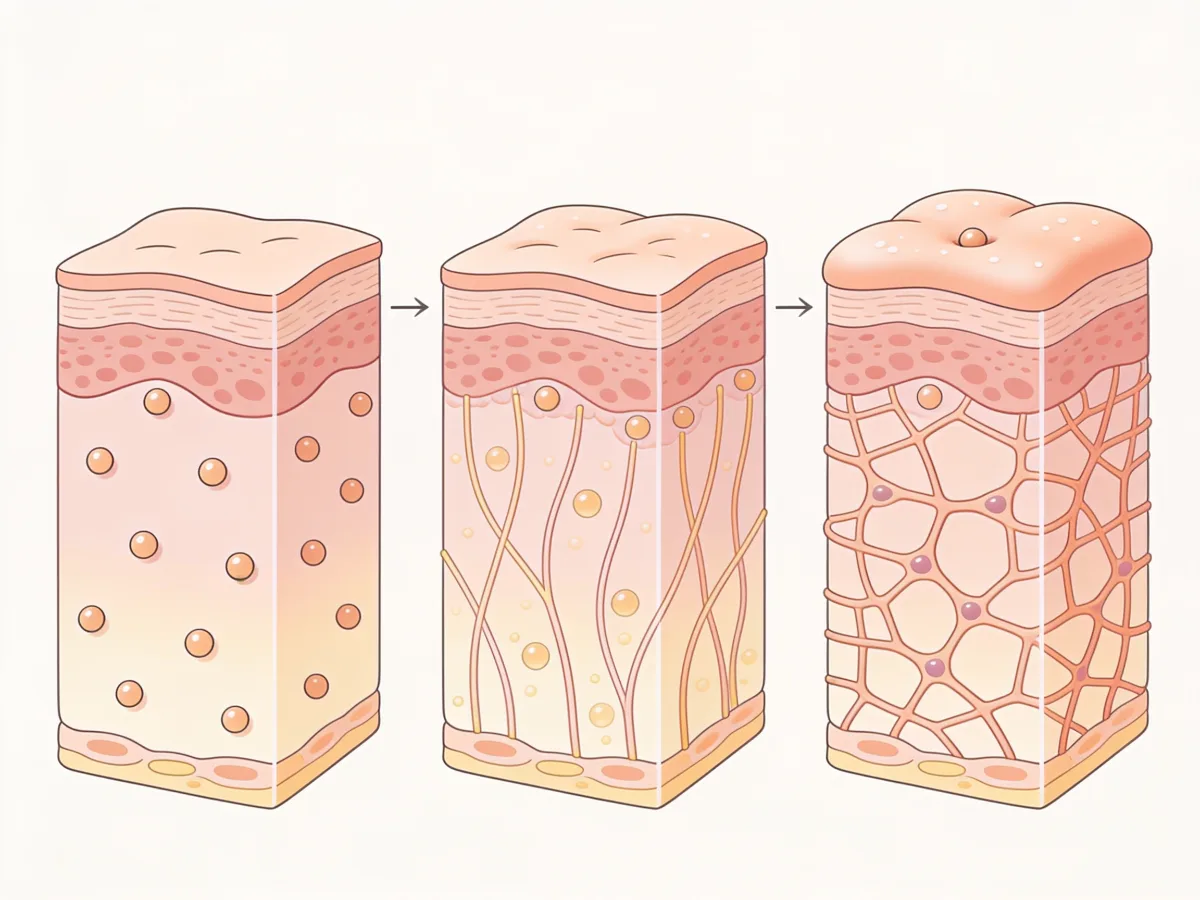
Juvelook is an injectable collagen stimulator that combines poly-D,L-lactic acid (PDLLA) particles with hyaluronic acid, and most treatments with it go smoothly; when something goes wrong, it is usually a lump or bumps that do not settle. Its maker, VAIM Co., Ltd. of South Korea, describes its products as hybrid collagen stimulators combining PDLLA with hyaluronic acid. A published study describes Juvelook as PDLLA with non-cross-linked hyaluronic acid, mixed with fluid before injection (Seo and colleagues, 2024).
PDLLA is a slowly absorbed synthetic polymer, a close relative of the poly-L-lactic acid in Sculptra. The particles prompt the skin to build collagen over the following months, and the maker describes uses for skin rejuvenation and scarring as well as for volume.
The problems people ask about most:
- Bumps on the day: small raised spots at each injection point.
- Lumps that stay: firm spots that can be felt, and sometimes seen, weeks later.
- Redness or bruising that takes longer than expected to fade.
- Unevenness: one area more textured or fuller than another.
- Rarely: an inflamed lump months later, infection or a blocked blood vessel, which is an emergency.
This page explains problems after Juvelook and is not a recommendation for any product. For how the treatment itself works, see the Juvelook guide. For how SkinRev Lab approaches filler problems in general, see filler correction at SkinRev Lab.
How common are problems after Juvelook?
Published data on Juvelook itself are limited, so how often lumps occur is not well established; the small studies available report mainly short-lived redness and discomfort. Across dermal fillers and stimulators in general, most reactions are mild and short-lived, and serious events are rare (Funt and Pavicic, 2013).
- A small study of Juvelook: 16 adults received two or three sessions four weeks apart. Temporary worsening of redness was recorded in 4 people (25%) and pain during the procedure in 3 (18.8%); no bruising, swelling or serious events were recorded. The study had no comparison group and was funded by the maker (Seo and colleagues, 2024).
- Evidence from other PDLLA products: a consensus on a different PDLLA collagen stimulator reports that the most common effects are minor, including bruising, mild tenderness and swelling, and that severe effects are rare. It attributes lumps mainly to technique, where product collects abnormally, often in areas of active facial muscle (Magacho-Vieira and colleagues, 2024).
Two points follow. First, a small study cannot show how often uncommon problems such as persistent lumps occur, so the absence of lumps in it is not proof that they do not happen. Second, findings for other PDLLA products may not apply directly to Juvelook, because the particles and the mix differ. Your doctor will advise how this applies to you.
If you are unsure whether you had a filler, a skin booster or a stimulator, see collagen stimulator vs filler.
Bumps after Juvelook: what is normal in the first days?
Small bumps at each injection point on the day of Juvelook are common and usually settle within a few days, as the fluid placed in the skin spreads and is absorbed. They are part of how the treatment is done, not a sign that it has gone wrong.
Usually normal in the first days:
- A grid of small raised bumps or needle marks, often most visible for the first day.
- Redness, mild swelling and tenderness.
- Small bruises, especially under the eyes.
- A slightly gritty or uneven feel to the skin.
Less likely to be normal:
- A firm lump you can still see or feel after about two weeks.
- A bump that is growing, red, warm or increasingly tender.
- Redness that spreads, or comes with fever.
- Any change in skin colour to pale, dusky or mottled.
What helps meanwhile: follow the aftercare you were given, including any massage advice. A consensus on another PDLLA product recommends massage for the first three to five days to help spread the product evenly and reduce the risk of lumps (Magacho-Vieira and colleagues, 2024), but advice differs between products and areas, so follow your own doctor's instructions. Avoid pressing on a bump that is tender or red.
For bruising, see bruising after filler; for swelling patterns, see filler swelling: what is normal.
Lumps after Juvelook that do not settle
A lump after Juvelook that is still there after about two weeks is usually PDLLA particles collected in one spot, placed too deep or too shallow, or in an area where muscle movement gathers them, and it is assessed by timing and by whether it is inflamed (King and colleagues, 2016).
- Firm, cool, non-tender lumps: the most common type, usually product concentrated in one place.
- Lumps in moving areas: authors writing about PDLLA note that injection into muscle easily causes nodules, and that lumps form more often where facial muscles are active (Lin and Lin, 2022; Magacho-Vieira and colleagues, 2024).
- Lumps under the eyes: the skin is thin, so small collections show more readily. Under-eye problems are often mixed with older filler; see tear trough filler problems.
- Red, warm, tender lumps between about day 3 and day 14: more likely to be infection and need same-day review (King and colleagues, 2016).
- Lumps that become inflamed weeks or months later: a delayed reaction or, rarely, a granuloma, which the PDLLA consensus describes as an exaggerated inflammatory response (Magacho-Vieira and colleagues, 2024).
What makes lumps more likely: a more concentrated mix, uneven placement, placement into muscle, and missing the aftercare advised for the product. Because the effect builds over months, a lump can sometimes become noticeable only after several weeks.
For the wider picture, see filler lumps and nodules, fibrotic filler lumps and collagen injection complications.
Can Juvelook be dissolved with an enzyme (hyaluronidase)?
Not the part that forms lasting lumps. An enzyme (hyaluronidase), the one used to dissolve filler, acts on hyaluronic acid only. Juvelook contains hyaluronic acid as well as PDLLA, so the enzyme may break down the hyaluronic acid portion, but the PDLLA particles do not respond to it. Authors writing about PDLLA state plainly that there is no dissolving enzyme for it (Lin and Lin, 2022).
What this means for you:
- No quick reversal: there is no injection that removes the PDLLA particles within days.
- Gradual natural breakdown: PDLLA is absorbed by the body slowly, over months, and how long the effect lasts is not well established.
- Juvelook cannot be dissolved: an enzyme does not act on its PDLLA particles, so firm lumps are managed by type rather than dissolved.
- Other filler may be present: many people have had hyaluronic acid filler in the same area, especially under the eyes, and that filler can be dissolved if it is part of the problem.
Ultrasound can show where material sits and may suggest whether it is hyaluronic acid or particles, though not always with certainty, so that the enzyme is used only where it can work. That is why knowing exactly what was injected, and when, matters. See non-dissolvable filler removal and dissolving filler.
What can help a Juvelook lump?
What helps a lump after Juvelook depends on whether it can be seen, whether it is inflamed and how long it has been there, and the gentlest effective option is usually tried first. Small lumps that can be felt but not seen often need no treatment.
Options, depending on the type (your doctor will advise which suits you):
- Time and review for small, quiet lumps, with no further sessions in that area meanwhile.
- Massage or moulding early on, only if your doctor advises it.
- Dispersion: a doctor injects salt water into a firm, non-inflamed lump to spread the product, sometimes releasing the tissue around it (King and colleagues, 2016).
- Antibiotics where a doctor suspects infection after examining you.
- Medicine injected into the lump for an inflamed nodule once infection has been treated or ruled out, used cautiously because it can thin the tissue.
- Energy-based treatment in selected cases, after assessment.
- Referral for removal of a persistent, well-defined lump, as a last resort.
What does not help: squeezing or picking a bump, which risks infection and scarring, and having anything injected into a lump by someone who does not know what it is.
Where the concern is fullness rather than a lump, and a collagen stimulator has over-responded, Dr Sin Yong may consider Time Freeze Laser LCLR, used for a microliposuction-like effect, after examination. This is Dr Sin Yong's clinical approach; no published trial has tested it for filler, and results vary. Hard, red, painful or growing lumps need medical review, not laser.
Other less common problems after Juvelook
Less common problems after Juvelook include lingering redness, unevenness, infection, delayed inflamed lumps and, rarely, a blocked blood vessel. Each needs a doctor's assessment, and the last is an emergency.
- Lingering redness: in the small Juvelook study, temporary worsening of redness was the effect most often recorded (Seo and colleagues, 2024). Redness that lasts for weeks, or comes with heat and pain, should be reviewed.
- Unevenness: texture or fullness that differs between areas once swelling has settled may reflect uneven spread; the effect builds over months, so it is usually reviewed before anything else is done.
- Puffiness under the eyes: swelling in the first days is common; puffiness that lasts weeks may be fluid, older filler or eye bags, and needs examination. See eye bags.
- Infection: a red, hot, increasingly painful swelling, especially from about day 3 to day 14, needs same-day review (King and colleagues, 2016). See filler infection.
- Delayed inflamed lumps: lumps that turn red, tender or larger months later need assessment rather than waiting. See filler granuloma.
- Blocked blood vessel: rare with any injectable. Pale, white, dusky or mottled skin, or pain that keeps rising, during or after injection is an emergency, and any change in vision needs emergency care at once. See filler vascular occlusion.
If you cannot reach the provider who treated you, any doctor or emergency department can assess urgent symptoms.
Warning signs after Juvelook: what is normal and when to get help
Small bumps, redness, mild swelling and bruising for a few days are normal after Juvelook, whereas a change in skin colour, escalating pain, spreading redness with fever or any change in vision is not. Use the table as a general guide.
| What you notice | Usual timing | What it may mean | What to do |
|---|---|---|---|
| Small bumps at injection points, needle marks | Day of treatment to a few days | Expected | Follow your aftercare advice |
| Redness, mild swelling, small bruises | First few days | Expected reaction | Avoid pressing on tender areas |
| A firm lump you can still feel or see | Beyond about two weeks | Product collected in one spot | Doctor review; no further session there meanwhile |
| Uneven texture or fullness | Weeks to months | Uneven spread | Doctor review before the next session |
| Red, hot, increasingly painful swelling | Often days 3 to 14 | Possible infection | Same-day medical review |
| A lump that turns red, tender or grows | Weeks to months | Delayed inflamed nodule | Prompt doctor review; do not massage |
| Spreading redness with fever | Any time | Possible spreading infection | Go to an emergency department now |
| Pale, dusky or mottled skin, or severe or escalating pain | During or soon after injection | Possible blocked blood vessel | Go to an emergency department now |
| Any change in vision | During or after injection | Emergency | Call 995 or go to A&E at once |
Do not wait for a routine appointment with any of the last three signs, and do not try to treat them yourself.
How Dr Sin Yong assesses and corrects problems after Juvelook
At SkinRev Lab, Dr Sin Yong, medical adviser, assesses problems after Juvelook by taking a full treatment history, examining the area and scanning it with ultrasound where useful. Because the PDLLA particles cannot be dissolved, the aim is to work out what the bump or lump is before deciding whether to wait, treat or refer.
What helps the assessment:
- The product name, dates, areas and number of sessions, and the aftercare you were given.
- Every other filler, skin booster or stimulator you have had in the same areas.
- Photos from before treatment and since the problem began.
- Any recent illness, allergy or autoimmune condition, and your current medicines.
What correction may involve, where appropriate:
- Observation and review where bumps are early or small.
- Medical treatment first for an inflamed or infected lump.
- Dissolving any hyaluronic acid filler found in the same area.
- Time Freeze Laser LCLR in selected areas of over-fullness, with the caveats above.
- Referral for a surgical opinion for a persistent, well-defined lump.
Before any further session: ask how the product will be mixed, how deep it will be placed, which areas will be avoided, and what to do if you feel a bump. A doctor who suggests fewer sessions, a different approach or no treatment is often protecting your result.
Doing nothing can be the right advice, and correction cannot shorten every problem. Correction is priced at consultation. You can see how mapping works in the ultrasound filler mapping video.
Sources
References & sources
- Seo SB, Park H, Jo JY, Ryu HJ. Skin rejuvenation effect of the combined PDLLA and non cross-linked hyaluronic acid: a preliminary study. J Cosmet Dermatol. 2024;23(3):794-802. doi:10.1111/jocd.16085.
- IMCAS. VAIM Co., Ltd.: exhibitor profile, IMCAS Asia 2026. Accessed 17 November 2026.
- Magacho-Vieira FN, Vieira AO, Soares A Jr, et al. Consensus recommendations for the reconstitution and aesthetic use of poly-D,L-lactic acid microspheres. Clin Cosmet Investig Dermatol. 2024;17:2755-2765. doi:10.2147/CCID.S497691.
- Lin JY, Lin CY. Thickness-adjustable injectable poly-D,L-lactic acid: a versatile filler. Plast Reconstr Surg Glob Open. 2022;10:e4365. doi:10.1097/GOX.0000000000004365.
- King M, Bassett S, Davies E, King S. Management of delayed onset nodules. J Clin Aesthet Dermatol. 2016;9(11):E1-E5.
- Funt D, Pavicic T. Dermal fillers in aesthetics: an overview of adverse events and treatment approaches. Clin Cosmet Investig Dermatol. 2013;6:295-316. doi:10.2147/CCID.S50546.
Main guide
Filler correction
filler correction at SkinRev LabRelated questions: What is Juvelook, and how is it done?How do Juvelook and Sculptra differ?What can be done about fillers that cannot be dissolved?
Juvelook removal: what can and cannot be done
Juvelook cannot be dissolved, and no injection takes it out. The body breaks the particles down slowly on its own. So "removal" usually means managing a lump while that happens.
| Situation | What your doctor may advise | What to expect |
|---|---|---|
| Small, soft bumps in the first weeks | Wait and watch, with aftercare advice | Many settle as swelling goes down |
| A firm lump that stays past a few weeks | Assessment, often with ultrasound, then a plan for that type of lump | Lumps soften slowly; the aim is a flatter, less visible lump |
| A red, tender or growing lump | Prompt review, as this can be inflammation or infection | Treated by cause; do not wait for the next session |
| A separate hyaluronic acid filler from an earlier treatment in the same area | Dissolving that filler with an enzyme (hyaluronidase), if ultrasound shows it is there | Fullness from the old filler can ease; the Juvelook stays |
| A firm, well-defined lump that never settles | Referral to a surgeon elsewhere to discuss removal | A last resort with its own risks and scars |
Dr Sin Yong first works out what the lump is, then advises whether to wait, treat or refer. Correction is priced at consultation. For other products that cannot be dissolved, see non-dissolvable filler removal.
Sources and medical review
Medically reviewed by Dr Sin Yong. Further reading from independent medical sources:
- Magacho-Vieira FN et al. Consensus recommendations for the reconstitution and aesthetic use of poly-D,L-lactic acid microspheres. Clin Cosmet Investig Dermatol. 2024;17:2755-2765
- King M, Bassett S, Davies E, King S. Management of delayed onset nodules. J Clin Aesthet Dermatol. 2016;9(11):E1-E5 (ACE Group guideline)
- Funt D, Pavicic T. Dermal fillers in aesthetics: an overview of adverse events and treatment approaches. Clin Cosmet Investig Dermatol. 2013;6:295-316
Juvelook lumps: what lowers the risk before treatment
Lumps after Juvelook usually come from where and how the product was placed. If you are planning treatment, these questions help.
- Ask which areas will be treated. Thin skin and areas that move a lot, such as under the eyes or around the mouth, show bumps more easily.
- Ask how deep the product will go and how much is used per area. Product collecting in one spot is a common cause of lumps.
- Ask what aftercare to follow, including whether to massage, and follow it exactly.
- Tell your injector about any filler or other injectables in the same area, with dates if you have them.
- Ask who reviews you if a lump appears, and whether an ultrasound scan is available to see what it is.
If a lump has already formed, see the lump sections above, or read about filler lumps and nodules.
Juvelook side effects long term: the first weeks and later months
Most Juvelook side effects show in the first weeks and fade. A few appear later, because the product works slowly. This timeline shows what is usually expected and what needs a review.
| When | Usually expected | Get it checked if | Why it can happen then |
|---|---|---|---|
| First week | Tiny bumps at injection points, redness, mild swelling | Pain keeps rising, or skin turns pale or dusky | Product and swelling sit near the surface |
| Weeks 2 to 8 | Bumps fading; skin feels smoother | A bump is still there and firm at week 4 | Product that collected in one spot may not spread out |
| Months 2 to 6 | Gradual change in texture as collagen builds | A new lump appears where there was none | Collagen can build unevenly around clumped particles |
| After about six months | Results hold and slowly soften | A lump turns red, tender or grows | Late inflammation around the particles is uncommon but possible |
Keep the date and areas of every session. If a late lump appears, that record helps your doctor tell a Juvelook lump from an older filler.
If your Juvelook went wrong: what to record and bring
The first thing to do is write down what was done, while you can still get the details. This matters even more if you had Juvelook overseas.
- The product name as written on your record, and the batch number if the clinic will give it.
- The date, the areas treated, and how many sessions you have had.
- The name of the doctor who injected you, and the clinic.
- Any other filler or injectable in the same area, with rough dates.
- Photos of the problem every few days, in the same light.
- The aftercare you were told, such as whether to massage.
If you were treated abroad, ask for your treatment record before you fly home. Any change in vision, or skin turning pale, grey or blotchy with rising pain, needs an emergency department straight away, wherever you are. For a non-urgent review, bring the list to a filler second opinion.
Common questions
Your questions,
answered
Are bumps normal after Juvelook?
Yes, in the first few days. Small raised bumps and needle marks at each injection point are common and usually settle within a few days as the fluid spreads and is absorbed. A firm lump that is still there after about two weeks, or one that is red, warm or growing, should be reviewed.
Can Juvelook be dissolved?
No. Juvelook cannot be dissolved. An enzyme (hyaluronidase), which is used to dissolve hyaluronic acid filler, does not act on its PDLLA particles. Lumps are therefore managed by type, from waiting to dispersion and medical treatment.
Do Juvelook lumps go away on their own?
Small lumps that can be felt but not seen often become less noticeable as the particles are absorbed over months. Some persist, and published data on how long Juvelook lumps last are limited. A visible, growing, red or tender lump needs a doctor's assessment rather than waiting.
Should I massage bumps after Juvelook?
Follow the aftercare you were given. Massage in the first days is advised for some PDLLA products to help spread the product evenly, but advice differs. Massage does not dissolve the particles, and a bump that is red, warm, tender or growing should not be massaged and needs assessment.
Why is my skin still red after Juvelook?
Some redness for a few days is expected. In a small study funded by the maker, temporary worsening of redness was the effect recorded most often. Redness that lasts for weeks, spreads, or comes with heat, pain or fever is not typical and should be reviewed by a doctor.
When is a problem after Juvelook urgent?
Seek same-day care for a red, hot, increasingly painful swelling. Go to an emergency department now if skin turns pale, dusky or mottled, pain is severe or keeps escalating, or there is spreading redness with fever. For any change in vision, call 995 or go to A&E at once.
Can Dr Sin Yong assess a lump after Juvelook?
Yes. Dr Sin Yong can examine the area at SkinRev Lab, wherever you were treated, scan it with ultrasound where useful and explain the options, including waiting. Bring the product name, dates and areas if you have them. Correction is priced at consultation, and realistic expectations are explained first.
Medical journal references
Peer-reviewed background reading for this page. These papers report research in groups of people and do not predict an individual result.
- Magacho-Vieira FN, Ducati EPJ. Clinical Management of Poly-D,L-Lactic Acid Nodules: A Guideline With Diagnostic and Treatment Flowchart. J Cosmet Dermatol. 2025;24(4):e70158. PubMed
- Wang H, Wu D, Lo C, et al. Foreign Body Granulomas Reaction Related to Collagen Stimulatory Cosmetic Fillers: A Systematic Review. J Cosmet Dermatol. 2025;24(10):e70459. PubMed