Guide · AestheFill gone wrong
AestheFill gone wrong: lumps, unevenness and what can help
Most AestheFill treatments go smoothly, with bruising, tenderness and swelling that settle within days. When something does go wrong, it is usually a lump or an uneven result, and because the poly-D,L-lactic acid (PDLLA) in AestheFill cannot be dissolved like hyaluronic acid filler, a lasting lump is assessed by type and managed step by step.
Medically reviewed by Dr Sin Yong, medical adviser · Last reviewed 17 November 2026
Advised surgery, or unsure what your options are?
Dr Sin Yong, our medical adviser, reviews filler lumps, nodules and overfilled areas, including filler placed elsewhere and fillers that cannot be dissolved. Surgery is sometimes the right answer; a review first helps you understand your options and their limits before you decide.
- Bring the product name and treatment dates if you have them, or the clinic's records.
- Take clear daylight photos from the front and both sides, and bring any scan reports.
- Do not wait for an appointment if you have pale, dusky or mottled skin or severe or rising pain (contact the provider who treated you at once or go to A&E), spreading redness with fever (see a doctor the same day), or any change in vision (call 995 or go to A&E at once).
WhatsApp us for a second opinion · Told you need surgery to remove filler? · What to bring to a filler second opinion
Quick answer
- AestheFill is a collagen stimulator made by REGEN Biotech in South Korea, made of porous poly-D,L-lactic acid (PDLLA) microspheres with carboxymethylcellulose, mixed with sterile water before injection.
- A 2024 consensus reports that the most common effects are minor, such as bruising, mild tenderness and swelling, and that severe effects are rare; it gives no rates.
- Lumps are linked mainly to technique, where product collects in one spot, often in areas of active facial muscle; injection into muscle is described as easily causing nodules.
- AestheFill cannot be dissolved with an enzyme (hyaluronidase): authors linked to the maker state that there is no dissolving enzyme for injectable PDLLA.
- Go to an emergency department now for skin turning pale, dusky or mottled, severe or escalating pain, any change in vision, or spreading redness with fever.
- At SkinRev Lab, Dr Sin Yong, medical adviser, assesses problems after AestheFill with a history, an examination and ultrasound where useful; correction is priced at consultation.
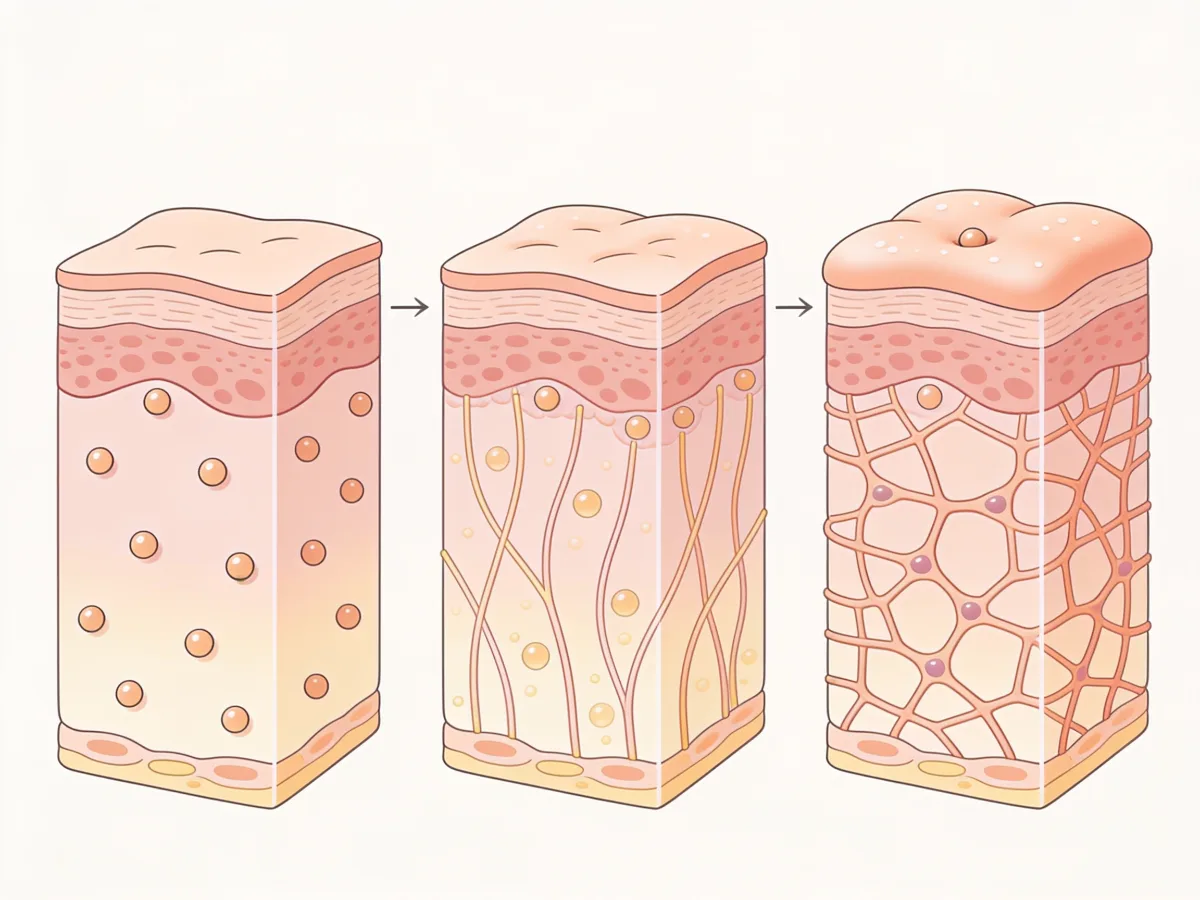
What is AestheFill, and what can go wrong?
AestheFill is an injectable collagen stimulator made of poly-D,L-lactic acid (PDLLA), and most treatments with it go smoothly; when something goes wrong, it is usually a lump or an uneven result. It is made by REGEN Biotech of South Korea. A 2024 consensus describes it as porous PDLLA microspheres with carboxymethylcellulose, supplied as a powder and mixed with sterile water before injection (Magacho-Vieira and colleagues, 2024).
PDLLA is a slowly absorbed synthetic polymer, closely related to the poly-L-lactic acid in Sculptra. The microspheres prompt the body to build collagen over the following months. Authors linked to the maker describe how the amount of water used changes how thick the mix is, so that it can be placed in different layers (Lin and Lin, 2022), and this matters when working out why a lump formed.
The problems people ask about most:
- Lumps and nodules: firm spots that can be felt, and sometimes seen.
- Unevenness: one side fuller, or a ridge where product gathered.
- Swelling or bruising that takes longer than expected to settle.
- An overfilled look: less common, building over months as collagen forms.
- Rarely: an inflamed lump months later, infection or a blocked blood vessel, which is an emergency.
This page explains problems after AestheFill and is not a recommendation for any product. For how collagen stimulators work in general, see collagen biostimulators. For how SkinRev Lab approaches filler problems, see filler correction at SkinRev Lab.
How common are problems after AestheFill?
Published information on AestheFill gives no reliable rates for lumps or other problems; the available sources describe common effects as minor and severe effects as rare, and most are written by authors with links to the maker or to companies in the field. How often lasting problems occur is therefore not well established.
- A 2024 consensus: a panel of Brazilian doctors agreed that the most common effects are minor, including bruising, mild tenderness and swelling, and that severe effects are rare. They attribute lumps mainly to technique, where product collects abnormally, often in areas of active facial muscle. The consensus did not report patient data, and several authors declare speaking roles for companies (Magacho-Vieira and colleagues, 2024).
- Authors linked to the maker: two doctors who are medical directors for the maker note that injection into muscle easily causes nodules (Lin and Lin, 2022).
- Fillers in general: most reactions are mild and short-lived, and most complications relate to the amount used and the technique (Funt and Pavicic, 2013).
Two points follow. First, the lack of published rates does not mean problems do not happen. Second, how the product was mixed, how deep it was placed and the area treated matter more than the product name alone. Your doctor will advise how this applies to you.
AestheFill lumps and nodules: what kind of lump is it?
Most lumps after AestheFill are product and the tissue around it collected in one spot, and they are usually firm and not inflamed; a smaller group are inflamed, infected or immune-related and are managed differently. Doctors sort filler lumps by timing and by signs of inflammation (King and colleagues, 2016).
- At the time of injection or within hours: usually swelling or where the product was placed.
- Small bumps you can feel but not see: common with collagen stimulators, and often left alone and reviewed.
- Firm, cool, non-tender lumps that stay: product concentrated in one place, placed in muscle, or gathered by movement.
- Red, warm, tender lumps between about day 3 and day 14: more likely to be infection and need same-day review (King and colleagues, 2016).
- Lumps that become inflamed weeks to months later: a delayed reaction or, rarely, a granuloma, which the consensus describes as an exaggerated inflammatory response (Magacho-Vieira and colleagues, 2024).
How a lump differs from fullness: a lump is a defined spot under a fingertip; overfilling is broader fullness that changes the shape of the face. Because collagen builds over months, a lump can become noticeable only some weeks after treatment.
Collagen stimulator lumps can be stubborn. In a Brazilian survey of 55 complications after other collagen stimulators, almost nine in ten were nodules and only five had resolved completely; AestheFill was not part of that survey, but the pattern explains why prevention matters (Ianhez and colleagues, 2024).
For other lump types, see filler lumps and nodules, fibrotic filler lumps and filler granuloma.
Why AestheFill lumps form
AestheFill lumps form mainly when product collects in one spot, is placed into muscle or in the wrong layer, or is mixed thicker than the area suits. The published sources agree that technique is the main factor (Magacho-Vieira and colleagues, 2024; Lin and Lin, 2022).
- Placement into muscle: described by authors linked to the maker as easily causing nodules (Lin and Lin, 2022).
- Areas of active facial muscle: movement can gather product, for example around the mouth and eyes.
- Thickness of the mix: the product can be mixed thicker or thinner for different layers, so a mix that is too thick for a shallow layer can show as a lump.
- Depth: the consensus prefers the superficial subcutaneous layer, just under the skin; placement too close to the surface shows more easily.
- Aftercare: the consensus recommends massage for the first three to five days to help spread the product evenly and reduce the risk of lumps (Magacho-Vieira and colleagues, 2024). Follow your own doctor's instructions.
- Too much in one area, or sessions too close together, before the earlier result has shown.
What this means for you: knowing how the product was mixed, where and how deep it was placed, and what aftercare you were given helps a doctor understand a lump. Ask the provider who treated you for these details if you can.
For how the related product Sculptra behaves, see the Sculptra guide, and for how collagen stimulators differ from fillers, see collagen stimulator vs filler.
Overfilled, uneven or puffy after AestheFill
An overfilled, uneven or puffy look after AestheFill is less common than lumps, but it can happen when more product is placed than the area needs, when sessions are too close together, or when product gathers on one side. The consensus advises judging the final result two to six months after the last session (Magacho-Vieira and colleagues, 2024), so early impressions can change.
How it can look:
- Cheeks or temples fuller than planned, appearing gradually.
- One side fuller than the other, or a ridge along an injection line.
- Puffiness that lasts beyond the first two weeks.
What can look similar: swelling after each session; older hyaluronic acid filler in the same area; fluid in the upper cheek; and loose skin, which more volume does not correct.
What may help:
- No further sessions until the result has been reviewed.
- Time, as some fullness softens as the microspheres are absorbed.
- Dissolving any hyaluronic acid filler also present, which sometimes reduces the overall bulk.
- Where a collagen stimulator has over-responded and left an area too full, Dr Sin Yong may consider Time Freeze Laser LCLR, used for a microliposuction-like effect, after examination. This is Dr Sin Yong's clinical approach; no published trial has tested it for filler, and results vary. Hard, red, painful or growing lumps need medical review, not laser.
For the whole-face pattern, see signs of too much filler and pillow face correction; for swelling, see filler swelling: what is normal.
Can AestheFill be dissolved with an enzyme (hyaluronidase)?
No. An enzyme (hyaluronidase), the one used to dissolve filler, acts on hyaluronic acid only, and AestheFill is PDLLA with a cellulose-based carrier. Authors linked to the maker state plainly that there is no dissolving enzyme for injectable PDLLA (Lin and Lin, 2022).
What this means for you:
- No quick reversal: there is no injection that removes AestheFill within days.
- Gradual natural breakdown: PDLLA is broken down slowly by the body. The consensus suggests maintenance about every 24 months, which gives a sense of how long the effect is expected to last, although persistence in the tissue has not been measured precisely in people.
- Removal is a last resort: surgery can be considered for a persistent, well-defined lump, but it can leave a scar and is rarely the first step. At SkinRev Lab, surgical removal is by referral.
Where the enzyme can help: many people have had hyaluronic acid filler in the same area from other treatments. If that filler is part of the fullness or unevenness, it can be dissolved. Ultrasound can show where material sits and may suggest which type it is, though not always with certainty, so that the enzyme is used only where it can work.
That is why knowing exactly what was injected, and when, matters. For the wider group, see non-dissolvable filler removal; for how dissolving works with hyaluronic acid, see dissolving filler.
What can help an AestheFill lump, and other problems to know about
What helps a lump after AestheFill depends on whether it can be seen, whether it is inflamed and how long it has been there, and the gentlest effective option is usually tried first.
Options, depending on the type (your doctor will advise which suits you):
- Time and review for small, quiet lumps, with no further sessions there meanwhile.
- Dispersion: a doctor injects salt water into a firm, non-inflamed lump to spread the product, sometimes releasing the tissue around it (King and colleagues, 2016).
- Antibiotics where a doctor suspects infection.
- Medicine injected into the lump for an inflamed nodule, once infection has been treated or ruled out, used cautiously because it can thin the tissue.
- Referral for removal of a persistent, well-defined lump, as a last resort.
Other problems to know about:
- Infection: a red, hot, increasingly painful swelling, especially from about day 3 to day 14, needs same-day review. See filler infection.
- Bruising: common and short-lived; see bruising after filler.
- Blocked blood vessel: rare with any injectable. Pale, white, dusky or mottled skin, or pain that keeps rising, during or after injection is an emergency, and any change in vision needs emergency care at once. Because AestheFill cannot be dissolved, this is managed as a medical emergency without delay. See filler vascular occlusion.
Do not squeeze or pick a lump, and do not have anything injected into it by someone who does not know what it is. If you cannot reach the provider who treated you, any doctor or emergency department can assess urgent symptoms.
Warning signs after AestheFill: what is normal and when to get help
Bruising, mild tenderness and swelling for a few days are normal after AestheFill, whereas a change in skin colour, escalating pain, spreading redness with fever or any change in vision is not. Use the table as a general guide.
| What you notice | Usual timing | What it may mean | What to do |
|---|---|---|---|
| Bruising, tenderness, swelling | First few days | Expected reaction | Follow your aftercare advice, including any massage advised |
| Small bumps you can feel but not see | Weeks | Product settling | Mention at your review |
| A firm lump you can see, not tender | Weeks to months | Product collected in one spot | Doctor review; no further session there meanwhile |
| Fuller than planned, or one side fuller | Weeks to months | Overcorrection or uneven spread | Doctor review before any further session |
| Red, hot, increasingly painful swelling | Often days 3 to 14 | Possible infection | Same-day medical review |
| A lump that turns red, tender or grows | Weeks to months | Delayed inflamed nodule or granuloma | Prompt doctor review; do not massage |
| Spreading redness with fever | Any time | Possible spreading infection | Go to an emergency department now |
| Pale, dusky or mottled skin, or severe or escalating pain | During or soon after injection | Possible blocked blood vessel | Go to an emergency department now |
| Any change in vision | During or after injection | Emergency | Call 995 or go to A&E at once |
Do not wait for a routine appointment with any of the last three signs, and do not try to treat them yourself.
How Dr Sin Yong assesses and corrects problems after AestheFill
At SkinRev Lab, Dr Sin Yong, medical adviser, assesses problems after AestheFill by taking a full treatment history, examining the face at rest and while moving, and scanning the area with ultrasound where useful. Because PDLLA cannot be dissolved, the aim is to work out what the lump or fullness is, and whether hyaluronic acid filler is also present, before deciding whether to wait, treat or refer.
What helps the assessment:
- The product name, dates, areas and number of sessions, and how thick the mix was, if known.
- Every other filler or stimulator you have had in the same areas.
- Photos from before treatment and since the problem began.
- Any recent illness, dental work, allergy or autoimmune condition, and your current medicines.
What correction may involve, where appropriate:
- Observation and review for small, quiet lumps.
- Medical treatment first for an inflamed or infected lump.
- Dissolving any hyaluronic acid filler found in the same area.
- Time Freeze Laser LCLR in selected areas of over-fullness, with the caveats above.
- Referral for a surgical opinion for a persistent, well-defined lump.
Before any further session: ask how the product will be mixed, how deep it will be placed, which areas will be avoided, how many sessions are planned and how far apart, and what to do if you feel a bump. A doctor who suggests fewer sessions, a different approach or no treatment is often protecting your result.
Doing nothing can be the right advice, and correction cannot shorten every problem. Correction is priced at consultation. You can see how mapping works in the ultrasound filler mapping video.
Sources
References & sources
- Magacho-Vieira FN, Vieira AO, Soares A Jr, et al. Consensus recommendations for the reconstitution and aesthetic use of poly-D,L-lactic acid microspheres. Clin Cosmet Investig Dermatol. 2024;17:2755-2765. doi:10.2147/CCID.S497691.
- Lin JY, Lin CY. Thickness-adjustable injectable poly-D,L-lactic acid: a versatile filler. Plast Reconstr Surg Glob Open. 2022;10:e4365. doi:10.1097/GOX.0000000000004365.
- Ianhez M, de Goés e Silva Freire G, Sigrist RMS, et al. Complications of collagen biostimulators in Brazil: description of products, treatments, and evolution of 55 cases. J Cosmet Dermatol. 2024;23(9):2829-2835. doi:10.1111/jocd.16343.
- King M, Bassett S, Davies E, King S. Management of delayed onset nodules. J Clin Aesthet Dermatol. 2016;9(11):E1-E5.
- Funt D, Pavicic T. Dermal fillers in aesthetics: an overview of adverse events and treatment approaches. Clin Cosmet Investig Dermatol. 2013;6:295-316. doi:10.2147/CCID.S50546.
Common questions
Your questions,
answered
Can AestheFill be dissolved?
No. AestheFill is poly-D,L-lactic acid, and an enzyme (hyaluronidase), which is used to dissolve filler, acts on hyaluronic acid only; authors linked to the maker state there is no dissolving enzyme for injectable PDLLA. Lumps are managed by type, from waiting and dispersion to medical treatment and, rarely, referral for removal.
Why did I get a lump after AestheFill?
Lumps are linked mainly to technique: product collecting in one spot, placement into muscle, a mix too thick for the layer, or placement too close to the surface. Areas of active facial muscle show lumps more often. A doctor can assess the lump, ideally with ultrasound, and explain what it is.
Do AestheFill lumps go away on their own?
Small lumps that can be felt but not seen often become less noticeable as the microspheres are absorbed. Some persist, and published data on how long AestheFill lumps last are limited. A visible, growing, red or tender lump needs a doctor's assessment rather than waiting.
Should I massage after AestheFill?
Follow the aftercare you were given. A 2024 consensus on AestheFill recommends massage for the first three to five days to help spread the product evenly. Massage does not dissolve a lump that forms later, and a lump that is red, warm, tender or growing should not be massaged.
How long does AestheFill take to settle?
Bruising, tenderness and swelling usually settle within days, but collagen builds over months, and a 2024 consensus advises judging the final result two to six months after the last session. Fullness or a lump that appears in that period should be reviewed before any further treatment.
When is a problem after AestheFill urgent?
Seek same-day care for a red, hot, increasingly painful swelling. Go to an emergency department now if skin turns pale, dusky or mottled, pain is severe or keeps escalating, or there is spreading redness with fever. For any change in vision, call 995 or go to A&E at once.
Can Dr Sin Yong assess a problem after AestheFill?
Yes. Dr Sin Yong can examine the area at SkinRev Lab, wherever you were treated, scan it with ultrasound where useful and explain the options, including waiting. Bring the product name, dates and areas if you have them. Correction is priced at consultation, and realistic expectations are explained first.
Medical journal references
Peer-reviewed background reading for this page. These papers report research in groups of people and do not predict an individual result.
- Magacho-Vieira FN, Ducati EPJ. Clinical Management of Poly-D,L-Lactic Acid Nodules: A Guideline With Diagnostic and Treatment Flowchart. J Cosmet Dermatol. 2025;24(4):e70158. PubMed
- Wang H, Wu D, Lo C, et al. Foreign Body Granulomas Reaction Related to Collagen Stimulatory Cosmetic Fillers: A Systematic Review. J Cosmet Dermatol. 2025;24(10):e70459. PubMed
- Haykal D, Haddad A, Cartier H, Avelar L. Poly-L-Lactic Acid in Aesthetic Dermatology: A Decade Beyond Volume Restoration Toward Regenerative Biostimulation. Aesthet Surg J. 2025;45(10):1065-1072. PubMed